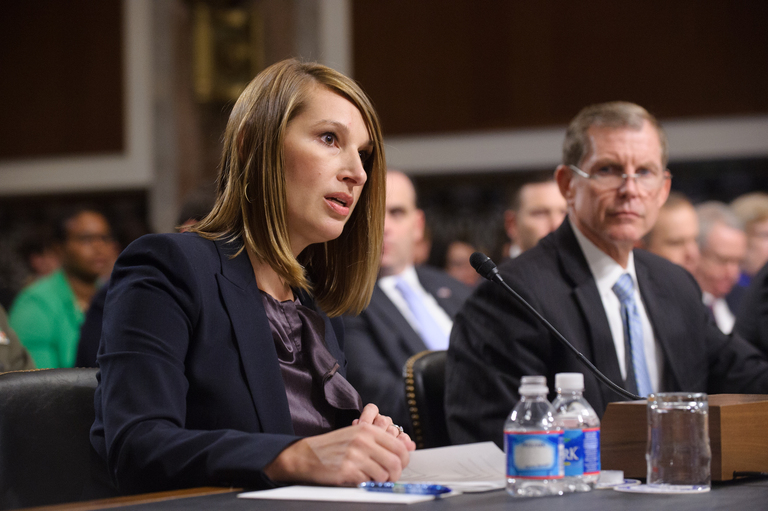
Administration officials brought their case for President Obama’s $6.2 billion request for emergency Ebola response funding before the Senate Appropriations Committee on Nov. 12, arguing that the spending is needed to protect the U.S. from the deadly virus.
Health and Human Services Secretary Sylvia Burwell, Homeland Security Secretary Jeh Johnson and officials from the Defense and State departments updated the committee on the U.S. response to date and pressed for swift approval of the funding.
“We are seeing some promising signs on the ground, but it is clear that the epidemic is not yet controlled. These resources are imperative to eradicating the Ebola outbreak at its source, which is the most effective way of protecting Americans here at home,” said Heather Higginbottom, Deputy Secretary of State for Management and Resources.
The bulk of the funding — roughly $6 billion — would be used by Health and Human Services, the U.S. Agency for International Development and the State Department to support ongoing humanitarian operations in West Africa, as well as monitor travelers for the disease and increase capabilities in the U.S. to test and treat any potential cases.
About $112 million is marked for the Defense Advanced Research Projects Agency to develop technologies that would provide temporary immunity and accelerate vaccine development.
While Homeland Security has stepped up monitoring at airports and instituted enhanced screening measures for travelers coming into the U.S. from affected countries, DHS Secretary Johnson said the department can absorb the cost of its Ebola response operations, $13.2 million, in its current budget.
“DHS is committed to taking every necessary and appropriate step to ensure that the traveling public and the American people are safe,” Johnson said.
The funding request came as the last patient with Ebola in the U.S., Dr. Craig Spencer, was released from a New York City hospital on Nov. 11.
But while responders appear to be gaining the upper hand in Liberia, where infection rates are dropping, they still are operating in crisis mode in Guinea and Sierra Leone, where cases are spiking, administration officials told senators.
According to the World Health Organization, the death toll as of Nov. 12 stood at 5,147 cases, with 14,068 residents infected in Sierra Leone, Guinea and Liberia.
“In a world as interconnected as ours, outbreaks anywhere are a threat to the U.S. and our global partners, ” Burwell said.
Committee members seemed supportive of the request to expedite the funding. In what was likely her last full committee hearing as Senate Appropriations chairwoman, Sen. Barbara Mikulski, D-Md., said Congress must support those on the front lines of fight against Ebola and other epidemics.
“We need to contain the disease and we need to eradicate it,” Mikulski said.
Ranking member Sen. Richard Shelby, R-Ala., called the government’s response to date “confusing and, at times, contradictory,” but he expressed hope prior to the testimony that witnesses would present cogent arguments for the funding.
“Given the size of the request, the slow progress in detailing plans for how the money will be spent and some of the missteps made so far, I think it deserves our careful oversight and scrutiny,” Shelby said.■