
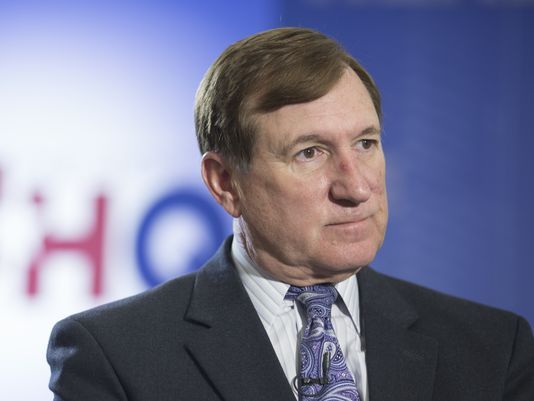
It’s a rare feat to completely reshape that landscape of military operations. And yet, David Bowen has put his mark on one key component of that: how armed services delivers healthcare.
As CIO of the Military Health System, Bowen was responsible for tying the health care systems of the four service branches into one, cohesive office, the Defense Health Agency. Two years into its existence, the DHA has achieved full operability and has saved nearly $60 million in investment costs through the consolidation of services.
Set to retire on Jan. 1, Bowen spoke with Carten Cordell about what the DHA has achieved during his tenure and where it will head next.
Looking at the end of your tenure at DHA, what achievement are you proud of the most?
Number one, I’ve gotten a tremendous sense of satisfaction from just standing up the organization. We worked about eight months prior to stand-up to design our organization, look at how we were going to move people. So from that point until today, we started with basically a blank sheet of paper and transitioned that into the effective working organization that it is today. I guess that makes me a plank owner in naval terms because I own a piece of the ship now.
I’m very proud of the fact that for the first two years of our existence, we soundly beat both the cost savings and investment goals that we sent to Congress in our business case that was a requirement of standing up the DHA. From an [Health Information Technology] perspective, we spent a lot of time figuring out what kind of savings we could generate the first couple of years, actually all the way through the budget cycle, the first five years of the organization. So for fiscal 2014 and 2015, we both under invested, meaning that we required smaller investments than we anticipated, and at the same time, we generated more savings.
Another thing we did was set up a bunch of operating metrics to evaluate how we run the DHA Health IT organization. They are in a big document called the Annual Performance Plan. We’ve grown that plan and we tied those performance metrics back to the individual performance plans of our senior leadership. So our individuals now have a stake in how the organization performs because that impacts their performance as well.
You achieved operational capability in October. What are your next steps moving forward?
Moving forward, a lot of things. We’ve got the baby home from the hospital and now we’ve got to turn it into a teenager and an adult and all of that stuff.
We are still driving to the original courses of action that were laid out in our business case. We’re implementing standardized infrastructure and actually accelerating that effort as a result of DoD’s acquisition of a new electronic health record. So my responsibility is to put into place a standardized infrastructure in our clinics and our hospitals that the electronic health record will sit on and operate under, so we are doing that.
The second thing is we’re developing a sustainment organization, because after the EHR folks deploy the EHR to our facilities, our organization will come back in and sustain that. We are continuing to support the integration of the military health system by enhancing our dashboard of 30 operational metrics we use to compare the performance of our facilities, plus all of the services. That was required as a result of the secretary’s 90-day review, so we continue to enhance and mature that capability.
We are very focused on increasing the amount of data that we get on the treatment of our members that takes place outside of our direct care system. I think we are going to talk a little more about that when we talk about interoperability.
Finally, we continue to mature the IT organization, both in terms of process and performance, also in terms of growing our capabilities, offering more services to our customers and doing a better job of managing our IT resources. So, that’s kind of what’s on the horizon.
How important was it to create DHA to help streamline and manage the military healthcare system?
When you look at the ability to consolidate the resources that we did, bringing the HIT resources from the three services together within the Military Health System, there are many benefits… we don’t think that some of this stuff would have been possible without the DHA.
Let me give you a good example, one of the elements in our business case is the fact that in the past, if we wanted to deploy a new system across the Military Health System, we would have that system certified separately by the Army, Navy and Air Force. This is a big deal just to do it once, but to do it three times costs us a ton of extra money and costs us a lot more time in getting this stuff deployed. Some of these system certifications can run up to a half-million dollars each. So as we move forward, we will only have to certify these systems once on our network, which is now standardized.
The same thing holds true when you start looking at medical equipment that sits on the network. We have a couple hundred-thousand of these kind of devices across the military health system. We found duplication in contracts, we found duplication in infrastructure and processes and tools and techniques and stuff, and that was why we were able to achieve some pretty short-term and yet significant savings goals; some of this stuff was fairly low-hanging fruit.
Where would you like the see the agency go next, in terms of development?
From a business standpoint, I’d like to see us do more with telehealth and other initiatives that will improve the satisfaction of our members and certainly keep them in the direct care system. I’d like to continue to improve our security posture so that we are taking even more steps to protect the confidentiality of the data of our membership, the PII—the personal information—and the PHI, the health information.
Finally, in terms of what I want to leave behind, I guess I would like to be remembered as a leader and a mentor to my staff, probably the best staff I have ever had. And to have helped them grow professionally so that they can become the terrific leaders that we have worked with up to this point, that would kind of be my best legacy.


