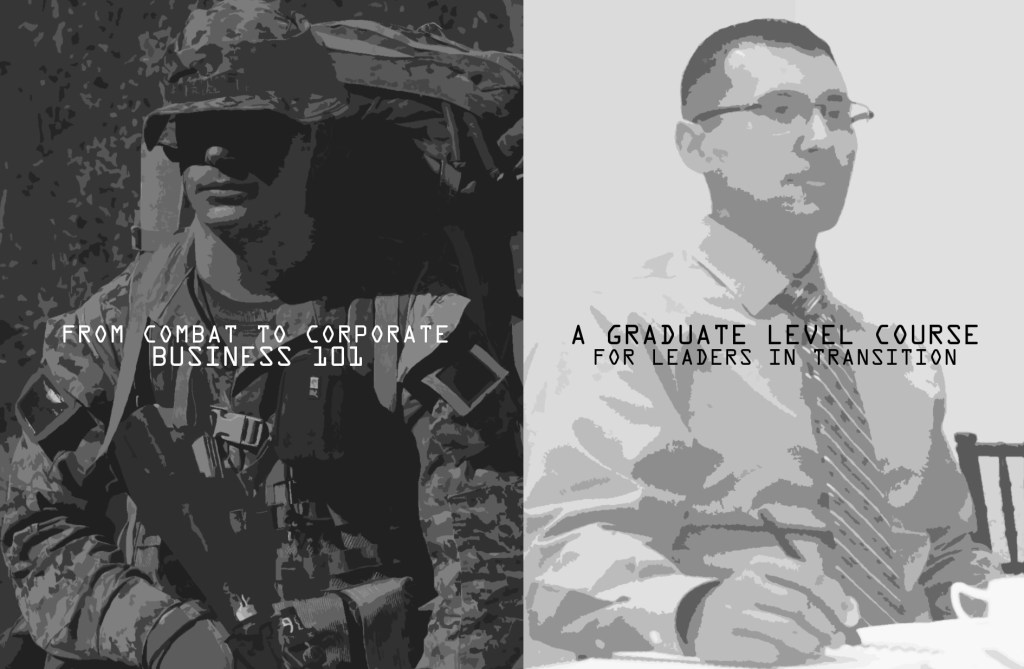
Like a lot of Marines, Maj. Bart Battista is leaving the Corps and about to start the next phase of his life.
He enlisted in 1991 and became a radio operator before he was commissioned in 1997 as an infantry officer. Now a 42-year-old an environmental engineering management officer at Marine Corps Air Station Camp Pendleton, California, Battista is on terminal leave and headed for a job in private sector where he hopes to start a long and satisfying second career.
For him and a lot of Marines, leaving the Corps for the corporate world might be as unfamiliar as moving to Mars. The military’s strict hierarchy is gone, as are its protocols. The emphasis isn’t on accomplishing the mission, but on managing costs and increasing revenues. It’s not something Marines are used to.
“Without some knowledge, you are going to look like the local rube,” Battista said.
To help Battista and other soon to be veterans former-Marines make a smooth transition switch from a life in uniform to one in suit, Marine Corps Community Services at Camp Pendleton has teamed-up with Marine Executive Association-West to create Business 101, a course designed to show Marines how the business world works. It’s like a cultural orientation for success in an office.
“The culture of the Marine Corps doesn’t always transfer perfectly to the culture of the business world,” said Ian Cherry, the operations manager for MCCS at Pendleton.
The class spans four consecutive eight-hour days for eight hours each time. It’s held three or four times per year and the next session is in the first week in February. It’s only at Pendleton, but the course’s organizers want to export it to other installations as well. About pproximately 50 to 75 Marines participate each time, officials said.
The course is geared toward staff sergeants and above on the enlisted side, and captains and above on the officer side.
These generally aren’t people who are looking for entry-level positions in a business, but due to their time in uniform, they don’t have the resume-worthy experiences gained by climbing the corporate ladder. Job titles with the words “executive” and “vice president’ are typically what these Marines are applying for, the course’s instructors said.
The event is divided into classes about small businesses, economics and how to negotiate compensation, among other topics. There’s one segment called “Why are Businesses so Different in Types and Cultures,” and another named “Sales: Until Something is Sold, Nothing Happens.”
It’s taught by academics and business executives, including some who ones that previously served in the military as well as ones with no prior service. There’s a panel during which veterans where prior military discuss their transition to the civilian workplace, and another where human resources executives talk about their experiences hiring veterans with a fresh-printed DD-214 in their hand. They all volunteer their time.
“They walk you through the steps and shows you, no kidding, what’s going to help you,” said Sgt. Maj. Ken Warren, the senior enlisted at Marine Corps Tactical Support Activity, said. . “LinkedIn, marketing yourself, making sure your have a brand, so to speak. … It’s so much more usable in the no kidding-private sector’ ” Sgt. Major Ken Warren, the senior enlisted at Marine Corps Tactical Support Activity, said. “ I found it more real, down to earth, real-life, and relevant right now.”
The course is It’s designed to show Marines what the business world wants, how it thinks and operates, and how Marines can retrofit their military experience for a second career in an office. And i It also shows them what the corporate world thinks it knows about the military, and what the military thinks it knows about the corporate world (hint: the event’s instructors said that these perceptions come from what both civilians and Marines see on television).
“It seemed to us, as business people, what was missing was something that gave the long-serving, exiting service person a better perspective,” said Ed Johnson, an instructor and one of the program’s creators.
It’s geared to staff sergeants and senior on the enlisted side, and primarily for captains and up for officers. These generally aren’t people who are looking for entry-level positions in a business, but due to their time in uniform, they don’t have the resume-worthy experiences gained by climbing the corporate ladder. Job titles with the words “executive” and “vice president’ are typically what these Marines are applying for, the course’s instructors said.
They’re trying to give Marines an understanding of business-talk and objectives so they can sell themselves in interviews and be an asset to their new company, said Steve Fischer, a former Marine and head MEA-W.
“We’d like to think that Business 101 gets you through the interview,” he said. . It kind of helps you talk the language of business so you can translate your skills to the business world.” he said.
The program was developed when a business networking group realized that it might be tough for outgoing service members with decades of experience to compete against out of work executives for mid- and senior-level corporate jobs, Rick Lamprecht, one of the program’s creators and instructors said.
“These guys are approaching six-figures in their current income. How are they going to compete with civilians when there are unemployed executives in those industries who are also working for those jobs?” Lamprecht said.
Battista said he took the course in February at the recommendation of a sergeant major and a lieutenant colonel who told him that it was much more helpful than the mandatory classes for transitioning service members.
“I went into it with an open mind,” he said.
He learned about billable hours and how it’s okay to modestly take credit for your accomplishments. There were talks about market differentiation and finance. Some lectures, like one about the differences between partnerships, limited liability companies, and a corporations, were on the technical side, but very helpful.
Like the lieutenant colonel or the sergeant major that spoke highly of Business 101, Lamprecht said he will now ould recommend the course to other Marines.
“It won’t make you a business genius in a week, but it provides you a baseline of business knowledge that should help you prepare to get a job … It gives you a baseline that you don’t get anywhere else in the Marine Corps,” he said.