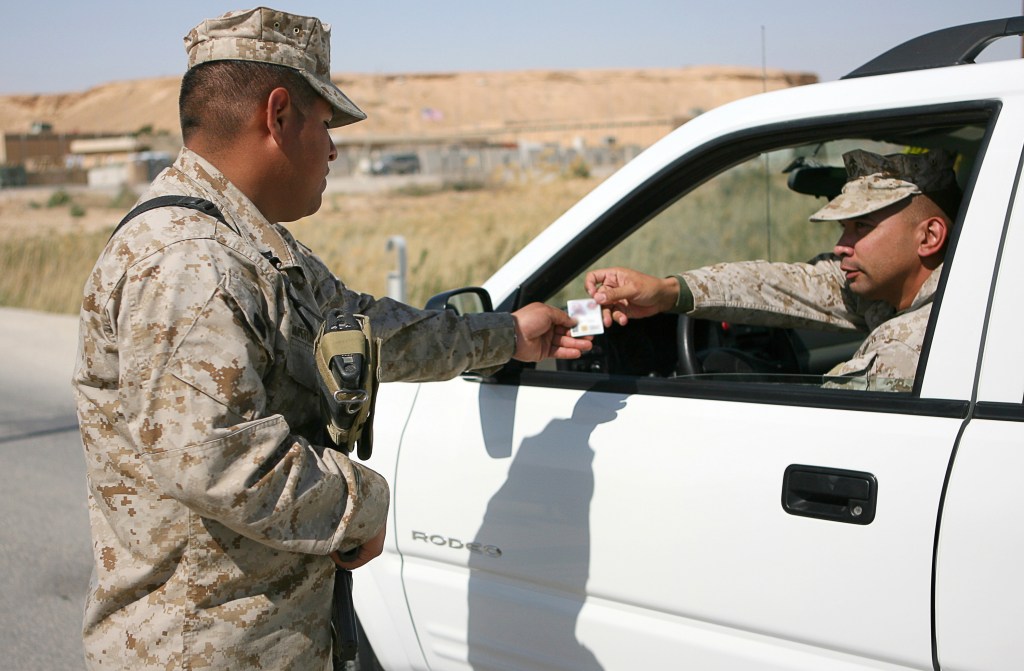
Marine Corps officials are developing a plans to eliminate the personal vehicle decals required to access bases and air stations get on Corps installations.
Despite rising concerns that extremists are targeting U.S.-based soldiers, sailors and airmen, the Marine Corps has yet to drop one very obvious outward sign of military service: the personal vehicle decal.
The pending policy shift comes Corps officials confirmed the move was under consideration just weeks after the service issued a memo to personnel warning them and their families to take extra security precautions amid threats from the Islamic State group of potential security threats to Marines and their families. It would allow thousands of Marines to remove the prominently displayed windshield Defense Department stickers, which identify them as Defense Department employees or dependentsinadvertently alert sharp-eyed bystanders or motorists that the vehicles is owned by a service member.
“There hasn’t been a decision made to drop the decals — it’s being staffed now,” said Rex Runyon, a spokesman for public affairs officer with Marine Corps Installation Command at the Pentagon. “There’s nothing really to talk about. There’s a decision that’s going to be made. All I can say is stay tuned.”
Runyon did He did not provide give a timeline for an announcement when a decision would be made.
Once required on stateside bases across all services, the Defense Department sticker has become a thing of the past almost everywhere on most military installations. The Air Force dropped it in 2007 with the Army following suit in 2011 and the Navy in 2013, though some individual commanders continue to require it.
But the Marine Corps asked for — and received — a waiver to continue registering personal vehicles and decals. To Marine spouses like Kristine Schellhaas, who oversees the popular family support website USMC Life, holding fast to the stickers contradicts recent calls to tighten personal security prompted by threats from the Islamic State group.
Officials are cautioning troops In late October, Corps officials issued a servicewide announcement warning Marines and their families to stay alert in unprotected venues, to be more careful of what they share via social media, and to report anything seemingly suspicious — no matter how minor.
The Pentagon issued a memo days earlier urging employees to, among other measures, downplay their affiliation with either the military or law enforcement. Concealing badges and vehicle decals in public were among the suggestions outlined in that guidance, which circulated after two following high-profile and deadly attacks on members of the Canadian military soldiers.
“I don’t like being targeted and my husband is always on me about opsec,” Schellhaas said, using the colloquial term for operational security. “… And yet we go and stick these symbols on our car,” said Schellhaas.”
When the Navy announced its decision to drop the decals last year, the Marine Corps was expected to figure out a plan to do the same, according to media reports at the time. As of Nov. 21, the Corps still was working on it.
According to Schellhaas said, she’s not alone in hoping the Corps drops the decals. There’s a “high level of concern” among friends and colleagues, she said.
“If they’re changing their Facebook profile, they’re not wanting to have things on the car as well,” she said.
And while the Air Force, Army and Navy eliminated decals before the Islamic State became a household name, the desire to protect preventing service members from being targeted by potential attackers played a role in those changes. Air Force officials even recommended airmen remove the decals as soon as the policy expired, so as to lessen the risk of falling victim to a terrorist or criminal, according to a fact sheet published in 2007.
Doing so would “avoid advertising the driver’s DoD affiliation while off-base, which could be of interest to potential terrorists, criminals, foreign intelligence operatives or other hostile agents,” the document states.
There were reasons other than security, though. For one, the decals no longer granted motorists access to military installations. Since September 11, identification checks have been required to get on bases.
“Post-9/11, obviously things changed and they went to 100 percent ID checks. The stickers kind of became obsolete,” said Air Force Lt. Col. Tom Crosson, a Defense Department spokesman for of the Air Force, a defense press officer with the Office of the Assistant Secretary of Defense for Public Affairs.
The 2007 Air Force fact sheet called notes that the decals “an expensive duplication of state registration and licensing.”
“The Air Force spends hundreds of thousands of dollars a year just on procuring the decals — countless more money and time is spent on issuing them,” it says. “All of our Security Forces units are able to verify vehicle ownership through the license plates and other means,” it reads.”
Navy officials likewise listed money as a reason for doing away with decals, telling Navy Times in 2013 that cutting the decals would save the department $750,000 annually.
If If and when the Marine Corps elects to join the Army, Air Force and the rest of the Navy Department, it “will reflect what is in the best interests of the Marine Corps, its civilians, families and visitors to our installations,” Runyon wrote via in an email.