New noncommissioned officers NCOs noncommissioned officers in Hawaii have attended a beefed-up Corporals Course this year which culminated in four hours in the field recreating the combat a four-hour scenario based on the battlefield experiences of Silver Star recipient Gunnery Sgt. Timothy Tardif.
Tardif earned the nation’s third highest award for an April 2003 battle in Tarmiyah, Iraq, where he ran through intense small-arms and rocket-propelled grenade fire as his unit assaulted and enemy-held compound (to save buddies???)) before being struck by grenade fragmentation inside a compound.
The course, developed by 1st Intelligence Battalion, is just one of several examples of unit leaders units are developing that going above and beyond the standard Corporals Course to make professional military education PME more physically demanding and motivating as the service begins requiring more resident courses.
“Masterfully interweaving PME and training for Marines enhances unit readiness and cohesion. We applaud units like 1st Intel Bn, who are clearly making best use of this educational opportunity,” said Col. Richard E. Jordan, TECOM’s director of Enlisted PME. “The course itself is based on education, but adding in training equips Marines with the variety tools needed to meet the challenges of present and future operational environments.” said Col. Richard E. Jordan, TECOM’s director of Enlisted PME
The course in Hawaii forced corporals to think on their feet while pushing through chaos and discomfort as did Tardif did when he continued to fight and maneuver despite being hit by a grenade — until he finally collapsed.
With combat operations in Afghanistan nearing their end, leadership is placing renewed emphasis on grooming the service’s junior noncommissioned officer corps into stronger mentors in garrison who are also capable of shouldering more responsibility in combat or operating seamlessly during joint operations with other sister services and foreign militaries.
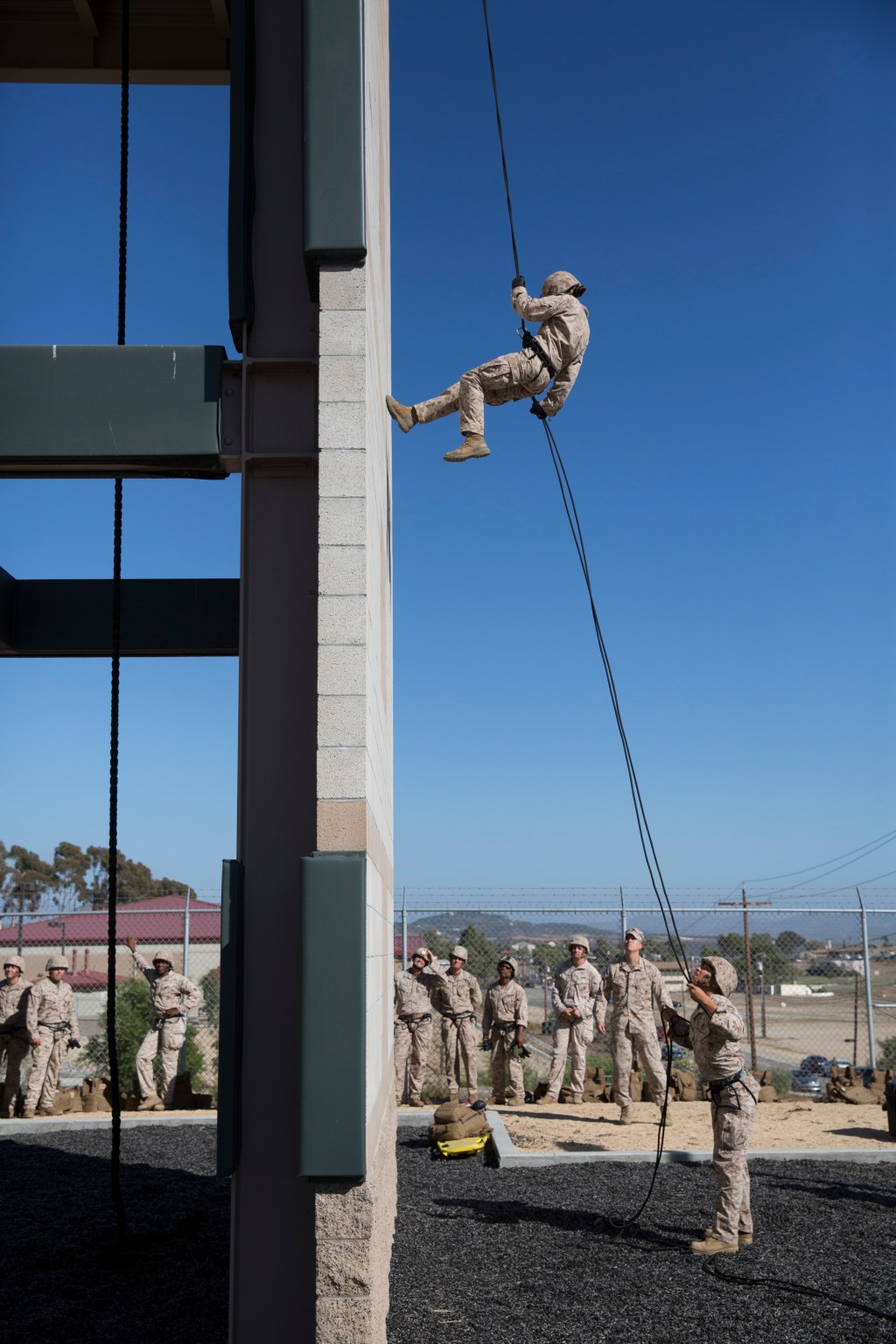
To do that, some units are developing corporals courses on steroids, stretching them well beyond minimum requirements to include visits by Medal of Honor recipients and members of the special operations community. They’re running corporals through live-fire exercises, making them repel and fast rope, operate in repelling and fast roping, combat scenarios and more.
But Marines in Hawaii aren’t the only ones getting a taste of enhanced PME. Most recently, Camp Pendleton, California-based 1st Intelligence Battalion put their corporals through a course that got them out of the classroom to shoot, hike, repel and fast rope. shooting, hiking, repelling and fastroping.
Whereas PME notoriously makes many junior Marines grumble about the demand on their time, which they try to balance against given the many demands on their time which include official duties, family life, preparing for selection boards, deployments and more. The Corps’ best Corporals Courses, however, have corporals hem enthusiastically engaged.
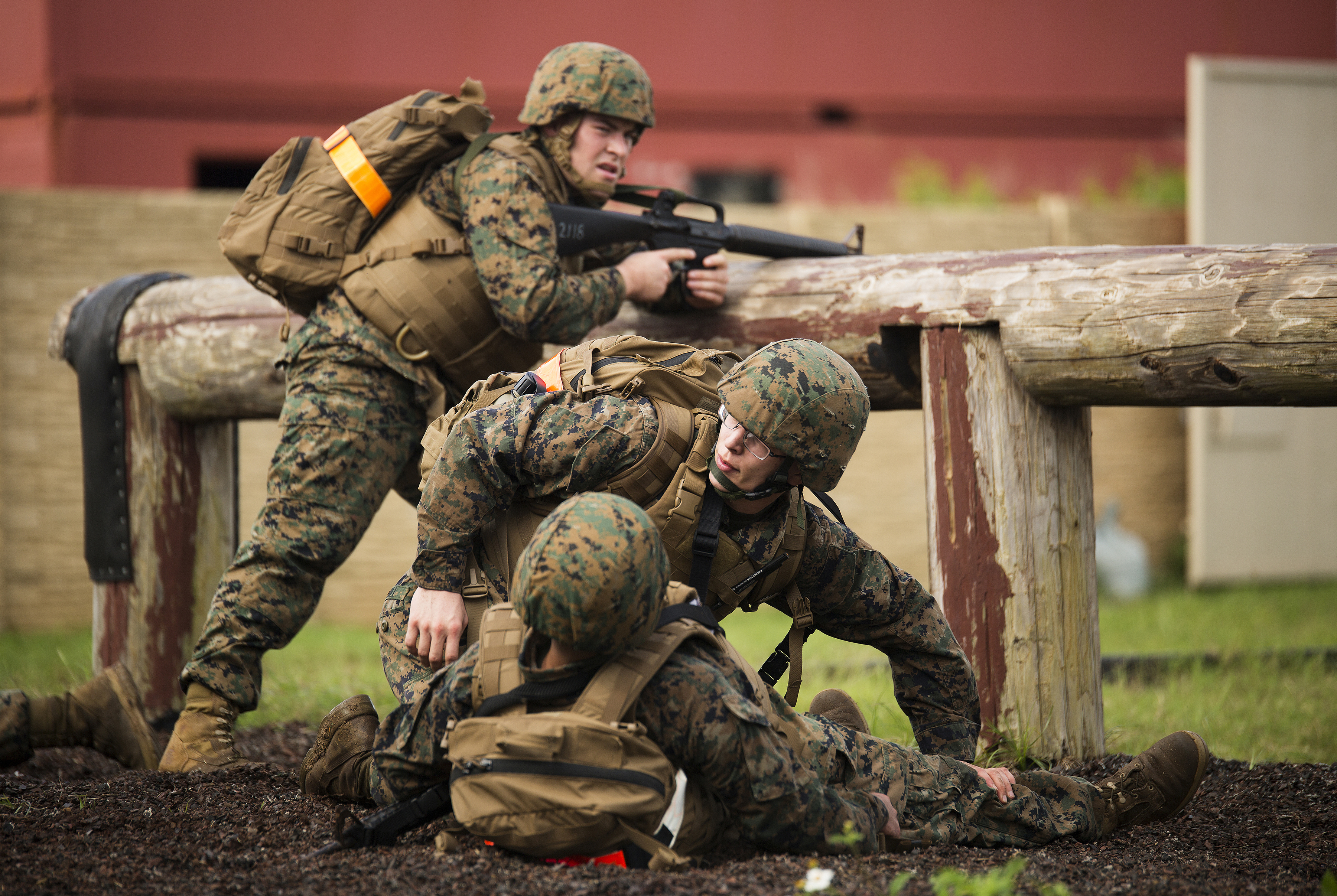
A Marine receives medical attention after being “wounded” by a simulated fragmentation grenade on the obstacle course at Boondocker Training Area aboard Marine Corps Base Hawaii, Feb. 25, 2014. The Marines were participating in Corporals Course and completed a case study that took them through several training exercises based off true scenarios Gunnery Sgt. Timothy C. Tardif experienced during Operation Iraqi Freedom, April 12, 2003. Three squad-sized teams participated in a leadership reaction course, and exercises at Boondocker Training Area to include the obstacle course and military operations on urban terrain facility and a 100-meter swim at the base pool. At the conclusion of the case study, the Marine gathered at Dewey Square to listen to Tardif explain the challenges he faced as a corporal on the battlefield and how he overcame them. (U.S. Marine Corps photo by Lance Cpl. Matthew Bragg)
Photo Credit: Lance Cpl. Matthew Bragg, U.S. Marines
Beefed up PME
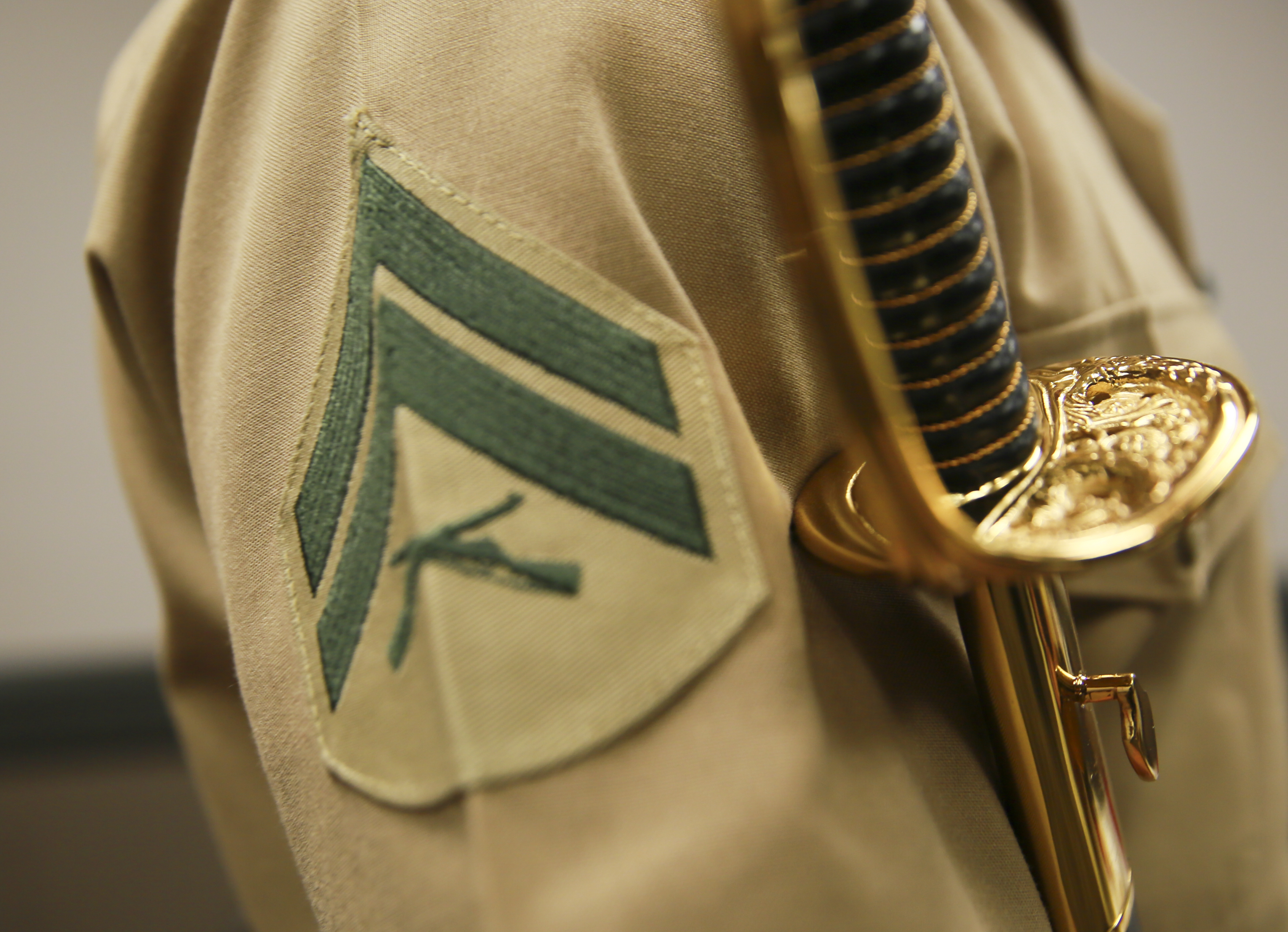
Three Marine noncommissioned officers formerly deployed with the 13th Marine Expeditionary Unit were presented personalized Marine NCO swords by the Miramar Semper Fidelis Rotary Club for achievements during three separate Corporal’s Courses, Aug. 14, 2014. Each of the Marines graduated as honor graduate of their respective classes, standing above more than 300 other Marines as an example of dedication and perseverance. (U.S. Marine Corps photo by Sgt. Paris Capers/ Released)
Photo Credit: Sgt. Paris Capers, U.S. Marines
Units like 1st Intel Btn. are putting an end to death by PowerPoint.
Just like a standard Corporals Course, the class lasted three weeks, Glass said.
“We had the basic [program of instruction] to meet minimum requirements, but we looked at what else we could do to elevate it to the next level — to make it more exciting.”
But beyond being a good Marine, Meyer spoke about being a good citizen.
Glass was also able to call on old associates who work in Tampa, Florida, with U.S. Special Operations Command including to arrange for a Navy SEAL and senior enlisted Air Force personnel to talk about joint operations.
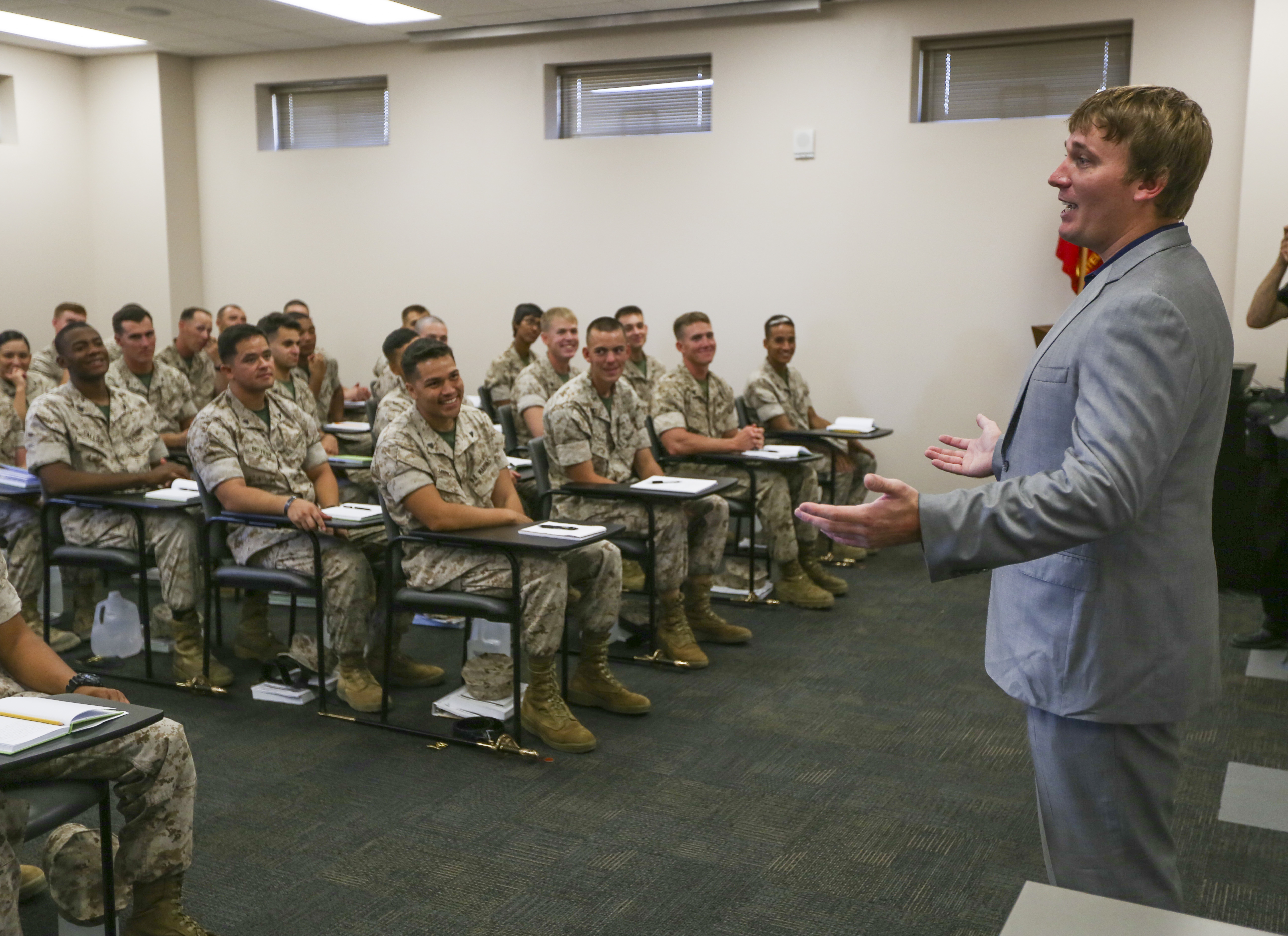
Medal of Honor recipient Sgt. Dakota Meyer talks to students of the 1st Intelligence Battalion Corporal’s Course aboard Camp Pendleton, Calif., Sept. 17, 2014. Meyer met with and spoke to the students about the importance of taking care of one another and the potential within every Marine.
Photo Credit: Lance Cpl. Carson Gramley, I Marine Expeditionary Force
“It is asking a lot of commands and units to give their Marines up for three weeks,” Glass said. “You better send back a better-trained NCO. When they graduated, not only were they PME-complete in their grade, they came back with a few annual training requirements knocked out.”
Some of the events they used to get Marines excited — like live-fire and time in the gas chamber — also satisfied annual qualification requirements.
The culminating event was a three-day field exercise that included shooting and a nine-mile hike, and was capped by a traditional mess night.
“We let the corporals run the course at the end. They took charge of their own squad and ran the culminating event so they understand when they have junior Marines under them they have to be able to lead them regardless of their MOS,” Parks said.
The first iteration of the course was so successful that the version that began ran beginning in September had students not just from 1st Intel Btn., but also from Marine Corps Recruit Depot San Diego, School of Infantry-West, and artillery battalion, 9th Communications Radio Battalion — 49 students in all.
While 1st Intel Btn. leaders have created a prototypical example of the services next-generation Corporals Courses, those in Hawaii and elsewhere are similarly pushing their corporals further.
“This is the only course in the entire Marine Corps that is taken from those specific events and incorporated into actual training,” said Sgt. Savanna Tardif, the Corporals Course faculty adviser.(???related???))
Basing it on a medal citation brought a sense of immediacy to the training.
Committed and Engaged Leadership
Being a good corporal is about more than just combat effectiveness. It is also about mentoring and caring for junior Marines.
After former Commandant Gen. Jim Amos and Sgt. Maj. of the Marine Corps Mike Barrett announced their efforts to “reawaken” Marines morals to combat troubling trends of sexual assault, substance abuse and other social ills, some units reacted proactively.
Beyond winning battles, it gives those who participate a baseline to start mentoring others when they return to their units or go straight to the Corporals Course.
Joint Operations
With new mission sets increasing operations in which military services work side by side — and dispersed operations that can force corporals into more prominent leadership roles on the battlefield — Marines stationed by the Horn of Africa are spearheading new joint training designed to bridge gaps of knowledge and experience.
A recent joint noncommissioned officer course may be the first of its kind, said Sgt. Maj. Bonnie Skinner, senior enlisted adviser at Combined Joint Task Force-Horn of Africa, Camp Lemmonier, Djibouti. The task force, activated in 2002 to counter regional extremist violence in the wake of Sept. 11, 2001 and now focused on strengthening military partner capacity in East Africa, has about 1,800 personnel, of whom just about 50 are Marines.
“It’s really no secret that we’re going to serve in the joint environment now and in the future,” she said. “We’re all going to be working together more.”
The diverse work of the task force, she said, requires navigation of cultural and language barriers, understanding of different agencies’ protocols, and maturity and diplomacy.
To that end, with Skinner’s input, the task force launched the first joint NCO course they’re aware of last December. The 12-day course, designed like a Marine Corps Corporals Course, had 28 students, including 18 Marines, five soldiers, three sailors, one airman, and a coalition partner from Spain.
There were presentations on the different services participating in the course and their history and warrior ethos. There were practical lessons on the other services’ ranks and promotion systems. And there were cultural briefings, too, she said.
On the second version iteration of the course, held in February, two Djiboutian Armed Forces Soldiers were among the 44 graduates.
“It was very positive, and [the participants] also thought it was very challenging,” Skinner said. “A lot of Marine NCOs are used to being with Marines. This gave them the opportunity to learn and get challenged, and they found it extremely rewarding.”
Whether joint NCO courses or enhanced Corporals Courses, Marine officials hope units will continue to adapt them to their own needs and resources. While there are specific requirements that must be satisfied, units are allowed, even encouraged to add to the basic curriculum.
“The Corporals Course was built on learning objectives designed for Corporals as its foundation with the intention that units would then add to the course of instruction based on command-specific requirements and resources available,” Jordan said.