MARINE CORPS BASE QUANTICO, Va. — Marines will have to spend less time checking off annual training requirements starting now.
As packs grew heavier during more than a decade at war, so too did the service’s training burden as lessons were added for everything from preventing suicides prevention to combating human trafficking.
Many of those requirements remain valid and necessary, according to officials here. at Marine Corps Base Quantico, Virginia. But others can be streamlined, shortened or ditched all together.
In an effort to alleviate the ever-growing burden, the Marine Corps’ Training and Education and Combat Development and Integration commands undertook a comprehensive review to update Marine Corps Bulletin 1500 Annual Training and Education Requirements. The newest version, published Feb. 20, will is a move to give commanders more discretion on when, where and how they meet requirements given the needs of their unit’s specific mission.
“As far as we call it rocks in the rucksack… we keep giving them more rocks and put them in the rucksack,” Lt. Gen. Kenneth Glueck, head of Marine Corps Combat Development Command, told members of Congress Gluek told Sen. Dan Sullivan after being questioned about the growing training burden during a hearing on Capitol Hill. March 11 hearing before the Senate Subcommittee on Seapower.
“It’s getting heavier and heavier…,” he added. “In fact, I just put out an all-Marine notification here just within the last couple of weeks giving the commanders the ability to go ahead and reduce some of those requirements.”
In some cases, the service was able to redesignate required courses as make courses that were Marine Corps’ requirements discretionary — heat awareness training, for example. That makes more sense for an infantry commander in Okinawa, Japan, than for a rReserve commander in Alaska.
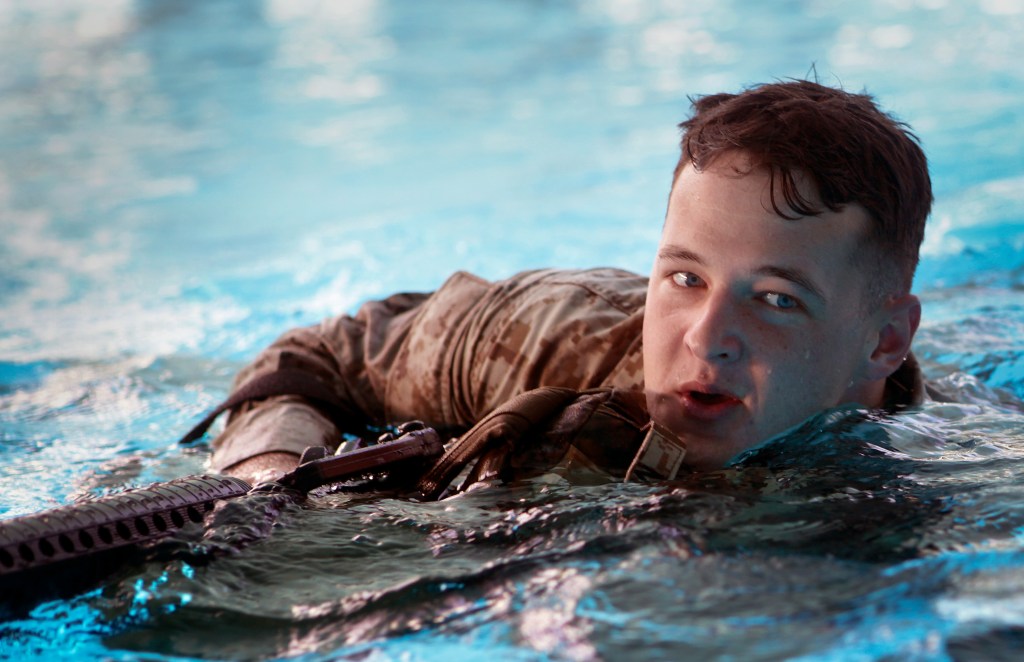
Other examples of training that is no longer mandatory or has been reduced in frequency includes Marine Corps Water Survival Training, which is now determined by the first general officer in the chain of command. Members of a Marine Eexpeditionary Uunit might need more water training that those in an office at the Pentagon. Chemical Biological, Radiological and Nuclear Defense Training is now required just once every two years rather than annually for active component Marines. That allows leaders to shift that time to focus on more pressing needs.
But many training requirements are top-down mandates by the Navy and Defense Ddepartments of Navy or Defense Department— those for hazing and operational security, for example.
Even in cases where they Marine Corps does not have authority to eliminate annual training requirements from the Pentagon, tweaks often can be made to they can often tweak how training is delivered, said Maj. Bret W. Morriss, the Vvalues Bbased Ttraining Ttask Aanalyst for Marine air-ground task force training and education.
While some requirements must specifically be delivered by PowerPoint, for example, others like those for hazing could be handled as group discussions during down time at the small-unit level by sergeants. That means some requirements could be satisfied by a company commander while waiting for a shuttle to another range, making use of what might otherwise be wasted downtime, said Erik Doyle, the director of operations for CD&Iombat Development and Integration, and MCCDCarine Corps Combat Development Command.
Whenre possible, the face-to-face teaching method also fits well with the service’s Reawakening campaign to empower noncommissioned officers NCOs and bolster them as the service’s mentors, Morriss said.
Clarifications in the new bulletin on how training can be delivered could also help save commanders from continuing to unwittingly double up some requirements. For example, Unit Marine Awareness and Prevention Integrated Training, or UMAPIT, covers substance abuse, and suicide prevention — themes commanders commonly address during safety briefings.
“The battalion commander talks about taking care of Marines every week – Friday morning,” Morriss said. “That is UMAPIT.”
To ensure commanders understand their latitude and save time where possible, the updated bulletin has a “delivery method” column in its chart of required training containing more detail, Doyle said. Commanders may have seen that MarineNet was listed next to a requirement and took that to mean that was the only prescribed method of delivery when in fact it was only one option.
“If [2nd Battalion, 8th Marines]two-eight has 30 thirty computers and 900 Marines, it doesn’t make sense,” Doyle said, pointing out the amount of time it would take 900 Marines to use 30 computers to complete training. “It might make sense for a colonel at MCCDC.”