ANNAPOLISnnapolis, Maryland. — The Navy secretary of the Navy announced huge sweeping and revolutionary changes related to policies affecting Marines’ fitness, uniforms, career options and promotion opportunities during a speech at the Naval Academy on Wednesday. during a speech Wednesday at the Naval Academy aimed at overhauling policies related to fitness, uniforms and career optionsmanpower policy for Marines and sailors.
Navy Secretary Ray Mabus announced a host of policy changes he said are arguing that each policy shift is necessary for the sea services to compete with private industry for the nation’s pool of talented youth. The changes will better prepare the Marine Corps and Navy fleet’s health and for future conflicts and make military service more attractive to those who want more career flexibility.
“Some changes will take place at the speed of my pen, others at the speed of Congress,” Mabus said.
Changes to fitness are being made with an eye toward integrating women into combat roles and stemming risky practices used by Marines and sailors to make weight by dropping pounds in the days leading up to a tape-test. Mabus also has a plan to boost the number of women the Marine Corps recruits.
He’s also forging ahead with plans to design and field unisex uniform items for male and female Marines. And new career policies The new policies will give Marines and sailors more opportunities to expand their education and professional experience outside of their military occupational specialties. is another of Mabus’ priorities
Here’s what you need to know.
Gender-neutral standards
If the Marine Corps and Navy and Marine Corps are to reflect the makeup of the nation the services defend, it must recruit and retain increasingly more women, Mabus said. A The more diverse a force is, the stronger, he said. it is, he argued.
“Both our platforms and our career paths will allow for equal service opportunities,” he said. “That is why I’m personally committed to opening all operational billets to women.”
But reaching that goal will not involve lowered standards. Mabus said he wants gender-neutral standards implemented. The ability to do the job, regardless of gender, remains paramount, he said.
Mabus held up the Corps’ Ground Combat Element Integrated Task Force as an example of the research being done in that area.
The experimental unit, composed rised of about 200 men and 75 women, is undergoing testing at Marine Corps Air Ground Combat Center Twentynine Palms, California. The intent is developing unisex standards for ground combat arms specialties still closed to female Marines.
But talk of integrating combat units with women has drawn criticism from past and present Marines who continue to worry it will lead to lower watered down standards. Mabus sought to alleviate those concerns, which arose again during a brief question and answer session with cadets following the secretary’s prepared remarks.
“In all cases, I personally believe we ought to have one standard for both sexes, a standard that matches the demands of the job, and if you pass, you pass,” Mabus said.
Unisex uniforms
In a significant milestone towards the adoption of common coats with mandarin collars for all Marines — male and female alike — Mabus said for the first time ever, female midshipmen attending graduation May 22 will wear collared dress coats, including those receiving Navy and Marine Corps commissions.
Mabus used the speech to highlight his initiative to issue common uniform items to female and male service members alike, saying it was important to cohesion and morale.
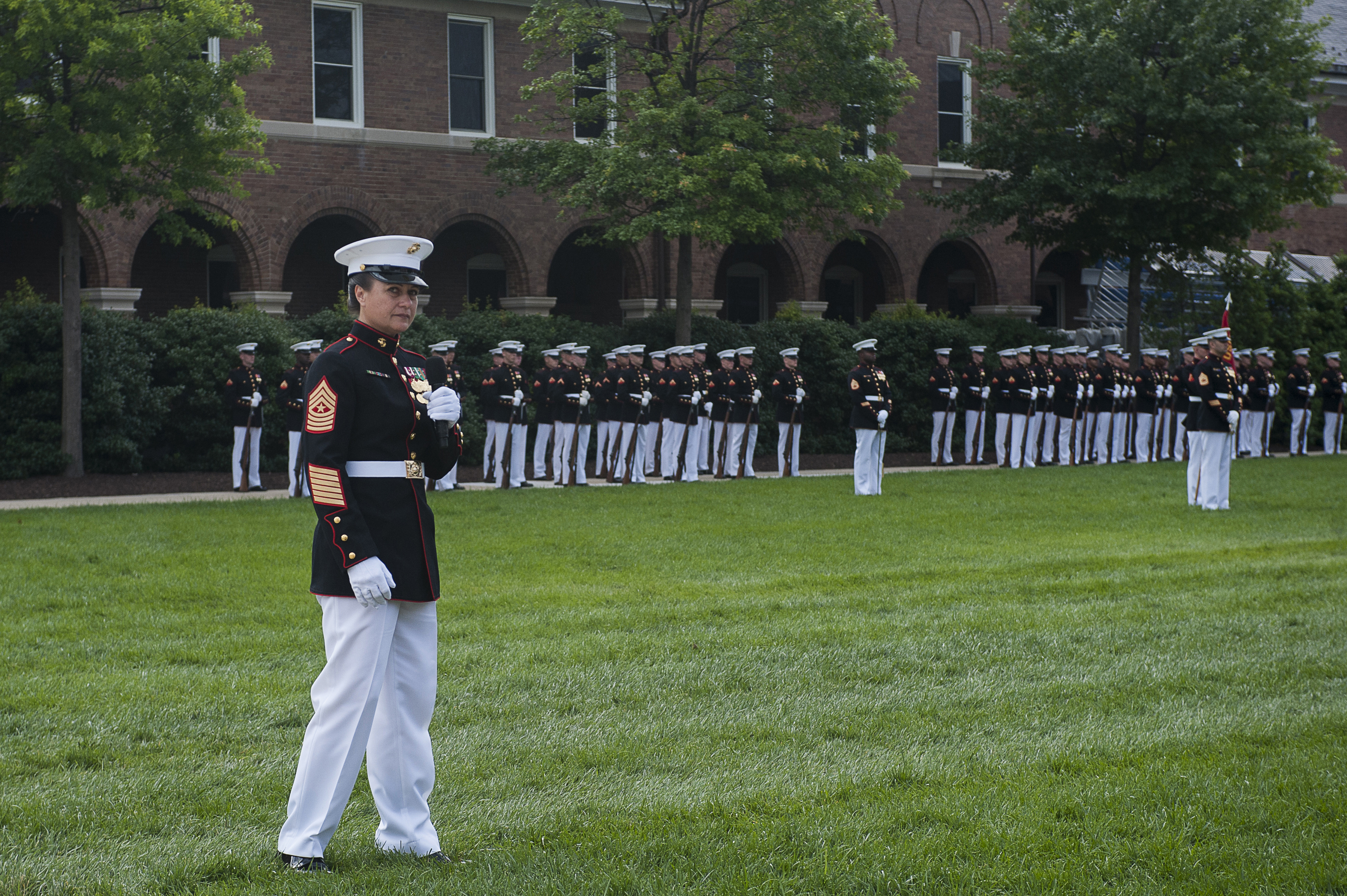
Sgt. Maj. Angela Maness, Marine Barracks Washington’s sergeant major, wears the unisex dress blues uniform. Navy Secretary Ray Mabus wanted all Marines to look the same in their uniform regardless of gender.
Photo Credit: Cpl. Mondo Lescaud/Marine Corps
During the question-and-answer session following his prepared remarks, however, he was questioned by a skeptical midshipman who described the effort as a way to make females look like their male counterparts.
Mabus rebutted saying, “We are not trying to make women look like men, but make everybody look like a U.S. sailor or Marine.”
The decision to issue women Marine Corps dress blues and Navy dress whites with mandarin collars to women was made because Mabus wants to provide both with what he called an “iconic” uniform. It was not a hasty decision to adopt male uniforms, but rather a decision to adopt a storied and well recognized uniform.
He added that while the coats are designed to have a similar appearance to a casual observer the services will not simply issue standard male coats to females. Rather, the female coats lack breast and hip pockets and are tailored to better fit their bodies.
The Marine Corps began testing an improved prototype late last summer, and saying that a decision is expected on a new coat could be finalized as early as this summer. Marines The Marine Corps began wear testing and refining the its female version of the male coat with mandarin collar in 2013. The coat has been worn mostly by women serving in ceremonial capacities in and around Washington and National Capital Region at Marine Corps Base Quantico, Virginia, and Marine Barracks Washington where the commandant resides. The included band members, but also area recruiters.
Early versions were tailored men’s coats, but more recent photos have shown a collared coat without pockets like those described by Mabus.
A decision has already been finalized for female Marines to wear a common cover that appears similar to previous male covers, but their wear is not mandatory until May 1, 2017.
Career advancement
Following more than a decade of combat, Mabus said those who succeed on the battlefield deserve a chance to broaden their knowledge, he said.
Quoting ancient Greek strategist Thucydides, who famously said a nation that separates its warriors from its thinkers is doomed to fail as its fighting is done by fools and its thinking by cowards, Mabus announced plans to increase the availability of private sector and academic billets.

A Marine studies for his college public speaking class. Navy Secretary Ray Mabus announced plans to allow more Marines to take time off to pursue an education.
Photo Credit: Lance Cpl. Bryan A. Peterson/Marine Corps
For officers pursuing an academic route, Mabus pledged to open 30 additional fully-funded, in-residence billets in graduate programs at the nation’s most prestigious schools, like Harvard University.
Mabus also wants to expand billets in the career intermission program, which allows service members to pursue other interests over a three-year period. With the approval of Congress, Mabus said he plans to expand those slots from 40 to 400, but it requires the approval of Congress.
He’ll also launch the “Secretary of the Navy Industry Tour” program in the fall, which will allow And increasingly more commanders to send their brightest officers to work in the private sector. could wind up taking time away from the Corps to work at Fortune 500 corporations, he said. The program, named “Secretary of the Navy Industry Tour,” will launch in the fall, according the Mabus.Commanders will be given discretion to send their best and brightest into the private sector. The hope is that they will return with corporations’ the industry’s best practices in hand, Mabus said.
He cited former commandant Gen. Jim Amos as an example of a leader who took a two-and-a-half year break from service to work in the private sector as a private airline pilot and gain additional leadership expertise in the corporate world before returning to uniform. That however, Mabus said, meant Amos was behind his peers when he returned and had to struggle to catch up, despite eventually becoming commandant. The new program would reward instead of penalize Marines who do the same.
Creating a more professional and versatile Corps also means adopting the private sector’s promotion and bonus practices, Mabus said. Commanding officers will receive more leeway to advance their subordinates based on their individual performance in the future, he said.
Milestones — not time in uniform — should determine promotions, Mabus said, noting that legislation to eliminate officer management by the end of the year is in the works. Overhauling the system will allow more capable officers to rise through the ranks faster while keeping those unprepared for advancement in their existing pay grades.
“A golden path of inflexible career wickets, year-groups and promotion zones will no longer determine your success,” he told cadets. “Your performance will decide your timeline for promotion and leadership assignments.”
Adopting these changes will strengthen the fleet by encouraging the Corps’ best and brightest to remain in uniform, Mabus said.
“[By] keeping our best people, we will be better warfighters,” he said.
New PT policies
Mabus also announced several changes to Navy fitness policies — including plans to revamp the reviled tape test system — that likely won’t affect the Marine Corps.
Sailors will face a year-round culture of fitness, during which commanding officers will be able to do random spot checks in between fitness tests. The Navy will also change the way in which sailors who fall outside fitness standards are measured, following years of complaints from those in the fleet.
“Our pass/fail system that only — and sometimes inaccurately — assesses one aspect of physical fitness is going to end,” he said.
The service is looking at the Air Force’s tape test model, which measures only the waist instead of the waist and neck.
The move is in part meant to address the sometimes dangerous methods sailors take in order to pass height and weight checks. While those problems exist inside the Corps as well, Mabus said the changes to the tape test aren’t likely to affect that service since Marines tend to be in better shape.
Sailors who maintain top-tier performance on physical fitness tests three consecutive times will also soon be eligible to earn the “Outstanding Fitness Award,” Mabus said.
The award will come in the form of a patch to be worn on the outside of their PT uniforms.
Staff writer Meghann Myers contributed to this report.