
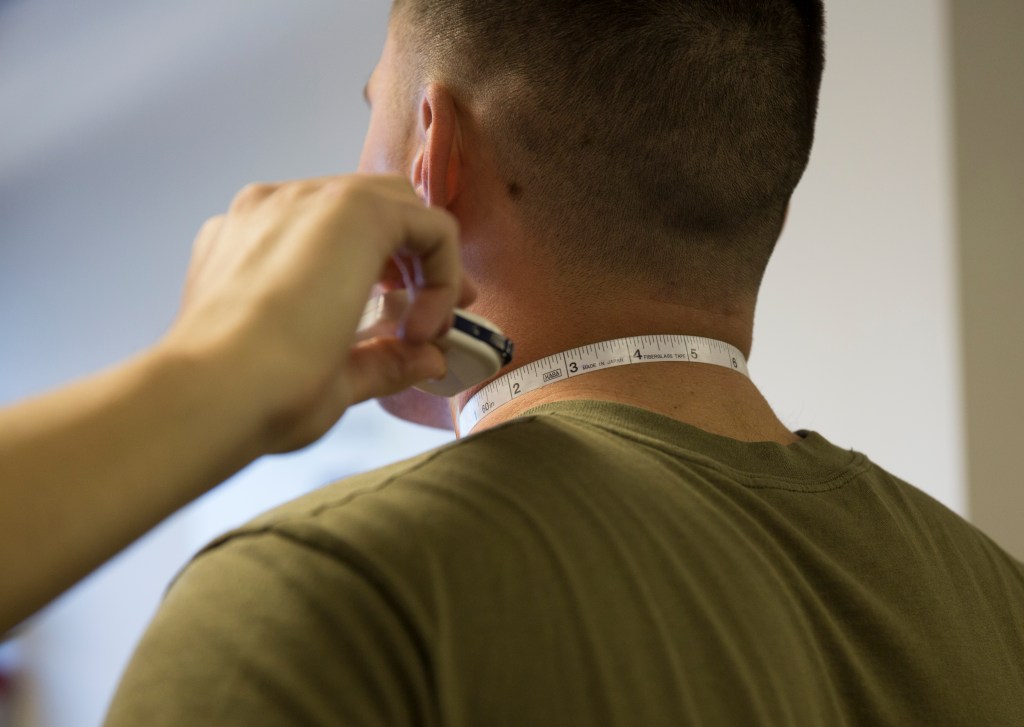
Sailors Some Department of the Navy personnel are getting a long-anticipated reprieve from the much maligned tape test. But the Navy Secretary said the change won’t apply to his whole department, meaning Marines are stuck with the test many view as , forthcoming revisions recently outlined by Secretary of the Navy Ray Mabus during a May 13 speech at the Naval Academy will not apply to Marines, despite complaints over the test that many say is inaccurate and unfair.
The Navy will soon adopt the same tape test the Air Force uses, which only measures troops’ waists, instead of the neck and waist. The Navy and Marine Corps currently measure troops’ necks and waists.
The In part, changes are aimed at curbing sailors’ of risky weight loss behavior leading up to tape tests including starvation, dehydration and the use of questionable supplements, Navy Secretary Ray Mabus said in a mid-May speech at the Naval Academy.
“A high-stakes, biannual crucible that often results in sailors resorting to drastic unhealthy measures serves no one,” he said of the tape test.
The Corps “already has a strong fitness culture,” Mabus told Marine Corps Times, which is why the change won’t apply to Marines. But the service has not been immune to Marines resorting to drastic weight loss tactics — including paying for liposuction out-of-pocket in the most extreme cases.
“There are Marines who run a 285 [Physical Fitness Test] twice a year and they are taking ammonium citrates amoniun citrates — a laxative — before every weigh-in despite PTing all the time, playing basketball, lifting weights,” said Staff Sgt. Justin Smith with Marine Aviation Logistics Squadron 36 in Okinawa, Japan.
Former Sgt. Giovanni Tricoche-Rodriguez, who said he left the Marine Corps in part due to the constant stress about tape tests, said he, too, has seen Unfortunately, Tricoche-Rodriguez has seen firsthand how the immense pressure can push Marines to engage in risky weight loss tactics. Some go days without trying to cut as little as three pounds so they wouldn’t have to be taped would go 48 hours without eating, wear rubber or plastic suits, or sit in saunas to drop extreme amounts of water weight.
Last year, In 2014, 1,144 Marines ran afoul of the tape test and were assigned to the remedial Body Composition Program commonly viewed as a career ender.
While many Many of those Marines make poor dietary choices or don’t exercise enough, said several current and former Marines. But, there are others who are fit and within standard, Smith said. They are put over the limit by the tape test’s notoriously high margin of error, he said. The test is not an actual measurement of body fat, but instead relies on a neck-to-waist ratio to estimate body fat, which is a particular problem for Marines who are muscular or have a small neck.
Smith was put on the BCP in 2009, despite consistently running first-class physical and combat fitness tests. He taped at 20 percent body fat even though an independent caliper-based measurement said he was 16 percent, but that didn’t save him.
“There are some very fine Marines who had their careers upended on inaccurate data,” he said. “It has ruined careers of some Marines in phenomenal condition. To me, even one forced out on false data is too much.”
Mabus said he is going to revamp the tape test to “evaluate health, not shape.”
But part of being a Marine is looking the part, said former Sgt. George Lockhart, who is now a rising star in the world of the Ultimate Fighting Championship — not as a fighter, but as a weight and fitness guru. He helps some of the biggest name fighters, including Ronda Rousey, Cris “Cyborg” Justino and Rory McDonald, cut weight.
“The tape test is so jacked up it isn’t even funny,” Lockhart said. “It can be off by so much.”
In 2013, an independent Military Times study showed margins of error from 12 to 66 percent when comparing tape test results to results from a high-tech hydrostatic dunk tank like those used by athletes. In nine out of 10 cases, that tape test yielded higher body fat percentages. That margin of error can actually put lean, but muscle bound Marines over the limit even when they aren’t.
But Lockhart, who left the service in 2011 after his stint at the Marine Corps’ Martial Arts Center of Excellence in Quantico, Virginia, says it can be a good measure of appearance.
“Not only do you have to be able to accomplish X, Y, and Z,” he said. “You have to look like you are going to accomplish X, Y, and Z. Every time you put on the uniform you are representing every Marine who lived before you. Who cares if you can run like the wind and do all these things, but look like a sloppy piece of crap in uniform. I understand where they are coming from.”
Still, Tricoche-Rodriguez said if the SecNav is changing what some see as a flawed system for one sea service, it should apply to the other. The former automotive organization technician and body builder who left the Corps in service in April 2014 now runs his own fitness business as a personal trainer in Virginia Beach, Virginia.
He said he was in peak fitness and looked the part in uniform, but his muscular torso meant he taped at 21 percent even when a professional seven-point caliper test gauged him at 7.2 percent. He went on to help run the BCP after using tuition assistance to earn fitness certifications, but his commanders were never willing to apply for a waiver, he said.
“It’s unfortunate that they are not also applying [the change] to the Marine Corps,” Tricoche-Rodriguez said since Marines engage in the same risky behavior Mabus is trying to stem in the Navy.
Ultimately, Tricoche-Rodriguez acknowledges that it’s a Marine’s responsibility to maintain standards. But a significant challenge is eating right when they work have a 12 to 16 hours per day, and have to go home and prepare for a uniform inspection.
“Where in there are you supposed to have proper nutrition and workout?” Tricoche-Rodriguez said. “More than anything nutrition has a larger role in cutting fat. Exercise is already part of Marine Corps culture, but nutrition is lacking.”
Lockhart agrees that Marines face challenges when it comes to nutrition. Some of the SemperFit programs push the benefits of organic food like grilled chicken and lettuce, but don’t account for the financial resources of lack of time many Marines have.
“When is an infantryman on a nine-hour hike supposed to make grilled chicken?” he said.
But that doesn’t mean Marines can’t have a good diet, he added. It What is all comes down to is educating Marines so they make the right dietary choices every day and don’t have to scramble to cut weight.
“Obviously the right answer is going to be long-term weight loss, slowly decreasing,” Lockhart said.
Staff writer Hope Hodge Seck contributed to this report.


