Marine second lieutenants have done progressively worse on a standardized test administered at The Basic School over the last 35 years, a new report from the Washington, D.C.-based Brookings Institution finds — but But Marine Corps officials say this doesn’t mean the quality of its leaders is any lower than it has ever been.
The study, “Military Officer Quality in the All-Volunteer Force,” released Monday by the Washington-based Brookings Institution, finds the average new officer’s score on the General Classification Test dropped from 131 to 122 between from 1980 and to 2014. A perfect score on the test, which measures intelligence and aptitude, is 160.
The study’s authors, Matthew Cancian and Michael Klein of Tufts University, contrasted the Marine officers’ slipping test scores with data showing an improvement in quality of enlisted troops across the military services since the end of the draft in 1973. The downward trajectory among officers’ test GCT scores, they concluded, is due to a larger pool of eligible officer candidates, with more Americans attending and graduating from college.
While the study does not explore the impact effect of a lower-scoring Marine officer population, Cancian and Klein suggested an ominous conclusion.
“Given the myriad studies associating performance with intellect,” they wrote, “it is hard to imagine anything other than a seriously deleterious impact on the quality of officers and, by extension, on the quality and efficacy of the military.” [[This is a really rough read — can we paraphrase or find a better quote? GH]]
The Marines, however, say said the quality of the Corps’ officer candidates is as high as ever.
Maj. Garron Garn, a spokesman for Marine Corps Recruiting Command, said the service command does not use the GCT, but a battery of other standardized tests, to screen and recruit potential officers.
“Historically, the scores of commissioned officers on these exams continue to remain well above the minimum requirements for a commission and have remained consistent over the past decade,” he said in a statement to Marine Corps Times. “Consistently high academic scores, coupled with high physical fitness scores … demonstrates that the quality of Marine officer candidates has not declined and is as high as it has ever been.”
Marine officer candidates continue to score above the minimum academic requirements on the SAT and ACT college placement tests and on the Armed Services Vocational Aptitude Battery, used by all services to qualify potential recruits for enlistment. Accession data from 2005 to 2014 shows that commissioned Marine officers scored an average of 26.2 on the ACT; 1202 on the SAT; and 85.4 on the ASVAB, well above the Corps’ minimum score requirements of 22, 1000 and 74, respectively, Garn said. He They also perform well on the Corps’ Physical Fitness Test, he added, with officer candidates scoring an average of 279 out of 300 added that officer candidates scored an average of 279 out of 300 on the PFT in 2014.
Garn did not indicate whether average scores on college placement and physical fitness these tests have declined or increased for officers since 1980.
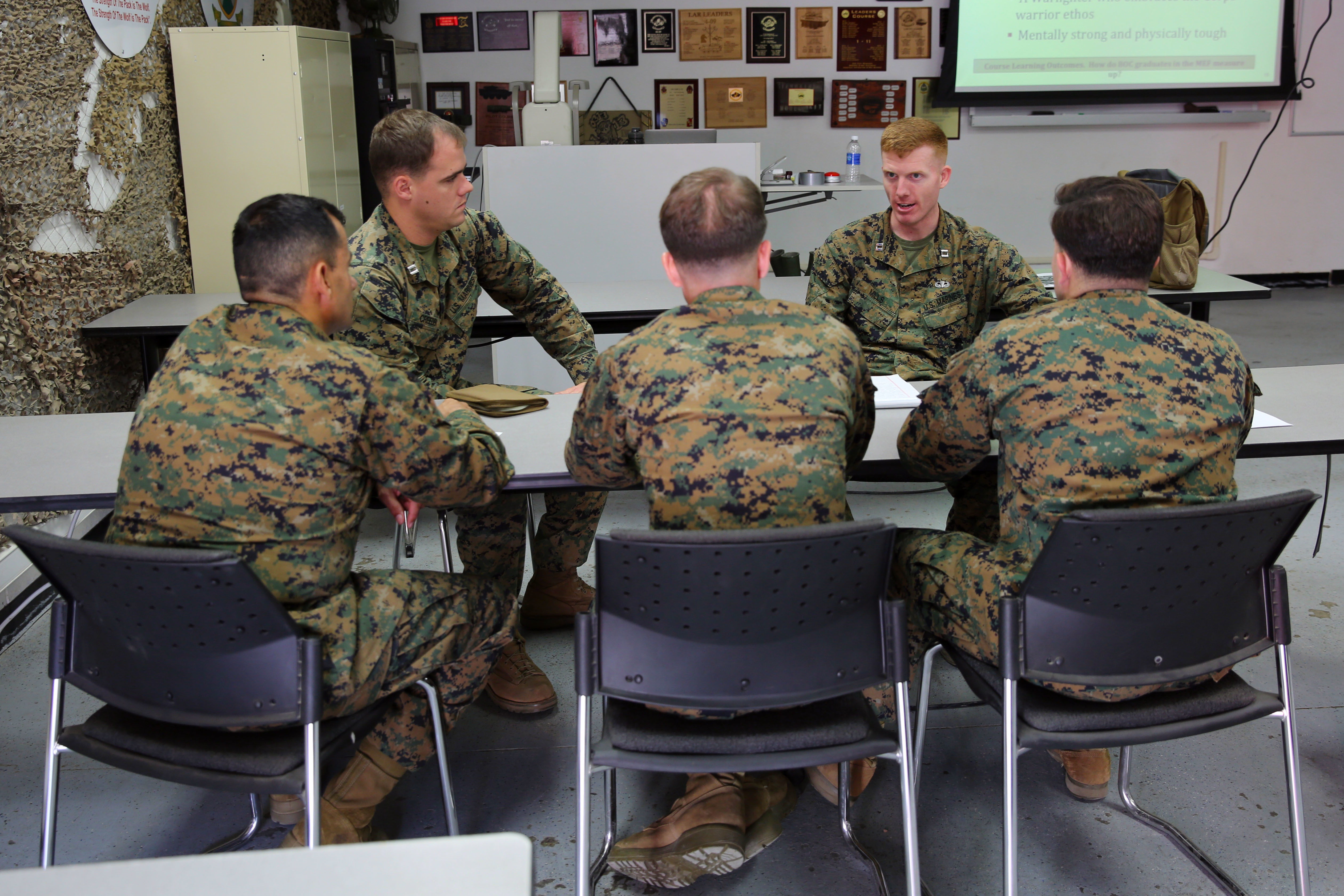
Capt. Kirby Mills, the testing and evaluation officer for The Basic School, sits down with instructors at the Light Armored Vehicle Training Company, School of Infantry-West, to discuss the quality of new officers.
Photo Credit: Lance Cpl. Caitlin Bevel/Marine Corps
The study’s ies authors argued that the General Classification Test GCT, which was developed in World War II as a predictor of successful military performance, is a more accurate point of comparison than the other standardized tests. While college admission tests the SAT and the ASVAB are periodically normed and revised, they wrote, the GCT has remained the same. While the Army also used to use the GCT, only Marine officers now take the test as a requirement.
While its conclusion about the impacts of lower Marine officer GCT scores may be contested, the study does rule out a number of demographic changes as not contributing to the trend. An increase in female and Hispanic officers over the last three-and-a-half decades is not responsible for the lower scores, the authors found.
While the number of female incoming officers almost doubled from 1980 to 2012, and the number of Hispanic incoming officers increased by a factor of 10 ten, there was no significant direct relationship between the changing demographics and the declining test scores, the study found. Rather, the authors concluded, a larger group of college graduates eligible to become Marine officers resulted in a broader range of test score performances.
“If the pool of those wanting to become Marine officers is representative of the pool of college attendees, and if there is a positive, monotonic relationship between intelligence and GCT scores, then the expansion of the pool of college students will be associated with lower average GCT scores,” Cancian and Klein wrote.
While the Marine Corps has not announced any changes to its officer testing and recruiting efforts their testing protocols in officer training and recruitment, officials are exploring new ways to decrease attrition during officer training and select more determined and resilient candidates in order to decrease attrition.
In June, Marine Corps Recruiting Command published a solicitation for non-cognitive tests that would help lower officer training attrition rates and predict future success in the service Corps.
The goal, according to the solicitation, was to “refine the recruiting process to produce higher quality officers while maximizing efficiency.”