
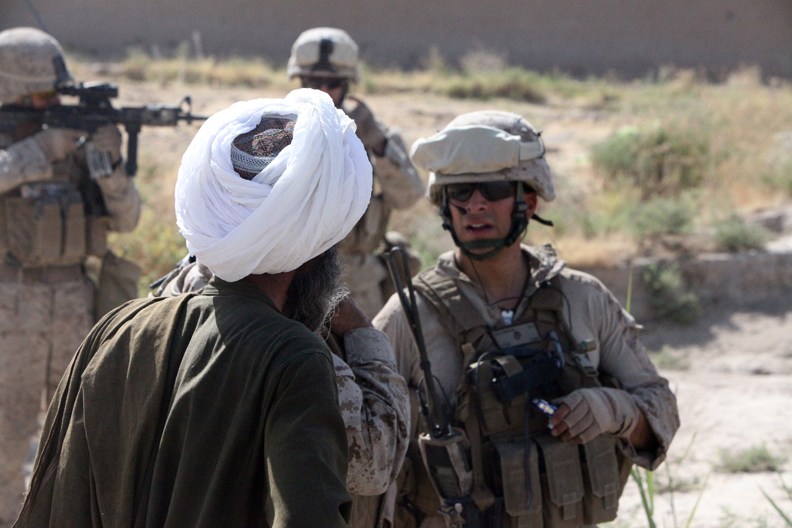
In an increasingly chaotic world, Marine Corps civil affairs teams will be key in shaping America’s military engagements abroad, according to a new study.
Civil affairs Marines will play a critical role in what the many in the defense community call “the new normal,” according to a July report from CNA, a nonprofit research and analysis organization in Arlington, Virginia. As Marines respond to more global uncertainty, civil affairs teams will be vital in building local partnerships and laying the groundwork for successful crisis response missions.
“As a community that is trained in understanding foreign cultures, socio-economic dynamics, and governance structures, [civil affairs] forces are uniquely positioned to recognize and assess the ‘push’ and ‘pull’ factors of violent conflicts and instability,” according to the study states.
This means Marine Corps civil affairs will be increasingly needed as the U.S. shifts its focus from large-scale combat operations to small‘minimal footprint’ engagements that which deter unrest, Vera Zakem and Emily Warner, the study’s authors, told Marine Corps Times.
After relying heavily on civil affairs teams in Iraq and Afghanistan to help local populations work towards build effective infrastructure, commanders see the value in having those capabilities when deploying today.
Warner said civil affairs teams should be viewed as an investment. If conflict arises, commanders already have an “influence network in place,” she said.
While many picture civil affairs Marines handing out soccer balls to kids in the war zone, Lt. Col. Anthonol Neely, head of the small wars branch, small wars and irregular warfare integration division of the Capability Development Directorate, said there’s much more to their mission. The small teams of young officers and non-commissioned officers are gaining important knowledge about their area of operations through partner support activities, medical and civil reconnaissance, and key leader engagements, he said.
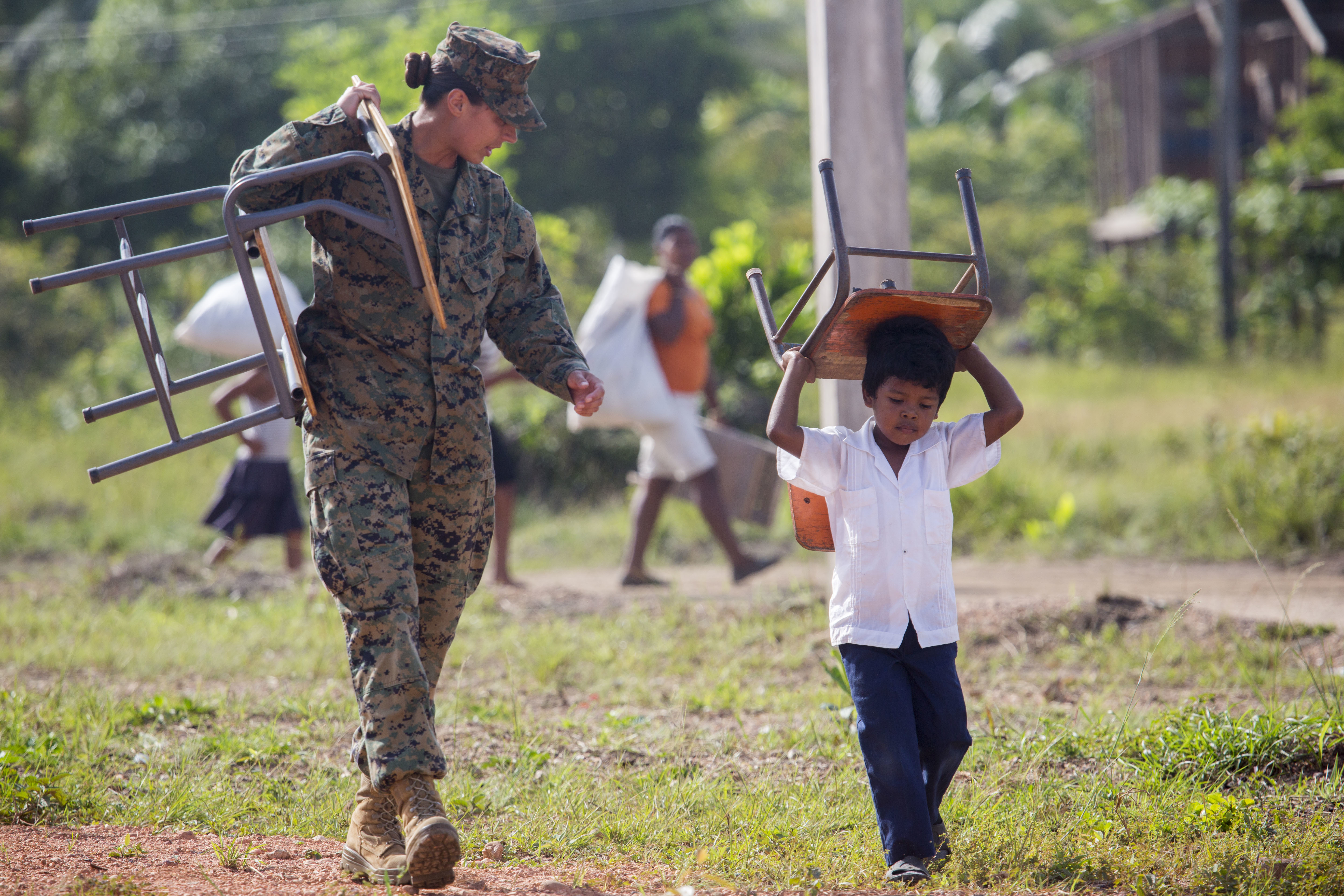
Capt. Jennifer Dymicki, the civil affairs team lead with 1st Civil Affairs Group, assists a student from Honduras as they work to reconstruct a school. The relationships civil affairs teams make with local leaders will be vital in future crisis response missions, according to a new study.
Photo Credit: Lance Cpl. Abraham Lopez/Marine Corps
That subject matter expertise is exactly what commanders need when Marines are called in to provide disaster relief, for example, and must work swiftly to establish liaison with local leadership, said Col. David Morgan, commanding officer of the 1st Civil Affairs Group in Camp Pendleton, California.
“Soccer balls can be given out for the sake of goodness, but those interactions are key to finding out information directly tied to the commander’s intent or mission,” Morgan said. “You need to look at things from the civilian perspective, whether when doing long-term planning or conducting operations. These things help accomplish the mission.”
The 1st Civil Affairs Group is a Reserve unit that supports I Marine Expeditionary Force. Reservists make up about 75 percent of civil affairs personnel, and since they often work as civil engineers or teachers in their civilian careers, they can bring critical skills to the mission.
Zakem and Warner, the study’s authors, said the Marine Corps should utilize the high number of Reserve civil affairs personnel to help carry out the in-demand mission. That would also go a long way in helping keep reservists connected to active-duty missions.
“As it stands today, the [civil affairs groups]CAGs are informally aligned with the MEFs, which in turn are aligned with the geographic combatant commands,” the study states. “However, since these relationships are still developing, CA Marines have not yet had a real opportunity to build regional expertise and are often sent to disparate parts of the world on episodic missions.”
The shift away from deployments in Iraq and Afghanistan have led a dramatic decrease in operations tempo for reservists, Morgan said. While they deployed in large numbers to support the wars, they’re now sent out as individuals or small teams rather than as standing units.
Such ad hoc deployments means the reservists have an up-hill climb integrating with units as they are “tacked on” to a mission late in the planning process.
“When they arrive at a unit, planning is already underway and opportunities to influence it is truncated or limited,” the authors said.
The slow-down in operations tempo has, however, meant an opportunity to increase training, according to Morgan, including integrating new technologies.
For example, a civil affairs team attached to I MEF conducted a training scenario this May simulating a post-typhoon disaster relief mission, according to a Marine Corps news release contingency operation. The team used smartphones installed with the “Marine Civil Information Management System,” a Wikipedia-like app which allows users to upload local, real-time information on medical, water and other essential services.
“We are now in the middle of an exciting era,” Morgan said. “It’s not about the device, it’s about the repository of virtual information.” “…We’re always asking, ‘hey, how do we do this better?’ Marines have always been excellent students of history; now we’re becoming excellent students of culture.”


