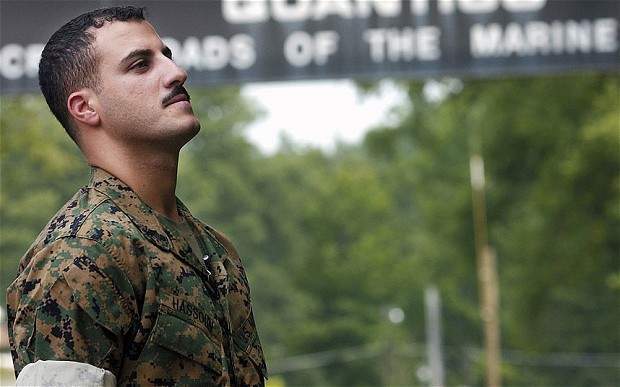
CAMP LEJEUNE, N.C. – A defense attorney said Thursday that a Marine accused of deserting his unit a decade ago in Iraq was kept in Lebanon for eight years while he faced a military trial there.
The Marine officer presiding over the hearing for Cpl. Wassef Hassoun adjourned the proceeding for at least a week to allow defense attorneys to translate Lebanese documents they say support his case.
The hearing officer, Lt. Col. Scott W. Martin, will eventually recommend whether Hassoun should face a military trial on charges including desertion as part of the Article 32 process. A Marine general will have the final say on whether to try Hassoun.
Defense attorney Haytham Faraj says Hassoun, 34, was kept in Lebanon for years for court proceedings triggered by U.S. accusations that he had deserted. Faraj said documents show Hassoun was tried and convicted by a Lebanese military court on charges that mirror the U.S. desertion charges. During the hearing, he said some English passages from the documents referred to specific charges in the U.S. military code.
Faraj said that as soon as the court proceedings in Lebanon ended, Hassoun contacted U.S. officials saying: “I need to get back to the U.S. The Lebanese have been holding me.”
Military prosecutors say Hassoun’s whereabouts were unknown for years until he contacted U.S. officials in 2013. Faraj at one point said the Lebanese government tried Hassoun at the behest of the U.S. but didn’t elaborate. He declined interviews after the hearing.
The case began in June of 2004 when Hassoun mysteriously disappeared from a base in Fallujah, Iraq. About a week later, he appeared in a photo purportedly shot by insurgents wearing a blindfold and with a sword poised above his head. By the next month, he showed up at the U.S. Embassy in Beirut, Lebanon.
Military authorities were skeptical of his story and began to investigate him on desertion charges back in 2004 after he returned to the U.S.
“It strains logic that he would flee and then turn himself in to U.S. authorities weeks later,” Faraj said.
Faraj said little about the purported kidnapping other than Hassoun was able to get away from his captors by using unique skills he developed as a serviceman and translator familiar with local Iraqis.
After returning to the U.S., Hassoun was granted leave in December 2004 to visit family in Utah but disappeared. Faraj said that he traveled to Lebanon for what he intended to be a short visit but was held by Lebanese authorities within days of arriving.
Prosecutors argue that there is overwhelming circumstantial evidence that Hassoun was unhappy and fled the army in Iraq and later fled to Lebanon after briefly returning to the U.S. They gave the hearing officer statements by witnesses who said Hassoun was unhappy with his deployment and how the U.S. was interrogating Iraqis. Prosecutors say Hassoun packed a bag and withdrew hundreds of dollars shortly before his disappearance.
“What we do have is circumstantial evidence, and that evidence is overwhelming,” said Capt. Christopher Nassar, one of the prosecutors.
Military officials say that around the time of his 2004 disappearance, a marriage for Hassoun had been arranged with a woman in Lebanon. Hassoun and the woman are now married and have a son who has dual U.S. and Lebanese citizenship.
Nassar said that even if Hassoun were tried in Lebanon, it doesn’t alter the Marines’ jurisdiction over the desertion case.
Martin has given the defense at least until Aug. 27 to translate the documents, and no new court date has been set.
Retired Maj. Gen. Walt Huffman, a Texas Tech University law professor who previously served as the Army’s top lawyer, said he finds it very unusual that a foreign government would try an American serviceman on charges of deserting the U.S. military, though he said he had less experience with governments in the Middle East than those in Europe or Asia.
For example, in Germany and Japan where there are U.S. military bases, local authorities can try U.S. servicemen on certain criminal offenses, but they’d have no interest in pursuing military charges such as desertion.
“I find that very unusual,” he said.
In desertion cases, he said it can be difficult to prove the serviceman planned never to return.
“The hardest thing is proving that they intended to stay away permanently,” he said.