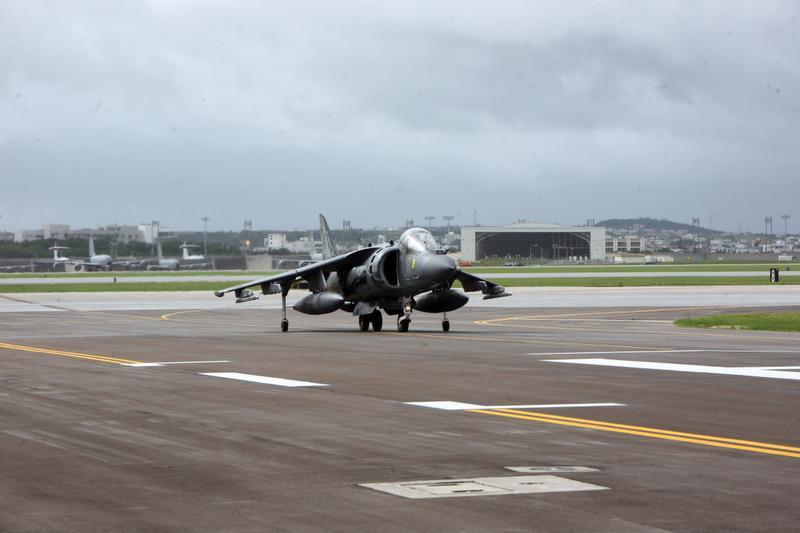
A Marine Corps AV-8B Harrier caught fire Thursday after making an emergency landing in Japan.
The pilot, who is assigned to the Okinawa, Japan-based 31st Marine Expeditionary Unit, saw a warning indicator light during a training flight and then landed the aircraft at the nearby Kadena Air Base. An aircraft rescue and a firefighting crew then put out a “small” fire caused by hot brakes, according to a Marine Corps news release.
There were no injuries.
The Marine Corps said that the damage to the Harrier — a jump jet that makes vertical takeoffs and landings — appears limited, and there will be an investigation to determine what caused the mishap.
While the extent of this accident is unknown, Marine Corps aviation is having one of its safest years in its history. According to the Naval Safety Center, fiscal 2014, which ends this month, will have the seventh-best mishap rate if it stats on track. It will also be the safest years since 2010.
The Maine Corps had five aviation-related mishaps since Oct. 1, including two that involved Harriers. The first was on June 4 in Imperial County, California, and the second was May 9 just outside of Phoenix. The pilots ejected in both crashes.
It’s not immediately clear what class of mishap Thursday’s emergency was, but the severity of the event will be determined by the extent of monetary damages and the severity of any injuries.
The Naval Safety Center defines a class A mishap as an event with at least $2 million in damage or a death or permanent total disability. A class B has between $500,000 in damage but less than $2 million or a permanent partial disability or three or more people injured and admitted as inpatients at a hospital. A class C mishap has at least $50,000 but less than $500,000 in damages or an injury that results in time off of work beyond the day the mishap happened. A class D mishap involves at least $20,000 in damage but less than $50,000, and an injury not included in the other types of mishaps.
The 31st MEU is preparing for its fall patrol. On Wednesday, the big-deck amphibious ship Peleliu arrived in Okinawa to embark Marines for their upcoming patrol. The amphibious ready group will also include the dock landing ship Germantown.