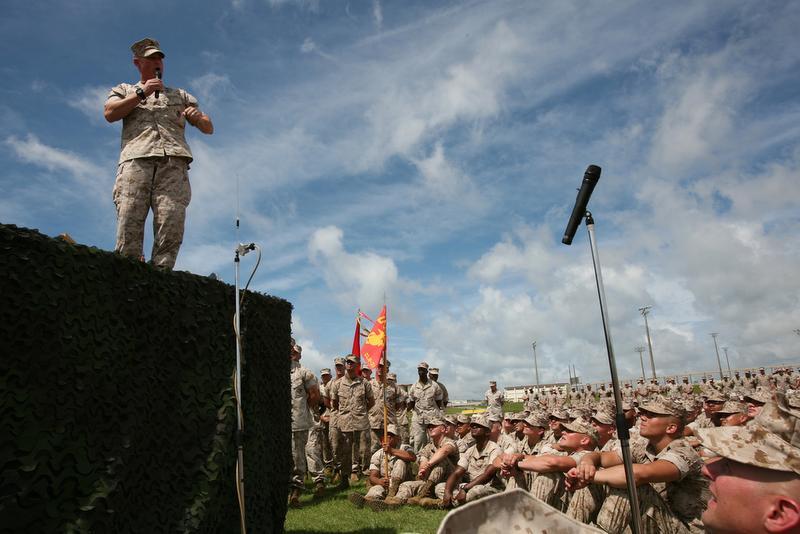
At a sergeants major symposium in mid-August at the Gaylord Convention Center near Washington, D.C., Sergeant Major of the Marine Corps Mike Barrett presented some four dozen top senior enlisted leaders with a snapshot summary of his job and responsibilities.
According to an official who attended the symposium, Barrett described the cyclic nature of the job: there was congressional testimony season, followed by summer parade season at Marine Barracks Washington. Then came Marine Corps ball season in the fall. Each of these seasons, he said, came with its own tasks and required preparation. Barrett also spoke about his office personnel and how his job was supported, the official said.
It wasn’t an academic discussion — when Gen. Joseph Dunford takes his place as commandant as soon as next month, selection of a new sergeant major of the Marine Corps will be among the early items on his agenda. For one of the 51 sergeants major invited to attend last month’s symposium, Barrett’s brief primer likely provided a helpful look at his or her next job assignment.
To get a sense of what the SMMC selection process may look like and Dunford’s thinking about his choice, Marine Corps Times spoke to a variety of individuals close to the process, including several former sergeants major of the Marine Corps. Most asked that they not be identified due to the sensitive nature of this decision.
A spokesman for Dunford, Lt. Col. Eric Dent, said the future commandant, who handed off responsibilities as commander of International Security Assistance Force in Afghanistan in late August, had been focused on the demands of that job and had no official comment with regard to the selection of the next SMMC.
The hand off
The timeline for selection hinges in part on how long Dunford opts to retain Barrett at the post. The commandant has wide discretion in this choice, and new commandants tend to retain previous sergeants major for a period as they adjust to their new role. That tradition began in 2003 with the 14th SMMC, Al McMichael, who served an additional five months after Gen. Jim Jones relinquished the commandancy to Gen. Michael Hagee. The current commandant, Gen. Jim Amos, kept the 16th SMMC, Carlton Kent, on for eight months before selecting Barrett to succeed him.
Sources with knowledge of Barrett’s thinking say he could serve up to an additional year, having come to the post in June 2011. But it’s rumored that he will likely stay on no more than six months after Dunford takes office. Barrett declined to comment on his plans.
The formal process, when it starts, does so with formation of a sergeant major selection board, another tradition that reportedly began in McMichael’s era. Typically, according to former sergeants major experienced with the process, a three-star leads the board, which consists of other general officers.
Parameters set by the commandant guide the board as they narrow the field of sergeants major. In 2011, the last time the board convened, the criteria were few and broad: Sergeants major qualifying for consideration had to be serving as the senior enlisted adviser to a general officer; maintain excellent physical condition and fitness and weight requirements; possess necessary security clearances or qualify to get them; and be willing to relocate to designated quarters at the home of the commandants in Washington.
The board narrowed the field to five candidates, who then interviewed with the commandant before the final choice.
If this selection process also includes a board, Dunford could choose, for example, to have the board only consider sergeants major who advised at three-star posts, which would narrow the field to about six candidates from the start. He could opt to place a time-in-grade restriction on eligibility, though one former sergeant major of the Marine Corps said that would be an unusual step. He can also dictate how many finalists he wants the board to produce.
While there are no formal requirements for a commandant selecting his sergeant major, the screening board has its devotees.
Retired Sgt. Maj. John Estrada, the 15th SMMC, said the process can help to eliminate favoritism and the tendency for commandants to gravitate too heavily toward sergeants major with whom they’ve served before.
“We do it differently, and I think our process is a much fairer process across the board,” he said. “You look at the history of our process, most of the time it’s not someone who has served with the commandant.”
The ideal sergeant major
The culminating interview with the commandant is a crucial moment in the selection process.
Estrada said Hagee, who selected him, looked for candor, asking him to name the things about the Marine Corps that he would change and probing his thoughts on training and equipping the troops, deployments, and family issues.
The most memorable moment, Estrada said, was when Hagee asked who Estrada would select as sergeant major of the Marine Corps if he himself wasn’t chosen.
“To me, that was the best question, because it gives you an opportunity to take a look at yourself and decide whether you’re looking at the best interests of the Marine Corps,” Estrada said.
Rather than one particular quality, commandants look for enlisted advisers with diverse experiences who will relate to them comfortably and honestly, sources said.
One former sergeant major of the Marine Corps, who asked not to be named, said he was quizzed by the commandant he would later advise on issues related to all parts of the Marine air-ground task force, and was asked to articulate his perspective on the Marine Corps mission and responsibilities.
“The commandant has to know that this sergeant major can click, and not come in there with a selfish attitude,” he said.
Because a big part of the role is relating directly to troops and their families, sources said sergeants major are often invited to bring their spouse to meet the commandant and his spouse during the final stages of the selection process.
Also relevant is the sergeant major’s experience relating to the public and the press, as the sergeant major of the Marine Corps can expect to field interviews and present testimony to Congress.
Estrada said the SMMC has to communicate a a reliable “pulse check” of the well being of the fighting forces, to the commandant and to the American public.
“You’ve got to be able to articulate what is going on with the Marine Corps,” he said. “What we need and how we need it … how we’re going to take care of these Marines after they have served and suffered some sort of traumatic injury, after they have passed away.”
Former sergeants major who spoke with Marine Corps Times said it was counted in their favor to have served in billets across the MAGTF and to have experiences within the service that differed from those of the commandant.
A glance at the resumes of the most recent Marines to fill the job illustrates that fact. Barrett, a ranger-qualified infantryman, served with Amos, an aviation officer. Retired Sgt. Maj. Carlton Kent, Barrett’s predecessor, had a background in air delivery logistics and served as an embassy security guard early in his career. Estrada, who preceded him, was trained in aircraft maintenance.
A Marine official with knowledge of Dunford’s thinking said he would be looking for a sergeant major who can communicate the needs and challenges facing enlisted Marines to him in a careful and candid way.
“I believe General Dunford is not looking for a ‘yes’ sergeant major,” the official said. “Rather, he’s looking for the best sergeant major.”