
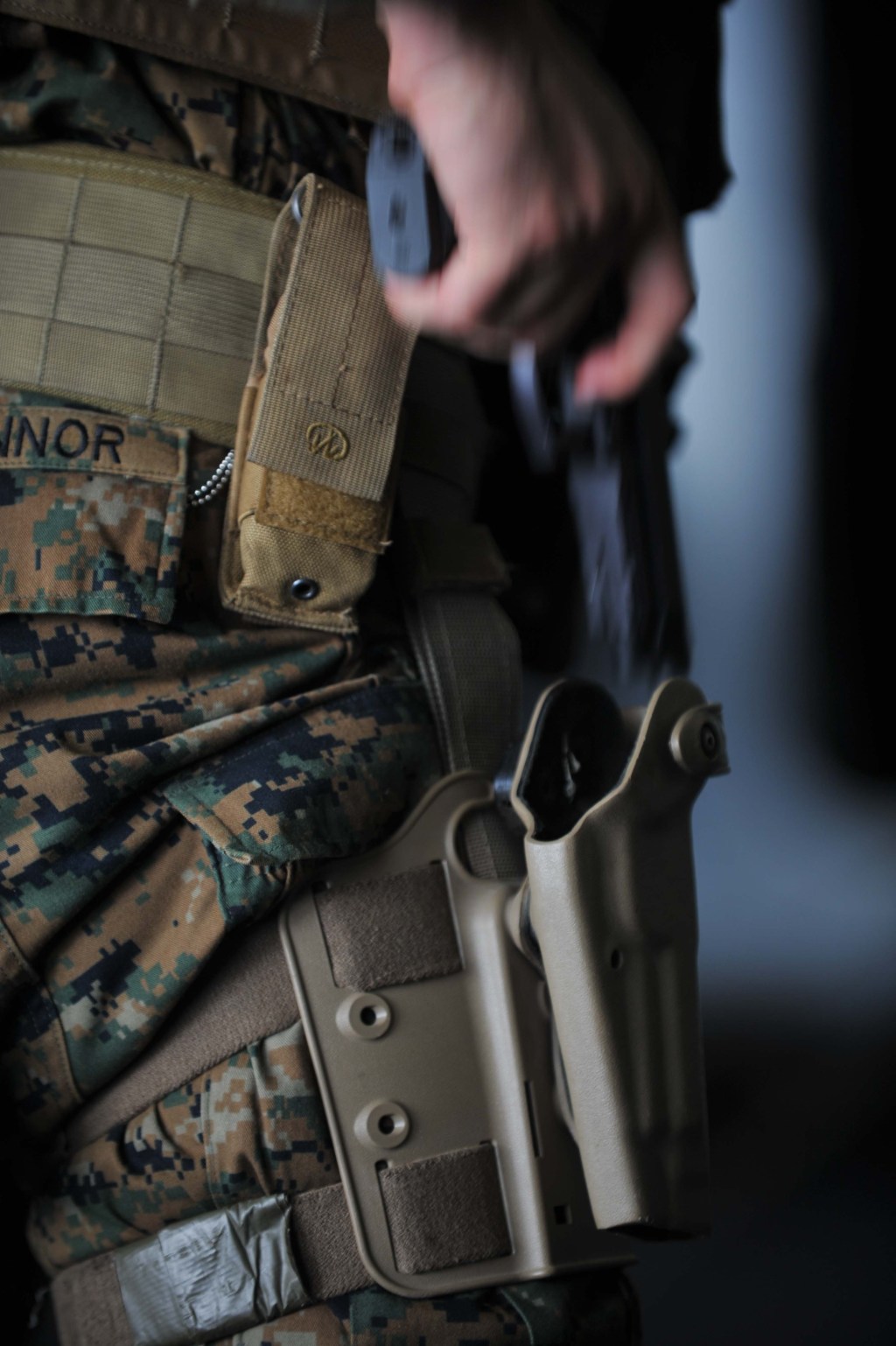
The Marine Corps’ top general Commandant has made it clear: Marine Corps recruiters will not be armed.
In an internal message issued late last month, Nov. 25, Commandant Gen. Robert Neller clarified the Corps’ official position on arming Marines and increasing security at recruiting centers following the July’s deadly July attack on two military facilities in Chattanooga, Tennessee, that in that shootings which killed four Marines and a sailor.
That attack, in which a homegrown violent extremist opened fire on a recruiting office and Navy Naval and Marine Reserve Center in Chattanooga, Tennessee, prompted the Defense Department of Defense to seek a cohesive plan to counter similar future such threats in the future, according to Marine administrative message 599/15.
“It is imperative we ensure uniform understanding and implementation of existing policy and authorities for augmenting security, including the arming of additional personnel,” the message Maradmin states.
The MARADMIN message provides explicit guidance on who can be armed: Only Marines engaged in law enforcement or security duties are permitted to carry with government-issued firearms and ammunition ammo while on duty. All other Marines are prohibited from doing so. performing law enforcement duties and will not be integrated into law enforcement forces.
Neller has said in the past that arming recruiters could hurt their mission. About a week after the Chattanooga attacks, he told members of Congress that recruiters need to stay connected to members of the American public in places where firearms are not allowed, like schools.

A Marine recruiter speaks to high school students about opportunities in the Corps. Visits to schools are one of the reasons cited by Marine leaders to keep recruiters unarmed.
Photo Credit: Sgt. Richard Blumenstein/Marine Corps
However, cCommanders do, however, have the authority to arm security personnel at off-installation facilities owned or leased by DoD the Department of Defense, such as recruiting offices. It’s not immediately clear whether the Marine Corps plans to assign armed law enforcement or security personnel to recruiting stations.
A spokesman for the commandant did not respond to questions submitted by Marine Corps Times about the guidance. But an official at Marine Corps Recruiting Command said the message commandant’s The Commandant’s new guidance does not create new Marine policies. It just clarifies existing authorities y for the Marine Corps, but clarify policy, authority and procedures for arming Marines and augmenting security, said according to Maj. Garron Garn, a spokesman for Marine Corps Recruiting Command.
“It is intended to amplify the existing policies currently in place and ensure commanders are best positioned to protect their Marines and sailors,” he said.
Citing operational security, Garn declined to comment on who is or is not currently armed at Marine Corps recruiting stations.
a Ccongressiona
“As the tragedy of July 16 illustrates, [homegrown violent extremist] attacks can occur with little to no know warning,” Defense Secretary ofDefense Ash Carter wrote said in the directive.
These additional security measures, he said, will mitigate the risk posed by such suck attacks.
In September, the head of Marine Corps Recruiting Command, Lt. Gen. Mark Brilakis, told Marine Corps Times that the service would begin implementing new security measures, including more security cameras, remote-locking doors and mobile ballistic protection.
“Marines in Chattanooga got out of that recruiting station in less than a minute,” he said. “And they did so because one, they were trained, and two, they sat down and talked about it before. Every one of those Marines had been trained or had a conversation once they got to the recruiting station about what happens in the event of ‘X’ – and when ‘X’ happened, they all executed perfectly.”
Garn declined to comment on the status of those measures across Marine recruiting stations, citing When asked for an update on these new security measures, MCRC spokesman Garn decsaid that for operational security concerns siderations, he could not say how far along they are in implementing them.
“Marine Corps Recruiting Command will continue to take a proactive approach to developing the most effective force protection measures that will strive to balance the requirements of our mission with the safety of our personnel and others operating at our facilities,” he said.


