
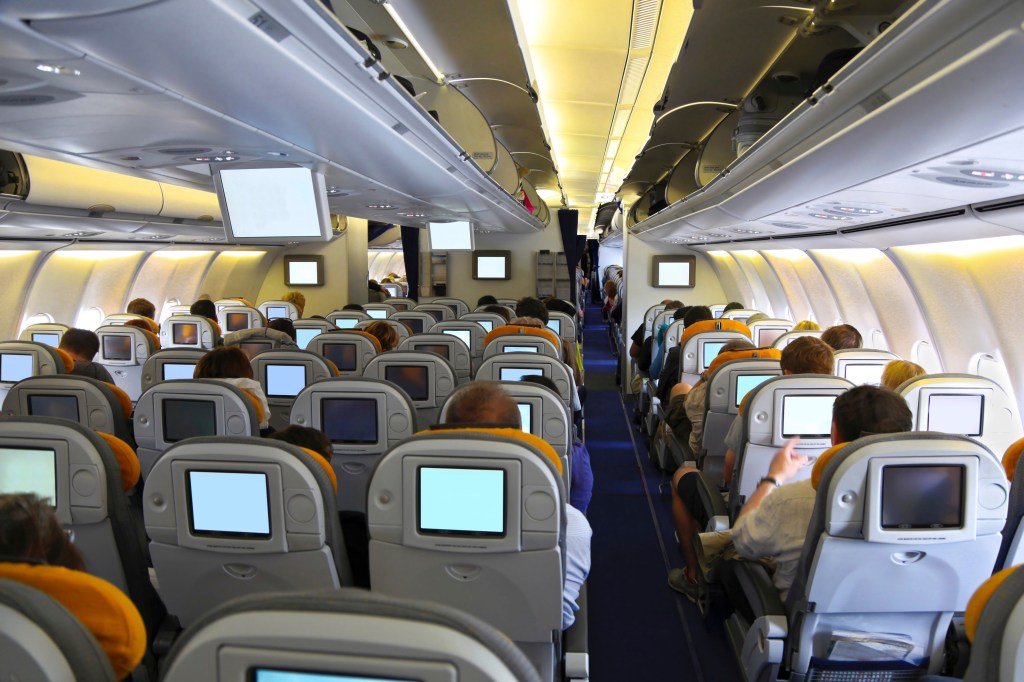
The gray Atlantic rolls in breakers 50,000 feet below. Five hours still to go. The movie credits have rolled. Someone is snoring. How is Warren Haines different from the several hundred other passengers in this transcontinental steel tube?
“I’m not sleeping.”
In fact, Haines is paid to stay awake. As a federal air marshal, he blends in with airline passengers and relies on his training, including investigative techniques, criminal terrorist behavior recognition, firearms proficiency, aircraft-specific tactics, and close quarters self-defense measures, to protect the flying public.
It’s his job to keep an eye on all goings-on in the skies, friendly or otherwise. It’s a job that gives him the chance to extend into his civilian career the spirit of his service as a Special Forces medical sergeant in the Army National Guard.
For those who’ve seen enough of Liam Neeson to consider the position, there’s good news: The Transportation Security Administration, which runs the air marshal program, says it plans a hiring wave in the near future, the first such round since 2011.
But the competition will be stiff. Last time around, the agency received between 35,000 and 45,000 applications for just a few hundred positions.
What it takes
But if you’re transitioning out of the military, you may have better-than-average odds of making the cut.
“There is a very natural fit for those individuals who have served in uniform, who understand sacrifice and selfless service, who can work with autonomy while protecting the values of the nation,” said Mark Escherich, TSA’s veterans program manager.
More than any single aspect of the job, that spirit of service is what seems to draw veterans. “It is a position where you are extensively involved in implementing our national security agenda,” Escherich said. “What you are going to do each day may be relatively unknown, but you will always be significant to the safety of our nation.”
“Relatively unknown” can span a wide range of circumstances. Some events may be easy to anticipate — the passenger who’s had one too many of those tiny whiskey bottles, or the altercation when elbows collide in seats that the airline has jammed too close together.
Then there are the events that may be less easy to anticipate.
September 2014: A federal air marshal is put into quarantine in Houston after being jabbed with a syringe by a passenger from Nigeria. Unprovoked, the attacker managed to fire off an unknown substance into the agent’s arm.
The mystery fluid eventually was deemed harmless, but that’s the kind of scenario that keeps Haines wide awake on the job. “It’s never what you are expecting. It is always something different, so you have to maintain that internal state of readiness,” he said.
Spidey sense
Federal air marshals have been aloft since 1962 and have taken a prominent place in the public eye since 9/11. While much is assumed about the air marshal’s job, a lot must be inferred. TSA won’t even say how many marshals are on the rolls, let alone how many ride on any given flight — though the agency acknowledges it’s always more than one.
With 100,000 commercial flights on the move on any given day, however, it’s presumed that not every flight has a marshal on board.
When the wheels leave the ground, Haines said he typically does not sit around looking for bad actors; mostly, it’s just the opposite.
“I get to know what normal is,” he said. “If you know what normal is, then you are going to know what is not normal.”
An aircraft is a tight, confined space, with people behaving in predictable patterns. When something is amiss, “there is a Spidey sense, like some sort of breeze sweeps through the place and you know something is a little bit different,” Haines said. “It’s something a lot of people in law enforcement understand.”
The reward for such vigilance comes in between $40,000 and $100,000 a year, with average pay around $62,000 a year, according to Payscale.com.
Getting an edge
So how do you get on the inside track when TSA starts hiring? Escherich advises checking the Office of Personnel Management job descriptions and guidelines. They can tell you exactly how to word your résumé. Also, keep in seriously good shape — TSA sets a high bar in that regard.
Beyond these, the basics include:
- class=”p1″>The ability to analyze problems, gather pertinent data, and plan and organize work.
- class=”p1″>A bachelor’s or higher-level degree in any field from an accredited college or university or a combination of experience and education.
- class=”p1″>Top-secret security clearance is a must, as is peak physical performance, firearms proficiency and the ability to travel constantly.
The travel requirement is significant, not just because an air marshal is away from home — many who have worn a military uniform are used to this — but because the marshals very often are left to fend for themselves.
“It takes an incredibly disciplined person to do this job, because you are expected to act appropriately in a lot of environments where there is not a lot of supervision right there with you,” said Haines, who is based in Virginia.
“You have to ensure that no matter where you are in the world, you are getting the rest you need, maintaining your fitness, and that’s hard. If you are in a foreign country and the hours are off of what you might normally enjoy, it takes a special kind of person to maintain that level of discipline,” he said.
For those who can maintain it, TSA offers the possibility of upward mobility. Taking an air marshal job doesn’t have to mean you’ll be flipping the pages of SkyMall forever.
“People who continue with the operational presence for as long as possible typically understand that they won’t be out in the field offices forever,” Escherich said. “You will be promoted into more leadership roles, dealing with more budgets and schedules and such. The presence of the desk does become a little more prevalent.”


