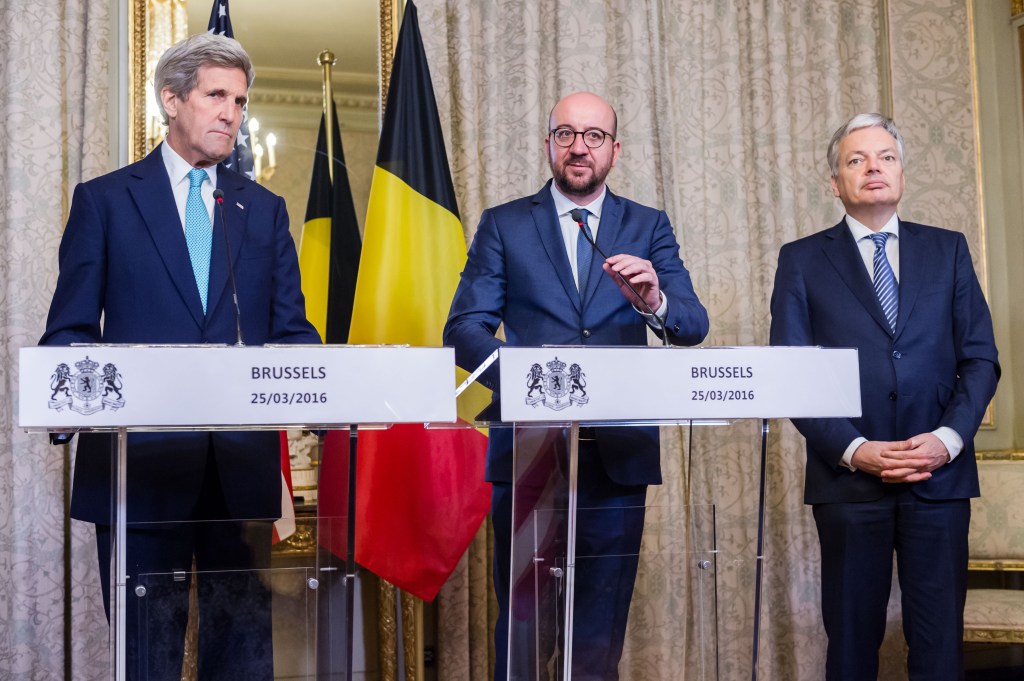
BRUSSELS — At least two American citizens have been confirmed killed in this week’s attacks in Brussels, according to a U.S. official.
The announcement comes as Secretary of State John Kerry is visiting the city to express his condolences to the Belgian people.
Kerry did not offer specific details about the two Americans, but a senior official said their families had been informed of their deaths in the attacks. The official, who was not authorized to speak to the matter publicly and spoke on condition of anonymity, did not have further details. The bombings killed 31 people and wounded 270.
Elsewhere in a Brussels neighborhood, a large police raid in Brussels is over and one person carrying a bag of explosives material has been wounded and arrested, according to Belgian state broadcaster RTBF.
A resident of the cordoned-off street in the city’s Schaerbeek district, veterinary surgeon Marie-Pierre Bouvez, told The Associated Press the area remains blocked off but heavily armed officers involved in the Friday operation have gone. Police still shouted at her to stay in her office, however.
AP reporters at the scene can see explosives robots and experts still combing the area.
Earlier, a witness speaking on Belgian state broadcaster RTBF described hearing blasts and shots from heavy weapons during the police raid. About 50 officers appeared to be involved in the operation.
RTBF quoted Schaerbeek’s district mayor, Bernard Clerfayt, as saying the arrested person has been linked to the attacks in Brussels this week and an arrest in France.
According to British officials, a U.K. citizen died during Tuesday’s attacks in Brussels. They confirmed that David Dixon, a computer programmer living in Brussels, was killed in the bombing on the Brussels subway. Dixon’s family has asked for privacy and indicated no statements will be made.
Officials said seven other British nationals were injured, too.
A Chinese national is also reported to have been killed, according to the Chinese Embassy in Belgium. He was identified only by his surname — Deng. No further details were released.
Speaking after a meeting with Belgian Prime Minister Charles Michel, Kerry said the “United States is praying and grieving with you for the loved ones of those cruelly taken from us, including Americans, and for the many who were injured in these despicable attacks.”
Visiting the Belgian capital on a hastily arranged stop, Kerry said all governments must consistently improve their strategies to fight terrorism, but maintained that Belgium had made significant improvements over the past year despite failing to stop Tuesday’s attacks. He noted that Belgium had actively sought additional assistance and that 10 or 11 FBI agents are now in Brussels helping with the investigation.
French counterterrorism police also detained a man Thursday who officials say was in the advanced stages of an attack plot. Officials told The Associated Press that the suspect, Reda Kriket, 34, had a past Belgian terrorism conviction and was linked to the suspected ringleader of the Paris attacks, Abdelhamid Abaaoud.
Belgian authorities have faced criticism for missing a series of signals pointing to a pending attack, and pressure is mounting on the government domestically and internationally. Belgium’s interior and justice ministers — who tried to resign this week but were told to keep working by the prime minister — are debating the airport and subway attacks with the country’s lawmakers Friday.
Authorities have formally linked the Brussels bombings and the Nov. 13 attacks that left 130 dead in Paris. Both were apparently carried out by the same Belgium-based cell of the Islamic State group.
Some of the Brussels attackers had been on the run from authorities in France and Belgium but were still able to hide in safe houses, assemble bombs and carry out linked attacks.
Turkey announced this week that it had warned Belgium last year that one of the Brussels attackers, Ibrahim El Bakraoui, had been flagged as a “foreign terrorist fighter.”
The intelligence shortcomings have prompted European authorities to call for quicker and more efficient intelligence cooperation.
“People are jumping to conclusions,” Kerry said of critics. “I think they are looking for things that just sometimes are very difficult to analyze in the immediate aftermath of something.”
“I don’t know what all the circumstances were, I don’t know if some events or evidence or opportunities were missed specifically,” he told reporters at the residence of the U.S. ambassador to Belgium. “That will come over a period of time, But I think all this carping four days later is a little bit frantic and inappropriate.”
Kerry said that prior to the recent attacks, the U.S. and other countries had already scheduled a number of meetings with Belgium about specific improvements they could make to their laws, intelligence collection and attempts to blunt the radicalization of youth in particular.
He said the reason ISIS “is resorting to actions outside the Middle East is that its fantasy of a caliphate is collapsing before their eyes; its territory is shrinking. Its leaders are decimated. Its revenue sources are dwindling, and its fighters are fleeing.”
Michel thanked Kerry for his visit, calling it a powerful message of solidarity. “It is very important for us today to receive your support,” he said. He offered condolences for the American victims and vowed to step up counterterrorism cooperation with the U.S. and others.
Both said the fight against ISIS will be relentless.
“We will not be deterred,” Kerry said. “We will come back with greater resolve — with greater strength — and we will not rest until we have eliminated your nihilistic beliefs and cowardice from the face of the Earth.”
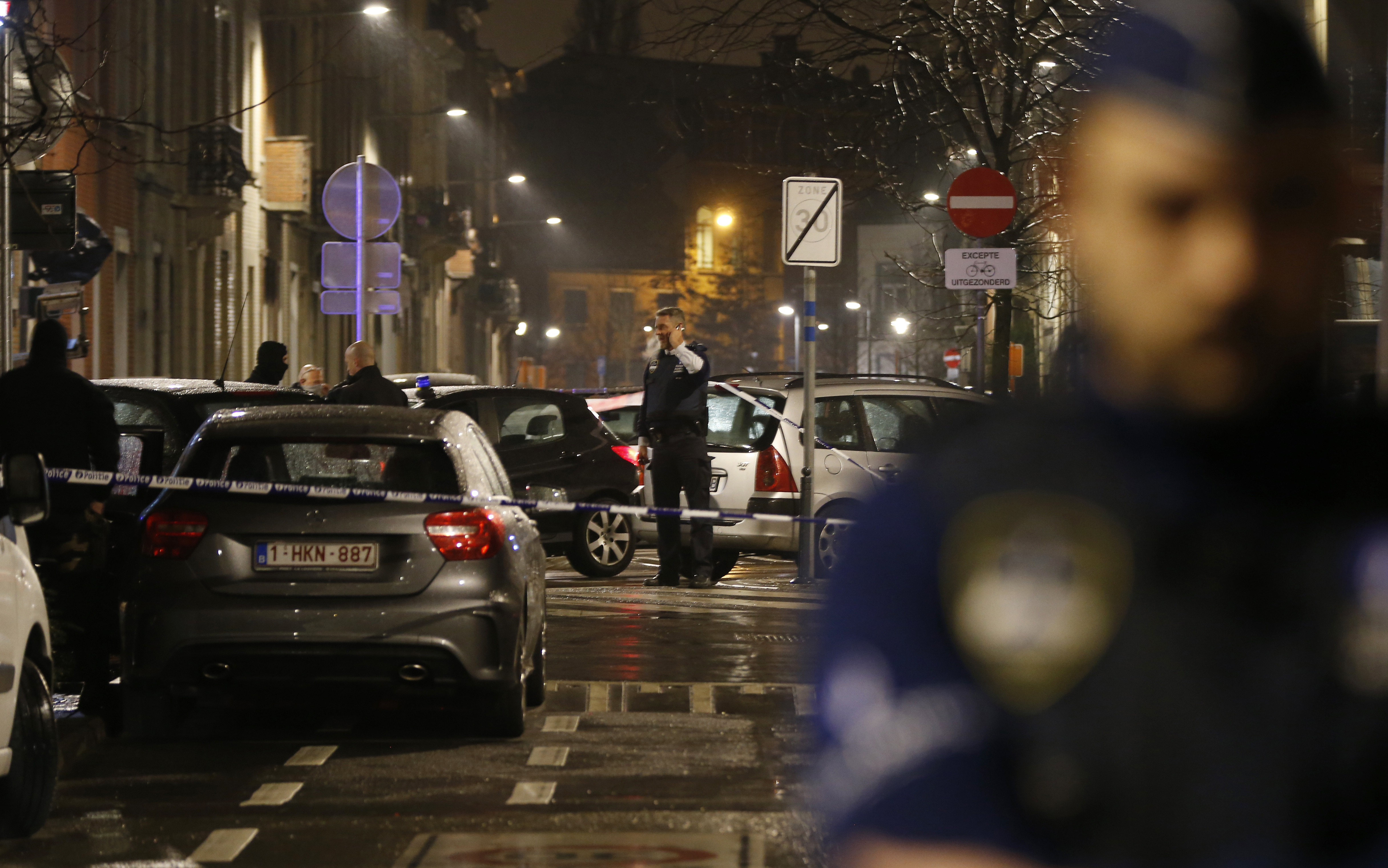
Police guard a check point and man positions during a police raid in the suburb of Schaerbeek in Brussels early Friday.
Photo Credit: Alastair Grant/AP
Elsewhere, Belgium’s nuclear agency said Friday that it has withdrawn the entry badges of some staff and denied access to other people recently amid concern the country’s nuclear plants could be a target for extremists.
Nuclear control agency spokeswoman Nele Scheerlinck said the move at some plants “is not necessarily linked with the terrorist attacks,” noting that the decision to deny access usually takes weeks.
Immediately after Tuesday’s attacks, security was boosted around Belgium’s nuclear sites and hundreds of staff sent home.
The dead and wounded in the Brussels attacks came from dozens of countries and are still being identified.
Angela Charlton and John-Thor Dahlburg in Brussels, Lori Hinnant in Paris, and Mike Corder in The Hague contributed to this report.