
source GAIA package: Sx_MilitaryTimes_M6201110111050320_5675.zip Origin key: Sx_MilitaryTimes_M6201110111050320 imported at Fri Jan 8 18:18:05 2016
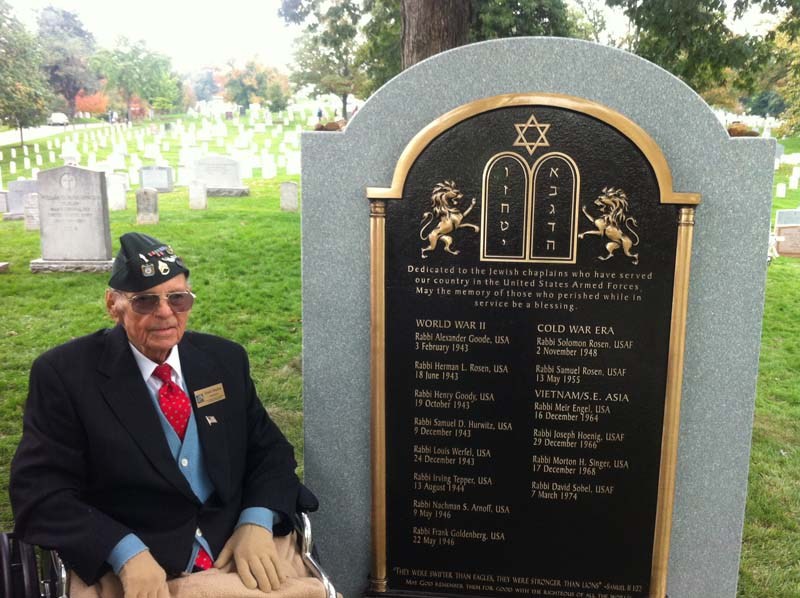
Hundreds gathered at Arlington National Cemetery in a solemn ceremony to dedicate a monument to 14 Jewish chaplains who died while on active military service.
Veterans and relatives of the deceased chaplains from around the country gathered Oct. 24 at the two-hour ceremony in the cemetery’s amphitheater, along with military officials and members of Congress.
“We’re acknowledging what these Jewish chaplains did for our nation,” said Army Chief of Chaplains Maj. Gen. Donald L. Rutherford. “The Army family and the Army chaplain corps have come together to honor these 14 men who gave their lives taking care of their soldiers and airmen, taking care of everyone.”
The most famous of the chaplains and the inspiration for the monument was Lt. Alexander Goode, a rabbi and one of the four “immortal chaplains” who gave away their life jackets as the Army troop ship Dorchester was sunk by a German U-boat in 1943.
Army Staff Sgt. Ernie Heaton, one of two survivors still living, remembered seeing how the chaplains, after the life jackets ran out, locked arms and sang a hymn as the ship sank.
“I saw them. The ship only took 20 minutes to go down,” said Heaton, 88. “They were comforting the guys, there were guys screaming and crying, who couldn’t swim.”
Their heroic action was all the more inspirational because the chaplains — two Protestant ministers, a Catholic priest and a Jewish rabbi — acted together. The four posthumously received the Four Chaplains Medal, established by an act of Congress in 1960. The “Field of the Four Chaplains” at Fort Benning, Ga., was dedicated to their memory.
Goode’s fellow chaplains appear on memorials previously dedicated to Protestant and Catholic chaplains on the cemetery’s Chaplains Hill. But no memorial for Jewish chaplains had been built.
The monument was funded by hundreds of private donations and backed by a joint resolution of Congress, which passed in May.
“When it came time for the votes, both the Senate and the House passed the legislation unanimously,” said Jerry Silverman, chief of the Jewish Federations of North America.
Rep. Jeff Miller, chairman of the House Committee on Veterans Affairs, said that, at long last, visitors to the cemetery may learn about the service and sacrifice of Jewish chaplains — who have been on a “long journey” to the cemetery.
“This is their last stop,” Miller, R-Fla., said of the chaplains. “The hallowed ground where they will take their rightful place among the souls they gave the greatest of comforts, the love and the mercy of God.”
Rep. Debbie Wasserman Schultz, D-Fla., said the monument epitomizes “how so many different faiths and cultures have an integral role in shaping and protecting our nation.”
Goode’s grandson Alex Fried, who was in the audience with his children, said the interfaith action aboard Dorchester is more relevant than ever.
“What needs to be remembered here were the actions of four men, acting for the benefit of mankind,” Fried said. “It wasn’t my grandfather looking out for the Jews, it was, ‘Who’s next, who’s in need,’ all working together.”
West Point’s Jewish cadet choir sang in Hebrew and English. Two Jewish clergymen sang the El-Malei Rachamim prayer for the dead in voices swelling with sorrow.
Of the 14 chaplains, all died while on active duty but few died in action. Eleven were in the Army.
Veterans, relatives of the chaplains and others had time for personal reflection beside the monument before and after the ceremony. Many placed a pebble on the monument, a Jewish custom of mourning and remembrance.
Retired Air Force Reserve chaplain Yaakov Hoenig was filled with emotion as he remembered his brother Joseph, an Air Force chaplain, who died of a cerebral hemorrhage at age 24 in 1966.
His brother left Queens, N.Y., to minister to service members in far-away Alaska and the remote Aleutian and Kodiak Islands.
“It’s extremely heartbreaking,” Hoenig said. “He was my brother and I looked up to him. One day he was here and the next he wasn’t, and he left a legacy.”
Hoenig called the monument “outstanding” and noted that the number of chaplains on the monument — 14 — is spelled in Hebrew with the letters “yud” and “daled,” which also spell the word “yad,” which means hand.
“These men were really the hand of God,” Hoenig said, “doing his work in the military.”


