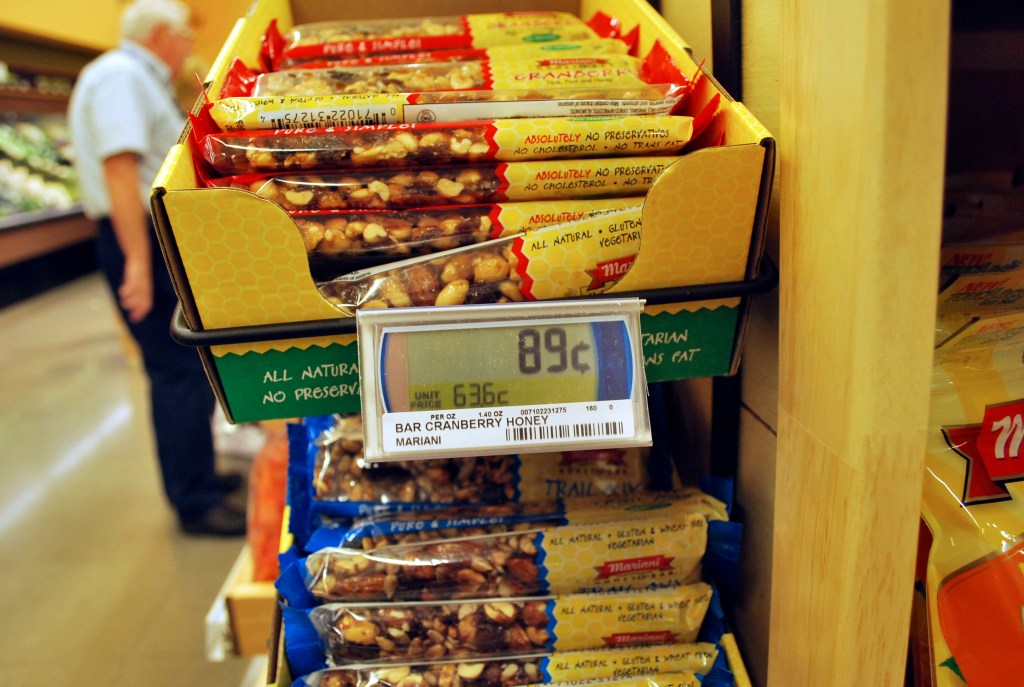
Allowing commissaries to use “variable pricing” doesn’t necessarily mean that the stores would increase prices — or at least, not a lot, according to a draft of a congressionally mandated study on ways to save money in the commissary and exchange systems.
But if the Defense Commissary Agency offered its own private label, the profits would help pay for some commissary operating costs, according to the draft report from Boston Consulting Group, contracted by Defense Department personnel officials.
The draft report is being closely held, but a source read the executive summary to this Military Times reporter.
The draft also reportedly recommends consolidating the three military exchange systems — Army and Air Force Exchange Service, Navy Exchange Service Command and Marine Corps Exchange — along with part of DeCA’s functions.
The idea that customers would automatically see price increases if DeCA were allowed to set the prices is a misconception, the researchers stated.
By law, commissary prices now are set at cost plus a 5 percent surcharge at the cash register. Last year, DeCA saw sales of $5.6 billion and collected $287 million in surcharge funds, which are used for commissary construction and renovation.
In a survey of commissary customers, BCG researchers found 60 percent would be willing to switch to private label brands, which would allow stores to charge enough to make a 40 percent to 60 percent profit in some categories of products.
In civilian grocery stores, about 19 percent of sales are private label brands. Operating an in-store private label brand also would cost DeCA money, though that issue was not addressed in the executive summary.
Customers surveyed by BCG indicated they would take a substantial amount of their business to civilian grocery stores if commissary prices rose by 5 percent.
The consultants noted that if commissary stores lost business, that would have a negative effect on the exchanges as well, cutting the dividends that are contributed to morale, welfare and recreation programs on military installations.
BCG believes commissary customers generally save about 15 percent to 20 percent in most continental U.S. locations.
An overall price increase of 1 percent to 3 percent would save about $140 million in taxpayer dollars out of DeCA’s $1.4 billion annual budget, the draft states. This, along with other savings initiatives identified, could potentially save between $440 million and $705 million a year in taxpayer dollars for DeCA.
But a price increase of 1 percent to 3 percent “is nowhere near what DoD wants,” said Tom Gordy, president of the Armed Forces Marketing Council, noting that DoD has asked for an increase of about 25 percent in commissary prices.
DeCA still would need some level of taxpayer funding, the report states, echoing the findings of other recent studies and proving that “the solution of doing away with [taxpayer funding] is not going to sustain this benefit,” Gordy said.
Researchers noted that running a grocery store is very different from retail, which means the costs of fully combining DeCA with the exchanges likely would exceed any value that could be gained from a merger, they said.
They do recommend consolidating some DeCA back-office and non-resale procurement functions with the exchanges, and consolidating the four entities’ governing boards.
Consolidating the exchanges alone could generate from $175 million to $265 million in savings annually, according to the draft. cut for space:Assuming that DeCA employees were converted from government employees to non-appropriated fund (NAF) employees (which could save about $95 to $155 million a year), consolidating DeCA back-office and non-resale procurement functions with the exchanges could generate about $40 to $60 million a year in savings of taxpayer dollars.
Army and Air Force Exchange Service officials expressed concern about the findings, saying the risks for an “unprecedented multiple-parties merger must be thoroughly analyzed,” according to a copy of their response to the findings obtained by Military Times.
Exchange officials noted that in BCG’s own 2013 industry analysis of mergers, they found that two-thirds of mergers destroy value.
cut for space for pirnt”Many synergies identified in the report can be achieved without consolidation. The report must identify initiatives that require consolidation versus those that can benefit from standalone implementation.”
cut for space for print The report also recommends reimbursing commissaries for consolidation expenses, but doesn’t identify the source of funds for the exchange consolidation costs, or account for lost earnings, AAFES officials stated. This could affect the dividend payments to the services’ MWR programs.
Officials cited a number of concerns about lack of details about the effects on operations, and underestimating costs to implement the changes.
“The maxim ‘retail is detail’ needs to be respected,” AAFES officials concluded. “Based on various internal analyses and actual efficiency implementation, the Exchange is concerned that the report’s recommendations, as currently written, are unsupported and in fact, have the capacity to negatively impact operations and earnings.”