
BAGHDAD — A preliminary investigation into Friday’s clashes between protesters and Iraqi security forces has revealed that police and military guards did not fire directly into the crowd of demonstrators, according to a statement released Sunday by Saad al-Hadithi, the spokesman for Iraq’s prime minister.
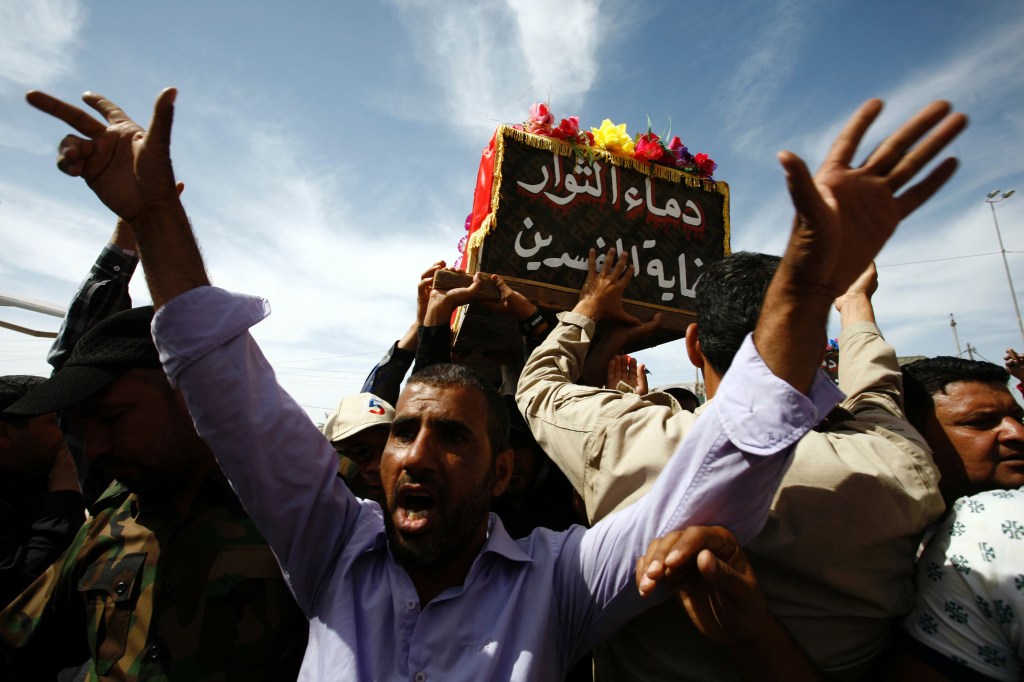
The statement came two days after two protesters were killed as hundreds of demonstrators stormed the prime minister’s office and the Parliament building, having breached the Green Zone compound that houses most Iraqi ministries and foreign embassies.
Security forces fired tear gas and live ammunition in an attempt to disperse the crowds. Over 100 people were wounded, hospital and police officials said. They spoke anonymously as they were not authorized to brief the press.
Many protesters were supporters of powerful Shiite cleric Muqtada al-Sadr, who has led months of demonstrations and sit-ins calling for government reforms. Al-Sadr has since issued a statement condemning the use of force against “peaceful” demonstrations and vowed to continue to support the “revolution” against the government.
“The results of preliminary investigations show that there was no direct fire,” al-Hadithi said in the written statement, adding that while two people were killed there was “no evidence of gunshot injuries from direct fire.” Al-Hadithi also said that there appeared to be “armed elements” among the protesters.
Iraqi security forces on Sunday installed additional blast walls and layers of razor wire around the Green Zone. The additional security has caused massive traffic jams in the Iraqi capital, home to more than seven million people.
“Blocking the bridges is no longer safeguarding the Green Zone,” Nasir al-Zuhairi, a Baghdad resident complained — implying that it would not make the area safer. “This measure will hamper traffic.”
Iraqi Prime Minister Haider al-Abadi spoke by phone with U.S. President Barack Obama and “agreed on the critical importance of improving the security” of Baghdad and the Green Zone, according to a White House statement.
Iraq’s political crisis has left the government deadlocked as security forces struggle to fight the Islamic State group. Despite a string of territorial defeats, ISIS still controls Iraq’s second largest city of Mosul and large swaths of the country’s north and west. The militant group also claimed responsibility for a series of large-scale bombings in and around Baghdad that killed hundreds.
Iraqi forces announced Thursday that ISIS had been pushed out of the western town of Rutba, located 240 miles (380 kilometers) west of Baghdad, on the edge of Anbar province.
After securing Rutba, the ISIS-held city of Fallujah — which lies 40 miles (65 kilometers) west of Baghdad — will likely be the next battle against ISIS before Iraqi forces focus on the fight for Mosul, according to the spokesman for the Joint Military Command, Brig. Gen. Yahya Rasool.
Iraqi security forces repeated calls for civilians trapped inside Fallujah to flee on Sunday, but the city has been under tight ISIS control for more than two years and residents say that checkpoints controlled by the extremists along all roads leading out of the city are preventing most from fleeing.


