
Three Waypointers offer trips that will give you a glimpse into our nation’s history, all while taking in beautiful sites.
These travelers are also helping to build Military Waypoint, the new online travel community exclusively for service members, veterans and their families.
Share your own history and see what others are posting at MilitaryWaypoint.com.

Richmond, the capital of Virginia, is home to many murals.
Photo Credit: Charlsy Panzino/Staff
ROAD TRIP TO RICHMOND
Richmond, Virginia
After two weeks of rainy, overcast skies in D.C., I knew I needed a southern escape. So I grabbed one of my friends and we took a spontaneous day trip to Richmond, the capital of Virginia. It’s only about 100 miles south of D.C., but it gave us the opportunity to leave our raincoats behind.
We headed south at 9:30 a.m. on a Sunday and were in Richmond at 11 a.m. on the dot. If you only have about five hours, these are some of the main sites to check out:
Sugar Shack Donuts: Even though I’m a loyal Dunkin girl, I couldn’t say no to stopping at the original Sugar Shack location — and they might just be winning me over. The doughnuts are handmade onsite, and they rotate flavors every 15 minutes so they don’t have time for labels, but it’s fun to pick based on how yummy it looks. I could write a whole post about the strawberry doughnut I chose!
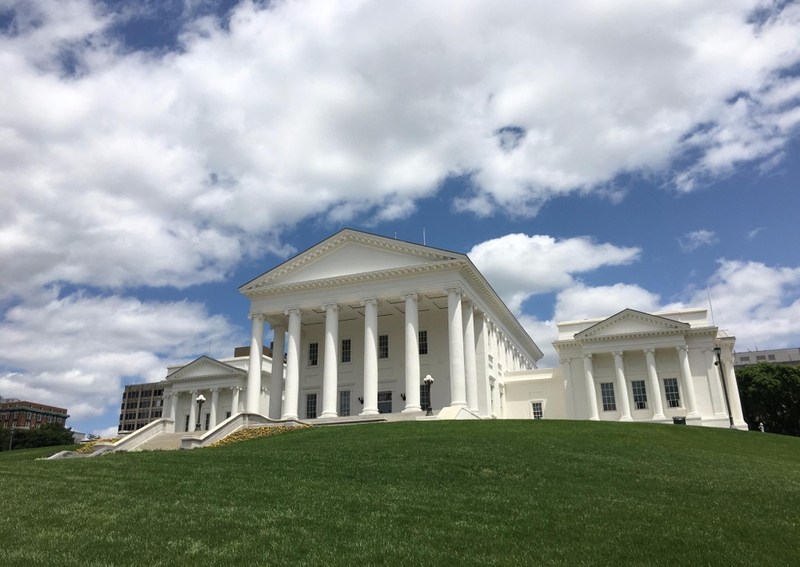
Capitol Square: This pretty park houses several buildings, including the Virginia State Capitol. We walked around the park instead of taking a guided tour, but there are plaques with tidbits of information scattered around. Thomas Jefferson modeled the Capitol building after a classical Roman temple, and it’s said because Jefferson didn’t want any semblance of British architecture. There are also monuments to George Washington, Edgar Allan Poe and more in the park.
Edgar Allan Poe Museum: It seems you can’t visit any city on the East Coast without finding some claim to the poet. Poe was born in Boston, but after his parents died, a foster family ended up raising him in Richmond. Guided tours are $5 for military (vs. the normal $6), and the tour lasts about an hour. There were five of us plus the guide, and that was plenty considering the rooms are pretty small. The guide definitely knew his Poe history, and we learned some interesting facts — something I never knew was that he went to West Point!
Carytown: Someone suggested we check out this neighborhood, and it didn’t disappoint! The streets are lined with cute, colorful houses with porches that make you want to sit out all afternoon and soak up the sun.
There’s definitely more to see in the Richmond area, but this gave us a taste of the city and was a perfect way to spend a Sunday!
— Charlsy Panzino, Military Times editor
GET UP CLOSE AND PERSONAL WITH CONGRESS
U.S. Capitol Building, D.C.
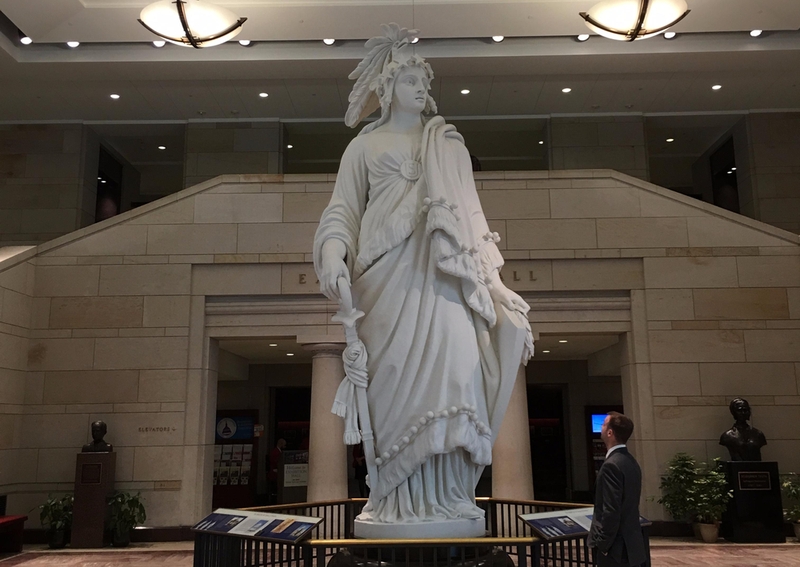
The U.S. Capitol Visitor Center houses a State of Freedom, similar to the one on top of the Capitol dome.
Photo Credit: Jon Anderson/Staff
No trip to D.C. is complete without soaking up some history with a look inside the stately halls, legislative chambers, and, of course, the soaring big dome rotunda of the U.S. Capitol Building. But long lines and gridlocked herds of tourists at the official visitor center can make that feel like way more trouble than it’s worth.
The good news: There are two far easier and, I would argue, even better ways to see it all.
Option 1: Arrange for a tour with one of your representatives.
I did this on a recent work trip, and it was great. I’m from Washington state, and Sen. Maria Cantwell’s office made the whole process easy. The tour started at Cantwell’s office at the nearby Hart Senate Office Building, where I met an intern who would be my guide for the next hour and a half. As it turned out, I was the only person booked on the tour for that day.
This also means you get to take the Capitol Subway, a small trolley system that connects the various satellite office buildings with Capitol Building, which is otherwise largely closed to the general public.
My intern-guide was surprisingly knowledgeable about the Capitol and its history and proved adept at staying one step ahead of the other tours roaming the various sections of the big building.
Option 2: At night, look to the light.
If it’s after dark, look up to the Statue of Freedom at the very top of the Capitol dome. In the columned structure below her feet is something called the Session Light. It’s actually two lights.
A red light means the Senate is in night session. A white light signifies the House is still conducting business.
In either case, the lights also mean the viewing galleries above the respective chambers are open to the public. The last time I did this a few years ago, I breezed through security and into the Senate gallery, where I was otherwise alone in the vast chamber with SNL funnyman-turned-politician Sen. Al Franken, along with maybe a page or two, as he delivered a speech to the C-SPAN cameras.
It was an amazing moment, to be able sit there without the press of crowds and soak up the history of the place even while watching a small slice of history unfold before me.
— Jon Anderson, Military Times editor
COLONIAL FORTS DEFENDED SPAIN’S CLAIM TO FLORIDA
St. Augustine, Florida
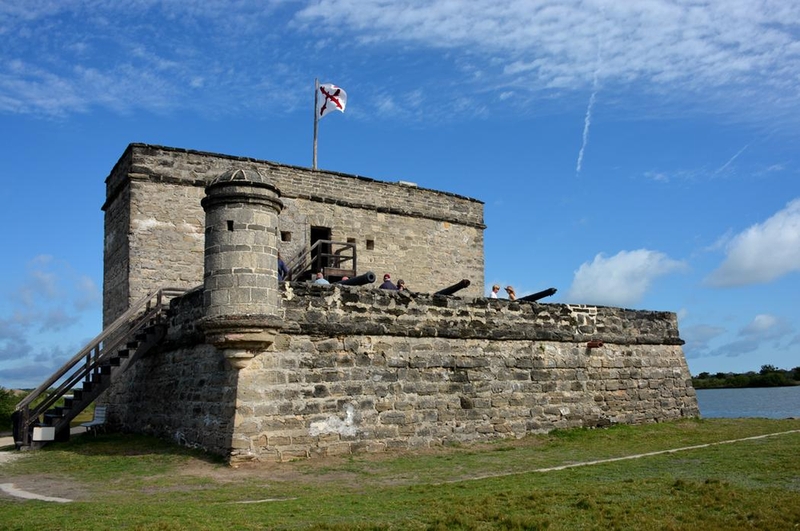
The gun tower at Fort Matanzas helped the Spaniards protect the inlet from enemies.
Photo Credit: Ken Perrotte
Founded in 1565 by Spain as a military outpost, St. Augustine, Florida, is one of America’s most historic cities. For military history enthusiasts, no visit to this incredible destination is complete without stops at two historic forts: Castillo de San Marcos and Fort Matanzas.
Both France and England sparred with Spain over control of Florida. In 1564, not far from where Fort Matanzas was erected on the coastal inlet leading to St. Augustine, Admiral Pedro Menendez de Aviles captured and slaughtered nearly 250 French soldiers marooned there by a storm. From that time forward, the inlet and its river was named Matanzas, Spanish for “slaughters.”
Fast-forward nearly 200 years. South Carolina’s British Colonial Governor James Moore leads a 1702 expedition against St. Augustine and the new Castillo de San Marcos. The English can’t breach the fort, but occupy the town, burning it to the ground when they retreat after 58 days. In 1740, Gen. James Oglethorpe’s British troops from Georgia attack, blockading the inlet. The Spaniards learn the inlet is a key vulnerability and build the gun tower at Fort Matanzas. From there, the fort’s five cannons well covered the inlet and its access. The fort’s gunners drove off an attempted British incursion in 1742 and then never had to fire their guns again.
A most unique feature of both forts is that they are made of a semi-rare form of limestone called coquina. Visits to a coquina quarry near the state park on Anastasia Island help visitors understand how this rock was removed and transported. Coquina is light and porous, seemingly suboptimal for fortifications. But, its composition let cannon balls burrow in without shattering the walls. The National Park Service uses an analogy of a BB sticking in Styrofoam.
Matanzas, on Rattlesnake Island, is accessed by a pontoon boat ferry from Anastasia Island. Trips run about every hour from 9:30 a.m. to 4:30 p.m. A visitor center opens at 9. Rangers give informative guided tours. See www.nps.gov/foma.
Castillo de San Marco is literally just across the street from historic St. Augustine. It’s open every day, except Christmas, from 8:45 a.m. to 4:45 p.m. See www.mps.gov/casa.
Both locations have superb, informative displays about military service, living conditions and more. Living history reenactors routinely perform at Castillo de San Marcos, sometimes issuing the order “Fuego” and firing cannons. Weekdays are least crowded for visits. Free admission for active military and dependents.
— Ken Perrotte, Military Times contributor


