
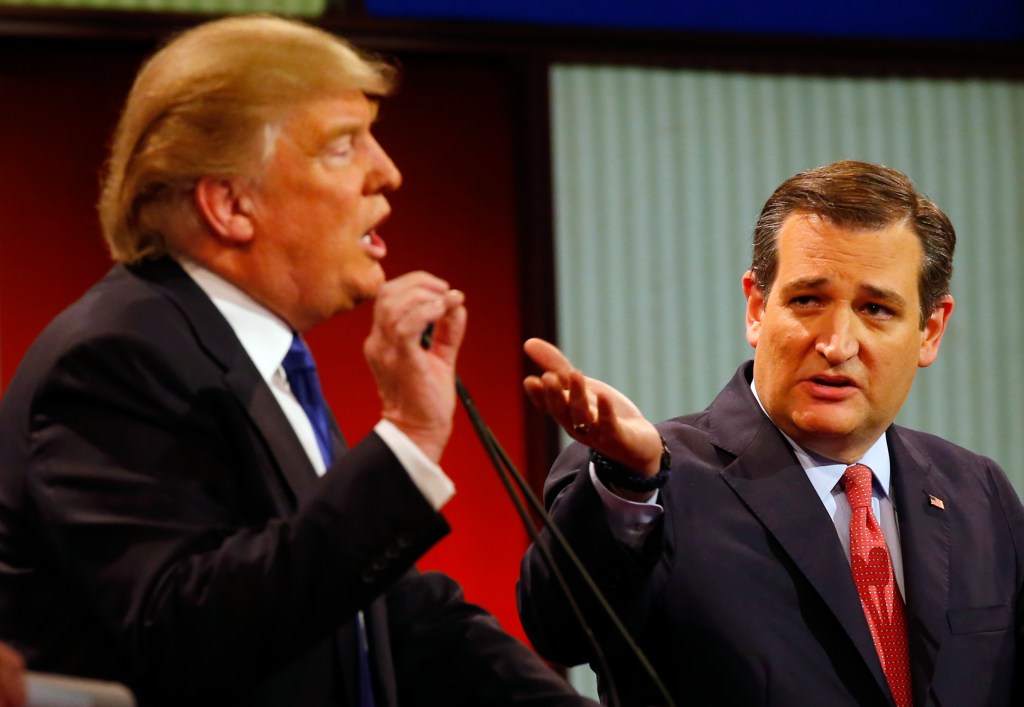
The attacks on Republican presidential frontrunner Donald Trump’s national security plans started hours before Thursday’s 11th GOP debate, with a host of party leaders labeling him unfit to be commander-in-chief.
And they continued into the night, with Trump’s three remaining rivals highlighting his lack of foreign policy experience and Fox News moderators asking whether his policies amounted to potential war crimes for U.S. troops.
Trump, who has won 10 of the first 15 Republican primary contests, used the Detroit event to repeat his promises to more aggressively target Islamic State group militants in the Middle East and strengthen America’s military.
“We are in a very dangerous place,” he said. “We have a depleted military, totally depleted. We’re going to build up our military and get the equipment we want. … I will prove to be a great leader.”
He also reiterated his support of waterboarding and targeting the families of terrorists with military force.
“Can you imagine these people, these animals over in the Middle East, that chop off heads, sitting around talking and seeing that we’re having a hard problem with waterboarding?” he quipped. “We should go for waterboarding and we should go tougher than waterboarding.”
Earlier in the week, former National Security Agency director Michael Hayden suggested troops may disobey orders if Trump becomes president, to avoid committing illegal or immoral actions.
Trump response to that charge: “They won’t refuse. They’re not going to refuse me, believe me.”
Also on Thursday, the last two men to win the Republican presidential nomination both accused Trump of being a disaster on national security.
Mitt Romney, who has not endorsed a candidate in the race, called Trump’s ideas “recklessness in the extreme” and suggested his campaign theatrics may already be making the country less safe.
“Trump’s bombast is already alarming the allies and fueling the enmity of our enemies,” he said. “Insulting all Muslims will keep many of them from fully engaging with us in the urgent fight against ISIS.”
Senate Armed Services Committee Chairman John McCain, R-Ariz., begged Republican voters “to think long and hard about who they want to be our next commander-in-chief and leader of the free world,” calling Trump’s proposals “uninformed and indeed dangerous.”
Trump dismissed both men’s criticisms, and announced shortly thereafter that McCain’s fellow committee member — Sen. Jeff Sessions, R-Ala. — will serve as chairman of his campaign’s national security advisory committee.
But his fellow candidates referenced numerous reports and polls hitting Trump’s lack of working knowledge on those issues.
“You have to have the experience,” said Ohio Gov. John Kasich. “I was there when Ronald Reagan rebuilt the military. I worked with him.”
Kasich also offered potentially the most controversial military statement of the debate, saying that U.S. forces need to be on the ground in countries throughout the Middle East “in significant numbers” to combat ISIS.
Florida Sen. Marco Rubio blasted Trump as not having “the intellectual curiosity or interest in learning about” key security issues. Texas Sen. Ted Cruz questioned whether Trump has the proper temperament to be trusted with control of the military.
Both senators reiterated their promises to build up the armed forces and more aggressively use American military might.
Cruz said that under his leadership, “every militant on the face of the Earth will understand that if they go and join ISIS, if they wage jihad against the United States of America, they are signing their death warrant.”
Four more states — Kansas, Kentucky, Louisiana and Maine — hold primary contests on March 5.
The two remaining Democratic candidates are scheduled to hold their 7th debate on Sunday, and the Republican candidates will spar on the debate state again March 10.
Leo Shane III covers Congress, Veterans Affairs and the White House for Military Times. He can be reached at lshane@militarytimes.com.


