The Navy’s top admiral said he wants to bring deployments down to a seven-month standard — a call that stands in stark contrast to recent deployment lengths.
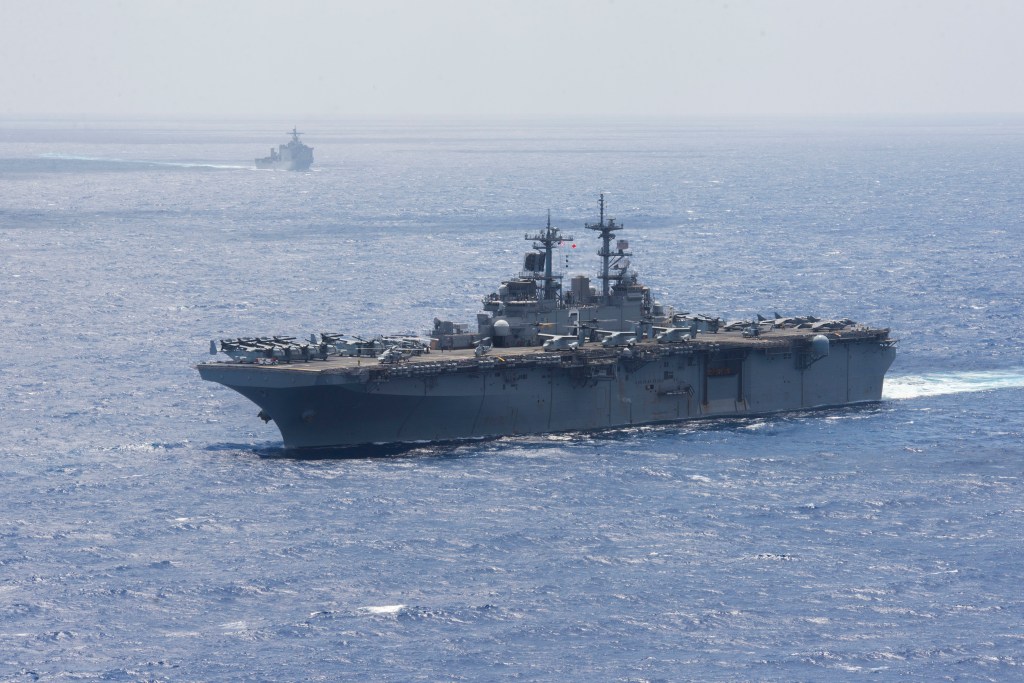
Chief of Naval Operations Adm. Jonathan Greenert made the comments during an all-hands call aboard the amphibious assault ship Kearsarge, which is moored in Norfolk, Virginia, and returned from an eight-month deployment in November. The four-star said lengthy eight-month deployments are no longer sustainable, and seven-month deployments are achievable.
“We can sustain that,” Greneert said. “That’s part of our plan. So, sustaining a carrier with an air wing in the Arabian Gulf, we can do that. And it doesn’t have to include eight- and nine-month deployments. The key is getting that maintenance done on the front end. Getting it done on time. … And that’s part of this plan we call optimizing the Fleet Response Plan that we currently have. Give enough time to do the maintenance, to do the training, certify them, send them on deployment.”
The George H.W. Bush deployed Feb. 15 and has provided the bulk of air strikes and operations against Islamic State militants. Bush was relieved by Carl Vinson in U.S. 5th Fleet on Oct. 18. It will depart the area of operations immediately and head home to Norfolk. Vinson, which set sail on Aug. 23, is expected to deployed for nearly 10 months.
The eight-month Optimized Fleet Response Plan deployment model, which was designed to provide predictability in deployments and yard time, is already off to a bad start. The carrier Harry S. Truman will deploy in the fall of 2015, nearly half a year ahead of schedule, as the Navy tries to fix the carrier Dwight D. Eisenhower. The latter ended a year-long drydock overhaul in late August, but work will continue into February 2015. A 30-percent growth in maintenance as well as shipyard production issues are to blame.
Three key factors threaten any hope of shorter and predictable deployments.
First, the Army and Air Force have a diminishing number of regional forces to address operational requirements in Europe and the Middle East, which places a greater burden on the blue-green team.
A second challenge to shorter and predictable deployments is that many ships are out of the fight as the Navy strives to catch up on long overdue maintenance. That’s a priority for lawmakers on Capitol Hill, and drove the Pentagon’s Feb. 24 decision to place 11 of 22 cruisers and three dock landing ships in a reduced operating status. In addition, the Navy will have eliminated all its frigates by this time next year, which begs the question: Who will cover these missions? Indeed, surge capacity — or lack thereof — is adding to the deployment dilemma. A few years ago, the Navy could muster five carrier strike groups, either deployed or ready to deploy within 30 days. Today that number is down to three. That number will dip to one for a few months next year.
The third challenge centers on funding. The Pentagon must cut $1.3 trillion from defense over 10 years, but has not reduced requirements on the force. Funding to the current strategy is not simply a matter of covering the cost of ships and aircraft that can meet current operations in the Middle East. The defense strategy is centered on the ability to win in one theater and deny objectives in another, and the Pacific still stands as the dominant theater in that strategy.
The Associated Press contributed to this report.