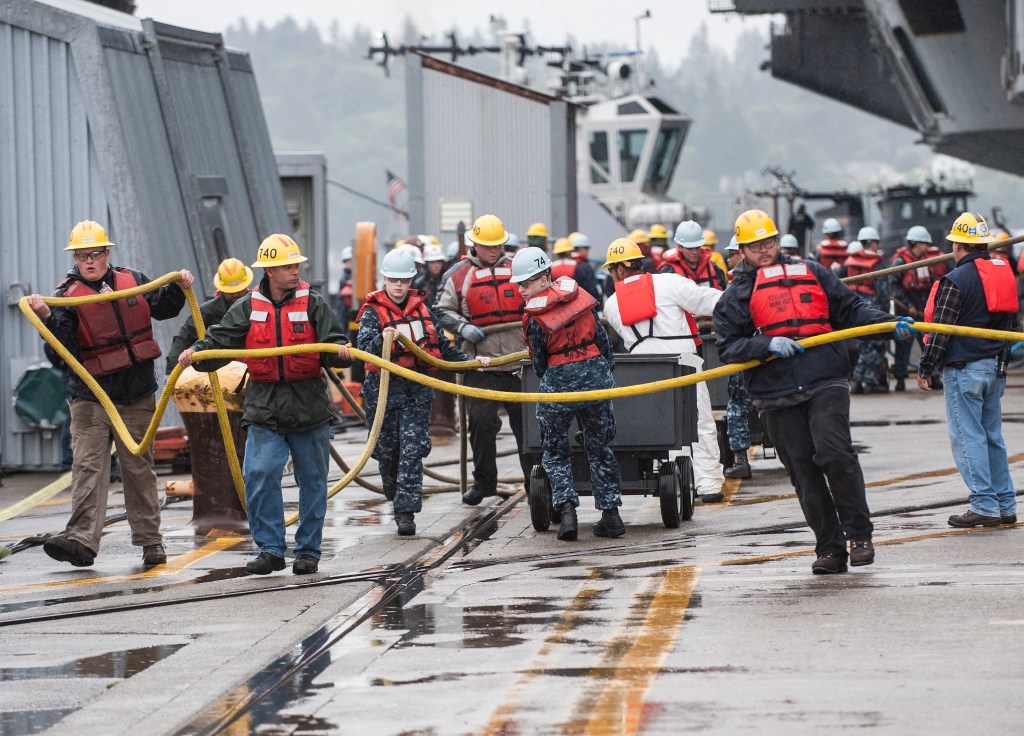
The Navy’s No. 2 officer said she’s concerned for the health of the civilian workforce in the face of looming budget cuts, an ominous signal that could presage more deployment and support uncertainty on the horizon.
Civilians took a big hit in the last round of budget cuts and the continued pressure could drive civilians out of their jobs, Vice Chief of Naval Operations Adm. Michelle Howard said Wednesday at the annual Sea-Air-Space Expo in Maryland.
“If you are furloughed and you’re not getting paid, you still have mortgage responsibility,” Howard said. “As a public servant there is a pride and a patriotism to why you continue to serve. But that angst, that thought that ‘I might not be able to provide for my family,’ might outweigh the more altruistic purpose.”
The Pentagon and lawmakers are at loggerheads over the military spending request, which exceeds mandated budget caps and will trigger an across-the-board sequestration cut unless averted. As with the last round of sequestration, in 2013, the automatic budget cuts this would have ripple effects throughout the force, from personnel moves and support to the as already strained nuclear maintenance facilities would fall farther behind.
Fleet leaders have been adamant that civilian furloughs and work stoppages in the public shipyards directly contributed to the haywire deployment cycles that sent carriers such as the John C. Stennis on back-to-back deployments and pushed deployment lengths to as much as 10 months.
“We have got to tackle this law,” Howard said. “And we have got to get back to maintaining a Navy and provisioning an Army.”
Maintenance on nuclear-powered ships, handled done largely in public shipyards managed by Naval Sea Systems Command, affects the entire fleet because of the carrier strike group construct.
The Navy has a massive civilian workforce, totaling just shy of 200,000 employees.
In January, Naval Reactors boss Adm. John Richardson told reporters that maintenance has a “ricochet” effect in the fleet that directly impacts sailors.
“If you don’t get the maintenance right, then it’s going to affect deployment lengths, and that’s going to kind of ricochet on you because you deploy longer and you need more maintenance,” Richardson said.
Richardson went on to say that the funding for hiring civilian workers to increase capacity at the shipyards has been difficult, but that the trend is in the right direction.
The Navy Department, which includes the Marine Corps, has requested $161 billion for fiscal year 2016. That must be trimmed by $13 billion if, as expected, the budget cuts take effect.
The Navy has already seen a brain drain in civilian workers, according to Chief of Naval Operations he Navy’s top officer, Adm. Jon Greenert. The furloughs and uncertainty, he said, convinced some civilians to leave their shipyard jobs, some out of the yards, Greenert said. told Navy Times in a March interview.
“When we were sequestered, if you will, we stopped doing maintenance on aircraft and ships for a period of time,” Greenert said in a March interview with Navy Times. “We had no overtime in the public shipyards. We were not hiring. We furloughed for a while.” That has had a manifestation of some of our key [to retire]
“Our hiring is not going as fast as we would want. If you do not have the overtime and if you could get furloughed, why would you work?”
The fleet has seen some success in driving down deployment lengths. For example, the withthe Makin Island Amphibious Ready Group returned in March after seven months and its relief, the Iwo Jima ARG, is also slated to return in seven months.
However, more work stoppages and furloughs have the potential to upset the deployment applecart.