
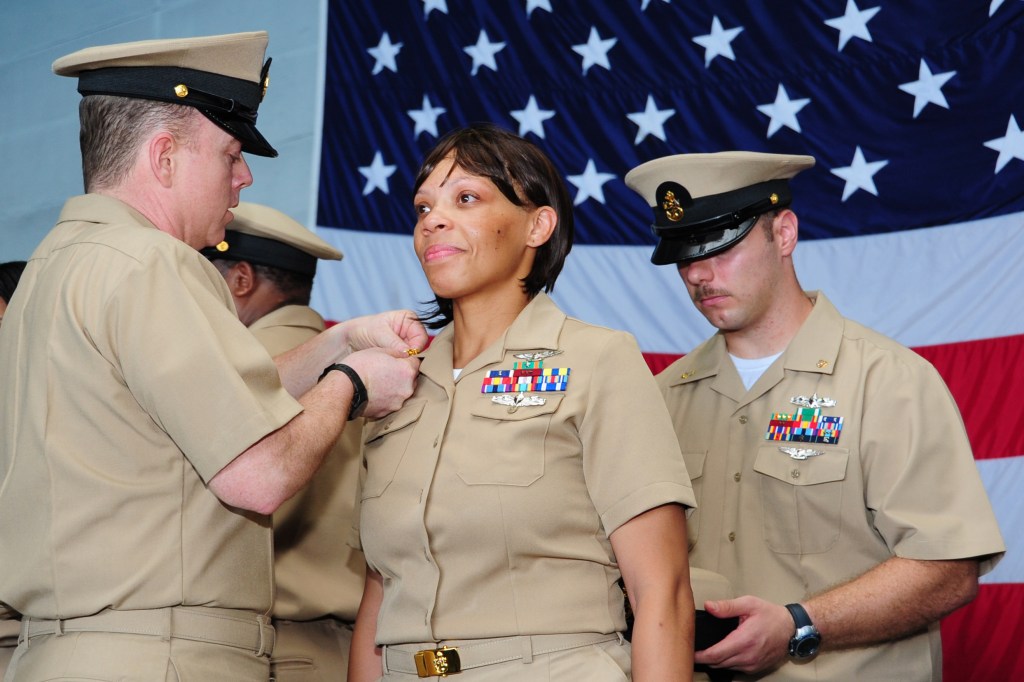
This year’s chief petty officer season has begun. The fiscal 2016 selection board convened Monday in Millington, Tennessee, to review the records of 17,639 first-class petty officers and fill 4,170 quotas offered up by the chief of naval personnel’s manpower planners.
That works out to a 23.64 percent shot at putting on anchors and getting a seat in the Navy’s goat locker this year. Though opportunity has declined each year since fiscal 2014, when 26.66 percent moved up, it’s still the fifth highest opportunity to make chief since fiscal 2007, when 24.61 percent moved up.
The CPO selection board is the Navy’s largest each year and it normally takes board members two to three weeks to sort through the eligibles and decide who gets advanced.
As a result, not all time-in-rate eligible first classes even make the board each year, only the top 60 percent as ranked by their test scores and evaluation marks get a look by the board. The only exception to that rule are those eligible first classes with boots on the ground in a combat zone who get a waiver and head straight to the board each year.
This year, as was the case with last year’s board, every rating will advance at least one first class into the khaki ranks.
This year’s biggest winners are the 24 submarine-qualified first-class logistics specialists, whose rating has 24 quotas and 24 eligible sailors.
On paper, it would appear that advancement is a slam dunk for all these sailors, but officials note that the board doesn’t have to advance all eligibles if they don’t feel someone is ready to be a chief. It’s the second straight year submarine LSs have had as many quotas as eligible sailors.
Some 4,062 first-class petty officers have been selected to join the goat locker in fiscal 2016.
Photo Credit: Staff
Not far behind their supply shipmates, gas turbine systems technicians (electrical) are also enjoying an two-year run of excellent opportunity to make chief petty officer. This year there are 58 eligible first classes being reviewed by the board, and quotas for 47 of them to move up — an advancement opportunity of 81.03 percent. Last year’s opportunity was almost identical, was a statistical dead heat in opportunity as 80.49 percent, as 33 of 41 eligible first classes got anchors.
In the most improved category, two aviation ratings are are seeing exponentially better opportunity this year than during last summer’s board.
Naval aircrewmen (tactical helicopter) is 17th on the list, with a 34.85 percent shot at advancing, up from just 6.67 percent last year. This year’s there’s quotas for 23 of the 66 eligible first classes as compared to
Naval aircrewmen (avionics) as well as saween a meteoric rise in their chance to put on chief’s anchors this year. Last year, just two of 61 eligible sailors advanced, or 3.28 percent. This year that opportunity jumped to an above the Navy-wide average to chance of 26.76 percent, with 71 of 19 moving up.
That advancement opportunity is particularly significant because the rating was hit hard this year by the P-3 Orion to P-8 Poseidon aircraft transition; billets are declining over the next five years in the active force.
Coming in last among the 89 ratings are at the 89th and final slot on the list is the cryptologic technician (interpretive) sailors who specialize in eastern European languages and culture. They’ll oOnly make one out of 22 eligible first classes will make chief, — a 4.55 percent shot at making chief. That’s down from a 36.36 percent chance last year, whenre 8 of 22 got the nod to move up.
A similar, but not to far fall from grace also happened in the machinery repairman rating, where opportunity now sits at 11.67 percent — with seven quotas and 60 eligible sailors competing for seven quotas. This is far below down from last year, whenre 20 of 53 eligibles, or 37.74 percent, joined moved into the goat locker.


