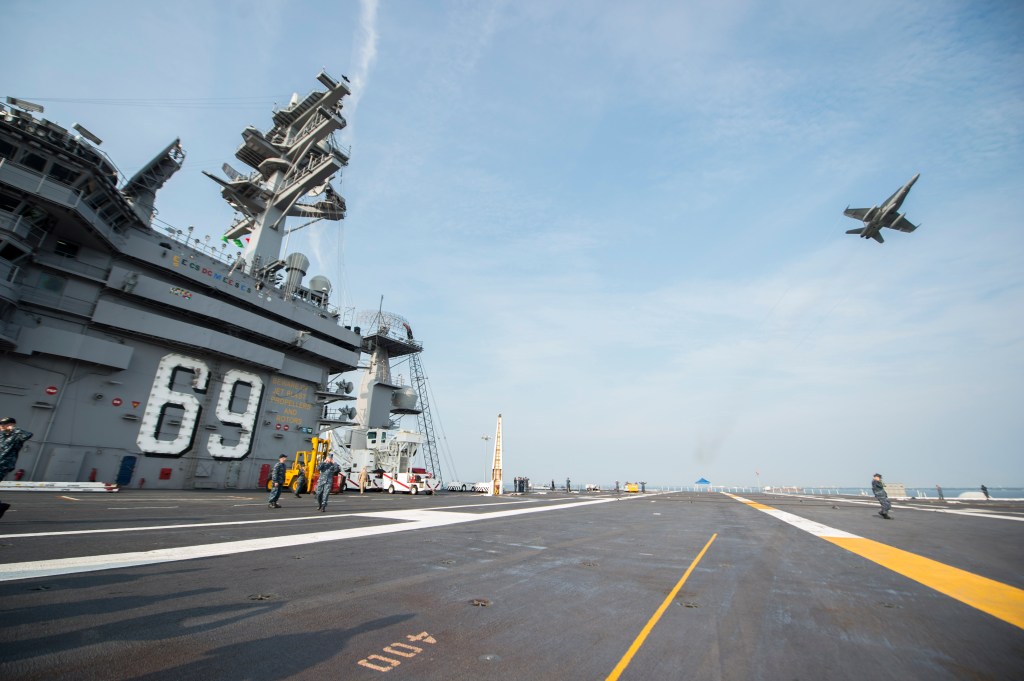
It could be said The aircraft carrier Dwight D. Eisenhower is going went from the frying pan into the fire.
Having survived an unprecedented 23-month dry-docking overhaul, Planned Incremental Availability, the flattop will be the first big deck to go through the new ship will spearhead the Navy’s new Optimized Fleet Response Plan — an effort that will culminate with a deployment next summer. On top of this, the ship will serve as the runway for the F-35C’s next round of at-sea flight tests in October. The 38-year-old flattop will take the point with a new air wing. As the two commands meld in months of work-ups and exercises, the ship in October will throw F-35C flight operations into the mix.
To say the crew has taken these challenges in stride is an understatement. They have amassed a number of awards along the way. These include the 2013 Commander, Naval Air Forces, Atlantic Yellow “E” Award; the 2013 and 2014 Ramage Awards; the 2014 Retention Excellence Award; consecutive Blue “M” Awards; and two consecutive CNO Health Promotion and Wellness Blue “H” Awards with Gold Stars.
Capt. Stephen Koehler, Ike’s commanding officer, credits the chiefs’ mess and department heads for keeping the crew fired up and motivated, despite being extended in the shipyard an when painstaking extensions kept them in the yard an extra 10 months.
Being manned before the ship even begins the training cycle — a new requirement for OFR-P that was a difficult hurdle for manpower officials — allows the crew to start training immediately and to gain competence during the work-up cycle. Manning the carrier early is a special challenge while thousands of fleet billets remain open. a early and on time was also “a huge deal” as it allowed the ship to send sailors to various training events and schools. The ship’s 98-percent manning is a rarity in recent years, but a primary goal of OFRP, which was designed to provide predictability in yard time and shorter deployments.The plussed-up crew allowed the command triad to send sailors on temporary assignments to get the critical, hands-on experience while the carrier was still in the yards, which is needed to be competitive for advancement. that is unavailable in the yard, but desperately needed for advancement.
Their efforts paid off, according to Navy promotion data. While carriers fell far below Navy-wide averages in the spring 2015 cycle for last round of advancements to third and second class petty officers, the Ike kept an even keel. Despite its long yards period, the ship’s advancement for third and second classes kept pace with Navywide average; they even exceeded the Navywide rate for E-6. The ship saw 23.11 percent advance to E-4 (the average for carriers was 24.29, and the Navywide average was 32.59). In addition, 17.24 percent made E-5 (the carrier average was 17.23, and the Navywide average was 22.80). For E-6, Ike saw 18 percent advance, which was below the carrier average of 18.75 percent, but better than the Navywide average of 17.01 percent.
Such rates are not easy during a prolonged yard period. For example, failure rates nearly tripled aboard the decommissioning carrier Enterprise in the past year, which saw 21.74 percent advance to E-4, 15.91 percent make E-5, and 15.17 percent advance to first class. Abraham Lincoln, which earlier this year passed the halfway point of its refueling and complex overhaul, scored lower advancement rates for all the petty officer ranks.saw 21.76 percent advance to E-4, 16.40 percent to E-5, and 16.37 to E-6.
Ike was supposed to come out of the yard in August 2014, but was delayed by shipyard production issues and a 50 percent increase in unforeseen growth in maintenance (mainly in the propulsion plant) that resulted from back-to-back deployments. Officials at Norfolk Naval Shipyard would not comment on the record-setting dry-docking planned incremental availability, which will carry the 38-year-old flattop Ike through its final 12 years of scheduled service.
The carrier received major propulsion plant modernization and repairs. More than 100 tanks, voids and vent plenums were blasted and painted, according to a NNSY release. All shafting and rudders were removed and overhauled, and two sponsons were installed for the Close-In Weapons System. All four catapults were overhauled, and the ship renovated more than 117,000 square feet of spaces that included 25 crew-living compartments and 774 racks. The aft mess decks received a complete overhaul, as did the chiefs mess and forward ward rooms.
The carrier spent the early part of September conducting basic surface operations and deck seamanship and running flight deck and damage control drills.doing what?/sf In an Aug. 31 interview with Navy Times, Koehler said he was “more than pleased” with the testing of equipment and upgrades, and considered it “an awesome opportunity to watch the crew rise to the occasion.” Did he say this in an interview or where?/sf More than 60 percent were at sea for the first time, which was most evident by their smiles as Ike rocked through by the wide eyes and smiles that accompanied high-angle rudder testing at top speeds with maximum rudder deflections.
The 2,000 sailors that comprise Carrier Air Wing 3 got underway aboard Ike on Sept. 4. Though they have worked together for the past five months, Koehler said the two commands are working “cautiously yet efficiently” as the new partners accrue shots and traps. The ship looks to achieve its first flight deck certifications since 2009 in mid-September. This will require 120 daytime and 40 nighttime launch and recoveries amid various emergency drills.
The wing includes the “Fighting Swordsmen” of Strike Fighter Squadron 32, the “Gunslingers” of VFA-105, the “Wildcats” of VFA-131 and the “Sidewinders” of VFA-86; the “Zappers” of Electronic Attack Squadron 130; the “Screwtops” of Carrier Airborne Early Warning Squadron 123 and the “Seahawks” of VAW-126; the “Dusty Dogs” of Helicopter Sea Combat Squadron 7; the “Swamp Foxes” of Helicopter Maritime Strike Squadron (HSM) 74; and the “Rawhides” of Fleet Logistics Support Squadron 40.
Ike’s unexpected delay forced fleet bossesofficials in October to swap Ike with aircraft carrier Harry S. Truman, which will deploy this fall, nearly half a year ahead of schedule. Truman in November entered a shortened availability condensed incremental availabilityat Norfolk Naval Shipyard, the first performed there, to accommodate the switch. In the meantime, the Eisenhower will spend much of the next nine months at sea in preparation for the ship’s 15th deployment.
“Ike has waited a long time to get back to the fleet, as this crew is ready to go do that,” Koehler said.