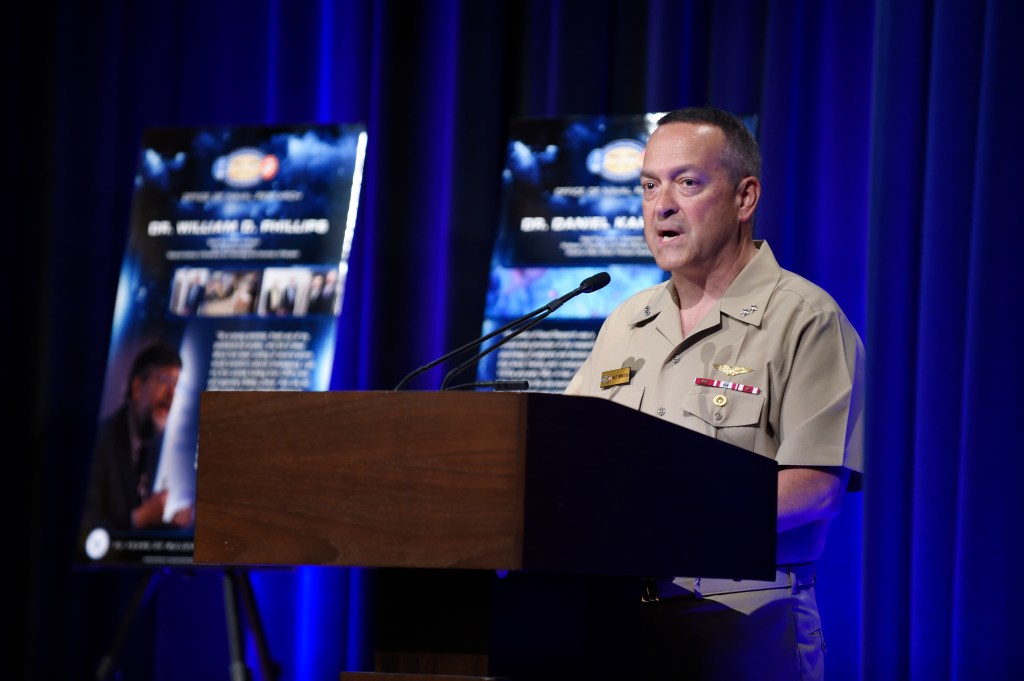
Efficiency, especially in today’s constrained budget environment, is imperative for the military. For one of the Navy’s top researchers, inefficiency is one of the biggest concerns. “What keeps me up at night? Inefficiency,” Rear Adm. Mat Winter, Chief of Naval Research, said at the Center for Strategic and International Studies on July 22.
In his line of work, inefficiency can mean duplicating efforts or working on problems that have been done before, which wastes resources. Winter described how his office — the Office of Naval Research — works across the Defense Department of Defense with other similar entities to coordinate efforts. Strategic Capabilities Office Director “Dr. [William] Roper and I have a very good relationship and we look at where our intersections lie,” he said. The Strategic Capabilities Office specializes in quick, near-term solutions leveraging existing systems in unconventional ways. Winter noted part of his work with Roper is understanding opportunities for mission success within SCO and ONR, though, SCO’s focus is DoD-wide as opposed to ONR, whichthat just concerns only Naval forces.
Winter also works with DoD’s Silicon Valley outpost: the Defense Innovation Unit, Experimental, which was stood up by Defense Secretary Ash Carter in April 2015 to interface and bring in both the talent and innovative ideas from Silicon Valley to solve the department’s critical problems. Carter shook up the office in May 2016, replacing its leader, who will report directly to him.
DIUx 2.0, as it’s now known, will try to become more agile and get projects and capabilities out faster. DIUx’s new director, Raj Shah, has outlined a concept where services and directorates will “come to them with a need, we’ll bring some money, they might match our money, they’ll do a very abbreviated announcement of what they’re interested in … do an operational evaluation [on products], potential deployment in the real-world network, figure out what works best and at the end of it have the documentation that’s going to allow us to do a follow on contract,” David Mihelcic, CTO for the Defense Information Systems Agency, said at a June AFCEA breakfast.
Winter said he had a productive conversation sat down with Shah. “We want to partner with you, we want to be a provider, a performer for DIUx, but we also want to be selfish and ask you to be a performer for us,” Winter said of his exchange. Winter noted he wants DIUx to work for ONR to leverage its inroads, relationships and non–traditional performer base to solve the hardest problems. “I was very encouraged hearing the DIUx team talk about how their commitment to public service and their desire to help solve our hardest problems,” he said.
Solving these complex problems involves defining what they are and the capable performers, Winter added. “DIUx understands to bring performers they will bring those folks that will be part of a team. And that team will be made up of the DIUx performers but also the other government to industry and academia performers that are already working on the other problems,” he said.
While ONR is working toward short-term, quick reaction capabilities, such as swarming, a slide in Winter’s presentation outlined top science and technology priorities. These include directed energy, cyber, electromagnetic maneuver warfare, UxS maneuver warfare and synthetic biology.