
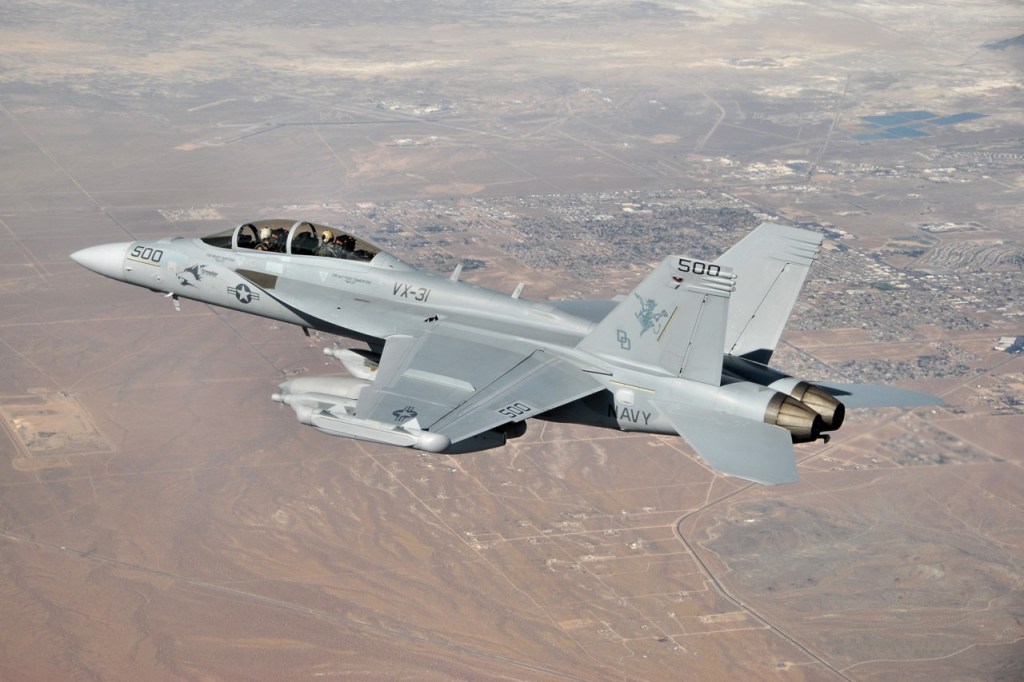
In a notice to Congress this week, the State Department approved a potential sale of military electronic warfare (EW) equipment to Australia.
The State Department made the determination that selling the AEA-18G Electronic Warfare Range System, with a total estimated cost of $115 million, won’t alter the basic military balance in the region.
“The proposed sale will allow continued efforts to improve Australia’s capability in current and future coalition operations. Australia will use the range to enhance Electronic Warfare capabilities as a deterrent to regional threats and to strengthen its homeland defense,” the notice said. “Australia will have no difficulty absorbing these items into its armed forces.”
State’s notice indicated that Australia requested additional funding to a previous delivery for two EW range systems used to conduct EW and electronic surveillance training within its borders. The renewed contract covers additional costs in support elements, integration testing, tools, equipment and personnel, among others. Leidos will be working on the hardware aspects of the contract while General Dynamics will focus on the software, State’s notice said.
While Russia is known for its advanced jamming and EW capabilities, China has also bolstered their prowess in this area.
“China is improving information and operational security to protect its own information infrastructure, and is also developing Electronic Warfare (EW) and other information warfare (IW) capabilities, including denial and deception,” the U.S. Department of Defense’s 2015 annual report to Congress on the military and security developments of China read. “China’s ‘information blockade’ likely envisions employment of military and non-military instruments of state power across the battlespace, including in cyberspace and space. China’s investments in advanced EW systems, counterspace weapons, and cyberspace operations — combined with more traditional forms of control historically associated with the [People’s Liberation Army] PLA and [Chinese Communist Party] CPC systems, such as propaganda and denial through opacity — reflect the emphasis and priority China’s leaders place on building capability for information advantage.”
This sale also tracks with recent cooperation with the South Koreans, considered a major U.S. ally, to develop interoperability in spectrum sharing. Spectrum sharing and management tools are a critical capability in understanding situational awareness within a maneuver space that cannot be seen by the human eye.
The lack of U.S. spectrum managers’ situational understanding of spectrum requirements for coalition partners in the same area of operation led to the need to increase interoperability and situational understanding, the Army said of its partnership with South Korea.
“This sale will contribute to the foreign policy and national security of the United States by helping to improve the security of a major contributor to political stability, security, and economic development in the Western Pacific,” State’s notice said. “It is vital to the U.S. national interest to assist our ally in developing and maintaining a strong and ready self-defense capability. By enabling Australian Defense Force (ADF) ranges, the U.S. Government will ensure consistency in training across platforms and theaters, whether the exercises are conducted in the United State or in Australia, where U.S. aircrews will be able to participate in training exercises alongside their Australian counterparts.”


