
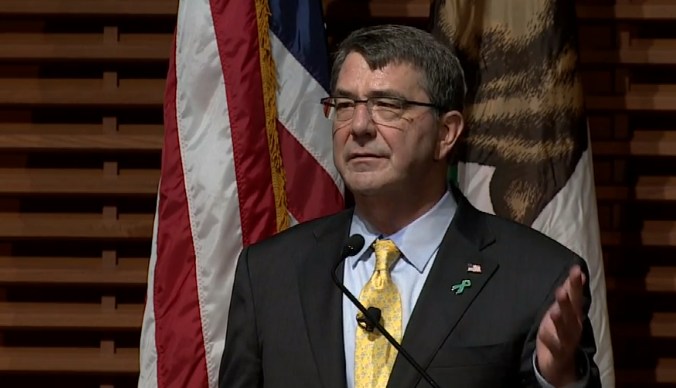
In a lecture at Stanford University on April 23, Defense Secretary Ash Carter formally unveiled a new cyber strategy, emphasizing innovation and partnership with Silicon Valley in combating growing cyber threats.
The new strategy includes a multi-prong approach to developing and launching the Defense Department’s cyber offenses and defenses. But in the California speech Carter focused on cooperation with the private technology sector – a relationship he acknowledged to be chilly at times, particularly in the wake of Edward Snowden’s revelations of government surveillance.
“Looking out over the last 75 years, we’ve had a long history of partnership. Sometimes the bonds between the academy, industry, and defense were particularly close…like during World War II, when the Manhattan Project and the MIT Radiation Lab brought together our brightest minds, and the best of industry cranked out the ships, planes, tanks and bombs that won the war,” Carter said. “At times, we also eyed each other warily – like when Bobby Inman faced off against Martin Hellman and Whit Diffie over public-key encryption and commercialization; during the controversy over the Clipper chip in the ’90s; and, more recently, after the actions of Edward Snowden…but I believe we must renew the bonds of trust and rebuild the bridge between the Pentagon and Silicon Valley.”
The push for renewed ties includes initiatives like the Defense Innovation Unit X – the X standing for ‘experimental’ – a “DoD point of partnership” to be located in Silicon Valley and staffed with elite tech talent from active-duty military, civilian personnel and members of the Reserves.
“They will strengthen existing relationships and build new ones; help scout for breakthrough an emerging technologies; and function as a local interface node for the rest of the department,” Carter said.
Pentagon leaders also will build out other exchanges of talent and ideas with the private sector, including a DoD branch of the U.S. Digital Service that helped fix healthcare.gov, as well as an expansion of the Secretary of Defense Corporate Fellows Program. The program sends military personnel to work at commercial IT companies, but “we don’t effectively harness what they’ve learned when they come back,” Carter said.
To that end, the Pentagon will expand the program to a two-year arrangement, one year on each side, he said.
“It’s important that we at the Pentagon find new ways to help bring in new people with the talent and expertise we need, and who want to contribute to our mission as part of our force of the future, even if it’s just for a time or for a project,” Carter said.
Taking a cue from the intelligence community, Carter also announced a pilot program working with CIA-backed venture capital firm In-Q-Tel “to provide innovative solutions to our most challenging problems,” he said.
“We will make a small investment with In-Q-Tel in order to leverage their existing proven relationships and apply their approach to DoD,” Carter said.
Despite DoD’s obvious connections to the intelligence community – particularly the National Security Agency, ground zero for the Snowden revelations – Carter pledged transparency, even revealing that an unclassified legacy DoD network was breached by Russian hackers earlier this year.
“Shining a bright light on such intrusions can eventually benefit us all – government and businesses alike,” Carter said.
The secretary also noted that there’s skin in the game for Silicon Valley too, including a path to potentially lucrative Pentagon contracts and a gratifying sense of mission and duty.
“We have really exciting problems that we work on and challenge people. We have some of the most exciting problems you can have in technology, and they’re consequential. They matter,” Carter said. “They have to do with our protection, our security and creating a world where people can live their lives, dream their dreams and give their children a better future.”


