As part of a sweeping, end-to-end review by the Army CIO/G6, the service’s signal corps are facing a hard look at the skills, requirements and military operational specialties (MOSes) that comprise the corps.
The review, which started back in December, is happening as the Army looks to streamline and sharpen its forces dedicated to cyber operations. Already, integration between signal and cyber are happening in the schoolhouses and at Fort Gordon, Georgia, home to the 7th Signal Command, the Army Cyber Center of Excellence and eventually Army Cyber Command.
As that integration gains momentum, Army leaders are looking at the best ways to bring the organizations together while still focusing on each side’s core competencies.
“What gave us the capability to do this is when the Army Operating Concept was released last October – so that helped us start to frame the problem,” said MG Stephen Fogarty, commander of the Army Cyber Center of Excellence and Fort Gordon. “The [Army Chief of Staff] gave us pretty specific guidance on what he expects our tactical forces to be able to do. It talked about the requirement to establish a home station mission command center, [and] the requirement to be able to deploy very robust [teams] that would allow a commander forward to leverage analysts and staff back in the United Staff and around the world to help them. What that does is reduce the footprint.”
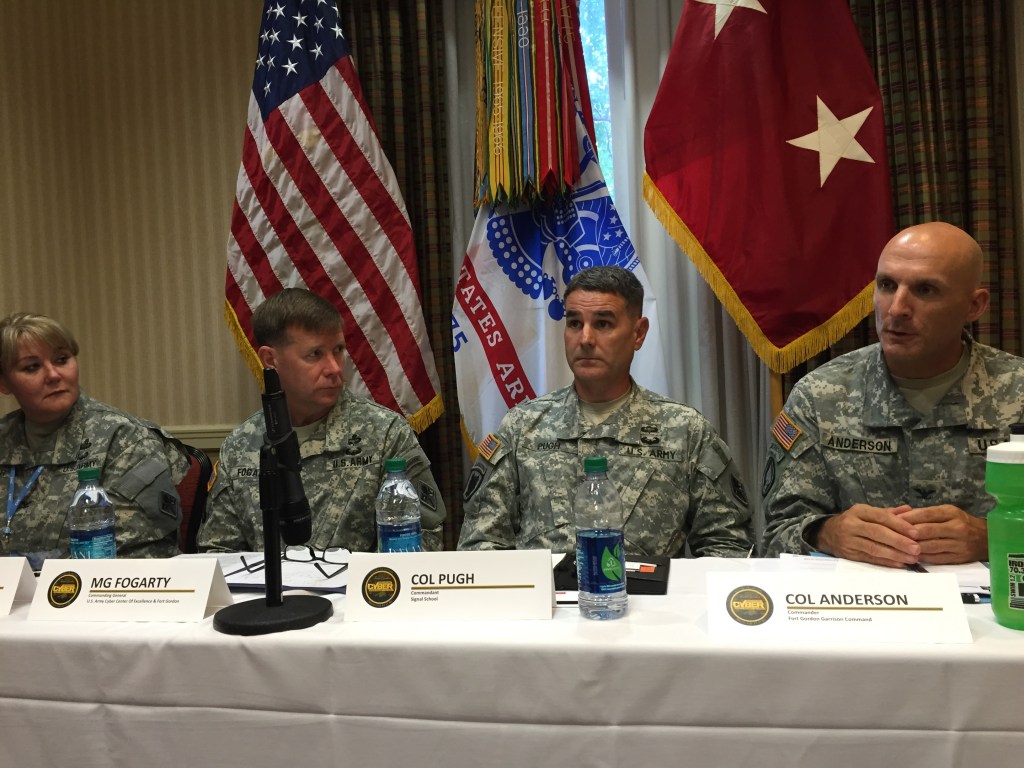
Fogarty spoke to reporters at the AFCEA TechNet Augusta conference in Augusta, Georgia, on Aug. 26.
Another driving factor in the review has been the Army’s installation of Joint Regional Security Stacks and multi-protocol lever switches, Fogarty said, both significant upgrades to existing Army IT infrastructure designed to modernize cyber operations and link to the Joint Information Environment.
“That’s really caused us to take a look at the organizational structure to make sure we optimize the organizational structure, the equipment in those organizations and…the workforce demand for those organizations,” he said.
Don’t expect a total merger of the signal and cyber groups and personnel just yet – but also don’t be surprised if the 17 MOSes between the two areas are pared down to a more streamlined and integrated set of specializations.
“I think we’ve come to the conclusion that there was a period of time where having 17 specific MOSes, each one having a very specific name, that probably made sense,” Fogarty said. “As we look to the future, based on models we’ve seen in the special operations forces, we think we can combine some of those skills. So you have a soldier who has much more versatility…someone who has a broader understanding of the requirements and the skill set, and we can move that very rapidly to where the requirement is.”