
The insider threat is never going to go away.
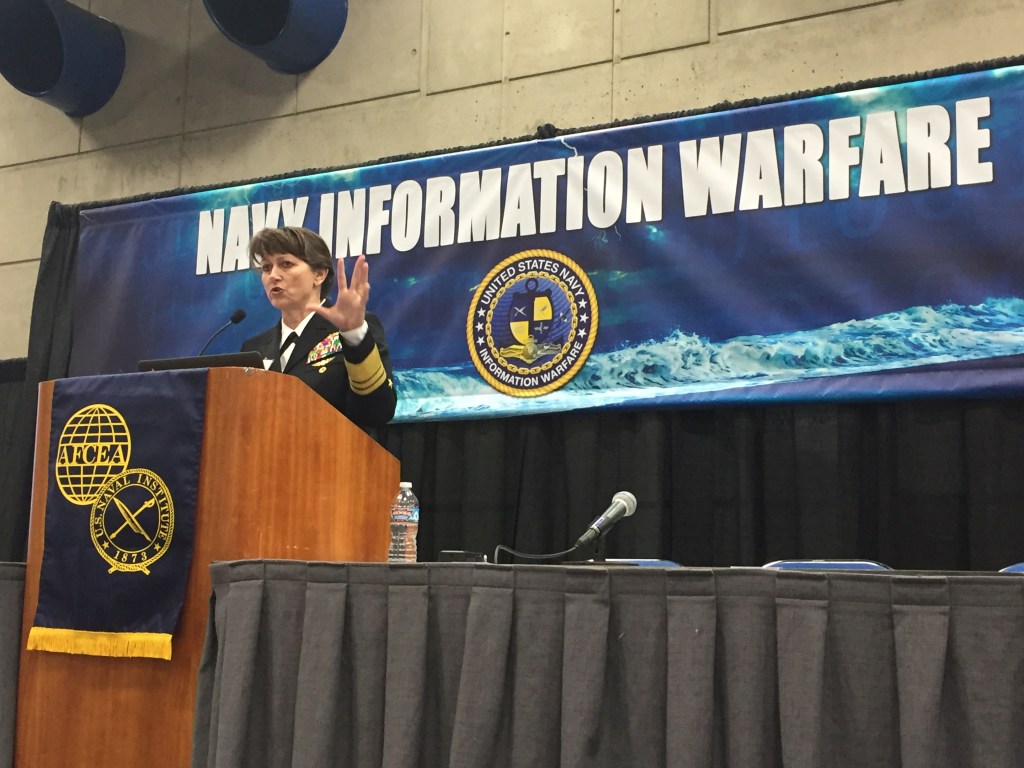
This statement, echoed by many in government and directly by Vice Adm. Jan Tighe, deputy chief of naval operations for information warfare and director of naval intelligence, is a recognition that the insider threat problem is virtually impossible to defend against.
“The dirty little secret, especially concerning the insider threat, is that the Navy was already working towards some solution in that regard before Snowden,” Tighe said in a luncheon keynote address on Dec. 7 at the C5ISR Summit in Charleston, South Carolina, regarding the trove of leaked documents from former government contractor Edward Snowden.
Tighe said the Navy was working a few initiatives on its own — though on a much smaller scale than the governmentwide, post-Snowden purge — that started down a path with a checklist of things the service could do to improve on the insider threat problem.
As the Snowden fallout became more clear, the whole of government started focusing on what technologies and alternative tactics can be used inside of the government to address the very real threat of future insiders, said Tighe.
One thing the government discovered, she explained, goes to the often duplicitous nature of cyberspace — many tools can be dual use. “In a lot of cases, the types of technologies that we would need to recognize anomalous behavior inside of our networks by a legitimate government employee is the same types of technology that would help us recognize bad guys that are coming in posing as legitimate users inside of our networks,” she said. There’s a natural nexus between the cybersecurity protections that we want to institute, or that we are instituting inside of our networks, and the insider threat detection.
In general cybersecurity terms, Tighe noted that the Navy is on a positive glide path, but it’s not quite there yet. “Our cybersecurity vector — and I said vector, not where we are today, but vector — is a bright spot for Navy, but we have new and evolving information innovation that needs to be baked in the way we do business and deliver capability in the future,” she said.
Part of getting to a better place involves ensuring security is baked in from the beginning of systems — not bolted on — and
adopting more of a resiliency approach to cyber as opposed to pure protection.


