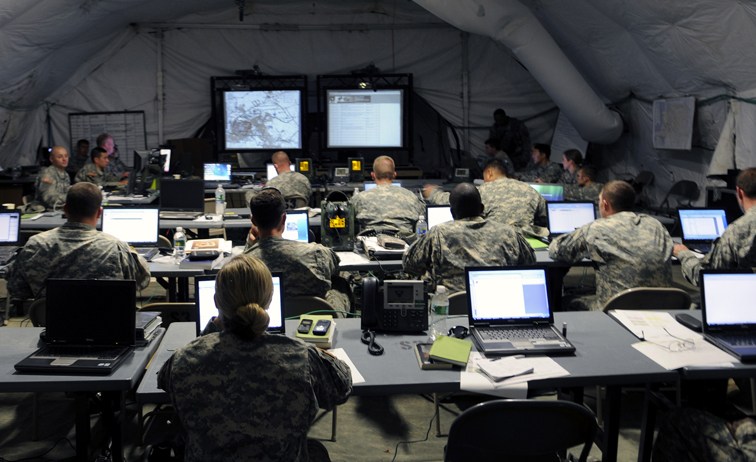
For much of the military, the intense counterterrorism, counterinsurgency (COIN) and high-value target fight is all many know given the prolonged operations in Afghanistan and Iraq over the past 15 years. This has forced many of the services to make adjustments in order to continue global supremacy in a complex environment involving both non-state and highly advanced nation-state actors.
For the Army, this means being ready and prepared for a wide variety of intelligence collection. With the addition of a near-peer fight potentially on the horizon as well as the continued counterterrorism (CT) fight, “for the intelligence work we’re going to have to do it all,” Annette Redmond, the director of Army Intelligence Community Information Management and the service’s intelligence chief information officer, said at a Sept. 16 luncheon hosted by the Armed Forces Communications and Electronics Association’s Northern Virginia chapter. “We have to be prepared with a mix of capabilities that will enable us to support a myriad of threats.” Those capabilities include multi-int sensor support and cyber operations, among others.
The advent of the cyber domain is “changing the continuum that we have focused on for the last 13 years. The Army’s been in a COIN/CT fight for about 15 years. We are now started to figure out: OK, what’s the next step as we are looking at near-peer adversaries?” she said.
Part of the effort involves maturing existing capabilities to laser in on a multitude of threats and actors. “We need to mature [the Distributed Common Ground System-Army],” she said. Maturing this capability might mean tailoring the capability to certain units.
“Maturing it might mean … we’ve created … [an] extraordinary capability but sort of done it in a one-size-fits-all, no matter what echelon you’re in,” she said. “Do we really need all those applications down at the battalion level? At the brigade level? Maybe we need to pair those down so that in that … environment they only need those critical applications, making it less cumbersome, making it easier to use for those that are operating at the speed of war.”
Another effort the Army is undertaking is a study to examine what the force needs to do better going forward and adjust to what Defense Secretary Ash Carter describes as a full-spectrum fight.
“We’re going to take a hard look at what is it that we actually need to strip out, where do we need to go and how can we do this better,” Redmond said of the study the Army is commissioning. “A lot of our millennials are asking us for iPhone-easy applications. Well, I mean we are talking about targeting and killing people, it’s a little different than figuring out your route via Waze. But we are looking at … both the skills that are required and the capabilities that are required within the programs of record and the capabilities that we are delivering.”
There’s a good, hard look at “if we have to go back to Europe because our friends in Russia — what kinds of capabilities do we need to bring that might be a little different than what we currently have,” she added.
Following her remarks, she declined to offer details regarding the individual components of the study, telling C4ISRNET that it has not been fully contracted yet.
“The overview I’ve given you is just the synopsis. We’ve just gotten the money aligned, they’re just moving it, so you’ll be hearing more,” she said, adding: “We used end-of-year money. … The end of the study is supposed to be December and January this year.”
Army turning toward full spectrum fight