Scientists from the Naval Research Laboratory (NRL) Information Technology Division have developed a new high-speed, full-duplex line-of-sight data link technology.
According to DoD blog “Armed With Science,” The Tactical Reachback Extended Communications (TREC) system provides high data rate transmission over long ranges. Originally developed to operate between airborne assets and a ground station, the TREC system was recently operated successfully in several ship-to-shore demonstrations.
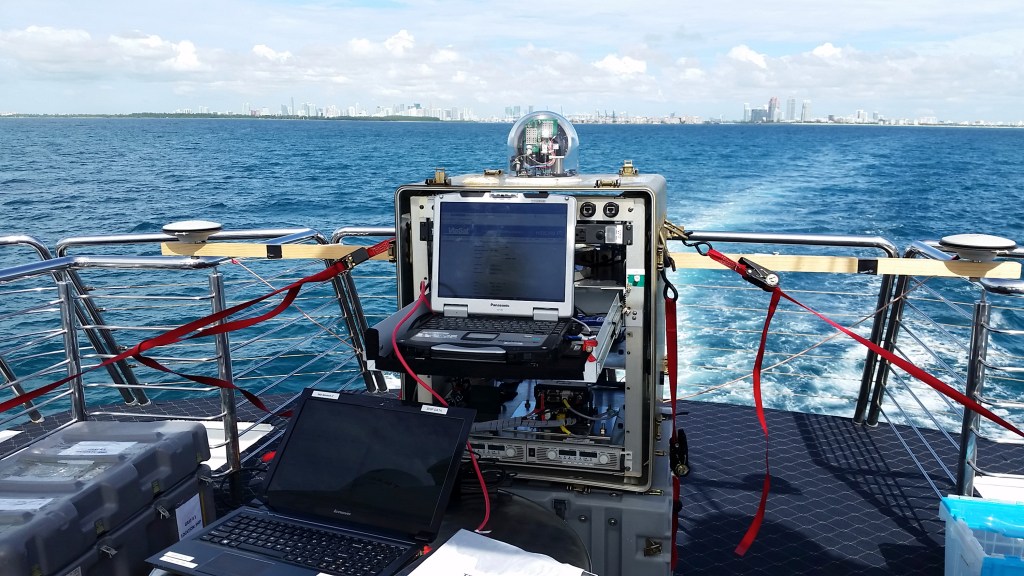
Testing the system as part of a cooperative research and development agreement with Mercury Continuity and Intelligent Designs LLC, the five-person NRL team deployed the TREC assembly on a Norwegian Cruise Line ship in the Port of Miami. Connecting to a node on top of a 760-foot-tall building near the harbor, the TREC terminals achieved data rates of 720 Mbps nearfield, while remaining stable at 100 Mbps out to ~16 nautical miles.
Multipath effects were observed, but the tracking of the directional antennas on ship and shore compensated to maintain consistent signal level and the trial runs helped identify performance-degrading blockages found in common harbor situations. TREC had previously met threshold benchmarks for performance (300 Mbps at 50 nautical miles), weight (less than 12 lbs.) and power draw (less than 57W).
The now-proven technology will be integrated within Navy and DoD programs, as well as commercial configurations.
“Beyond the relatively niche sector servicing commercial cruise lines and yachts, there is a substantially broader base of government and civilian customers who have long been eager for a wireless communications solution with ‘TREC-like’ capabilities,” said Adam Jaffe, CEO of Mercury Continuity, on “Armed With Science.”