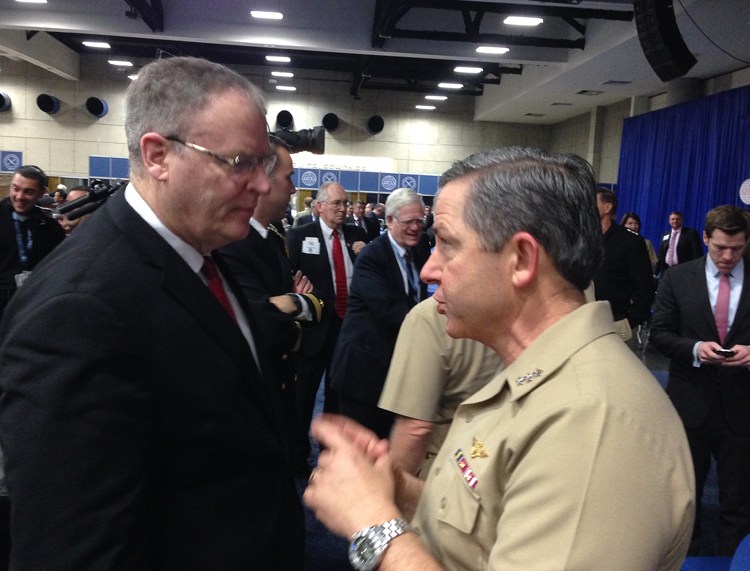
San Diego—The president’s just-released defense budget request for FY16 is a strategy-driven document designed to meet the nation’s strategic military goals. Unless Congress undoes sequestration, however, the security of the U.S. will be dependent on a resource-driven budget that threatens readiness and modernization.
That’s the word from Deputy Secretary of Defense Robert Work, the opening keynote speaker at the West 2015 conference/exhibition in San Diego, who noted that the proposed $585 FY16 budget request ($534 billion base budget plus $51 billion in overseas contingency operations) is $36 billion above the FY16 sequestration cap.
C4ISR & Networks will bring ongoing coverage of the event from open to close. Check this page for regular updates, and look for special daily e-newsletters highlighting each day’s coverage.
“We’re not asking for a force increase,” said Work. “We believe that is what we need to execute the strategy.”
That strategy means to maintain the balance between personnel, readiness and modernization by addressing five areas: proper troop levels, maintaining commitment to allies in Europe and the Middle East, engaging in a global fight against terrorists, supporting alliances and maintaining modernization of hardware and systems.
He described that as “extremely challenging,” and ” any reduction in funding below the president’s request is going to cause problems and risks” that would make executing the strategy become “unmanageable.”
That would also seriously impact the DoD’s ability to respond to evolving events such as Russian destabilization in Ukraine, the movement of ISIL out of northeast Syria into Iraq, the Ebola outbreak in West Africa and major cyber attacks such as the one against Sony late last year.
Incidents like those force the Pentagon to act on the fly and reverse some planned decisions that would have saved money in areas such as intelligence, surveillance and reconnaissance, for example.
“We had a bet that we could draw down permission ISR (in Afghanistan),” said Work. “But those CAPS (combat air patrols) have shifted to Iraq and Syria (because of ISIL).”
Add on sequestration going back to FY13, and the U.S. armed forces would be severely taxed by new and unforeseen challenges. Said Work: “Forward forces are locked and cocked. But the surge force is not as ready as it has been in the past. There’s no doubt about it; it’s a problem of time and money.”
Work also took Congress to task by refusing to act on DoD recommendations that would reduce the need for some funding. Work cited the need for additional base closings and realignment across the military, something that Congress has refused to address.