San Diego — Cybersecurity is not being integrated into risk awareness, according to a top Coast Guard officer who spoke at West 2015.
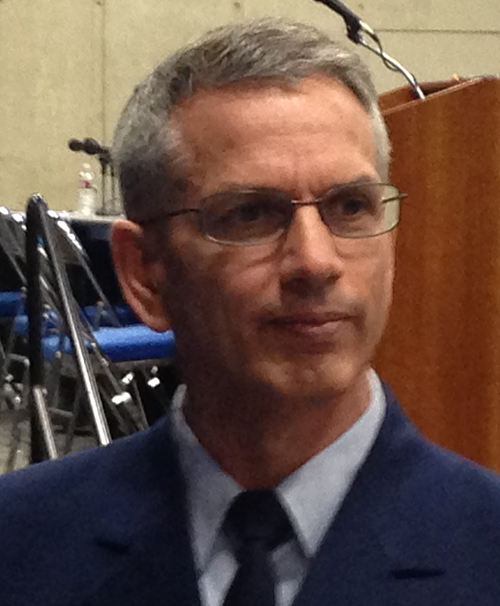
When a cutter crew prepares to disembark, he said, they will take an inventory of the food and fuel aboard the vessel and check on the status of people and machines, said RADM Marshall Lytle, the assistant commandant for the Coast Guard’s Command, Control, Communications, Computers and Information Technology (C4IT) Service Center and commander of the Coast Guard Cyber Command.
But “there’s no box for what’s the cyber risk assessment.”
Click here for all of our coverage of West 2015.
Lytle spoke as a part of a panel at the conference on the topic of networks as a key warfighter advantage, moderated by Marine Corps LtGen Robert Shea (ret.), who is now president and CEO of AFCEA International.
A similar lack of progress is happening in situational awareness, said MajGen Lawrence Nicholson, commanding general of the 1st Marine Division.
Nicholson told the audience that when he was a young Marine lieutenant, troops on helicopters were largely in the dark about what was going on outside.
“You were just hopeful that that pilot would put you in the right (landing zone),” he said. “It’s now 2015. Guess what? Not a whole lot has changed since.”
A new program called Digital Interoperability now under development might finally change that. The system uses a closed Secret Internet Protocol Router connection to allow collaboration, discussion and information-sharing.
VADM Ted Branch,deputy chief of naval operations for information dominance, took a 20,000-foot view of the security issue. “We said for a while now every platform a sensor and every sensor is a network, and that’s where we need to be for Information Age warfare to be effective,” he said.
Such a network enables battlespace awareness and integrated firing. But before any of that can happen, Branch noted, the U.S. military needs assured command and control “to enable that network to, in fact, work – and that’s the hard spot in most of these endeavors, and [it] gets even harder in a denied, degraded and limited bandwidth environment.”
Branch noted that Task Force Cyber Awakening is looking for strategies to deal with operations in a degraded communications environment.
In the meantime, he cited successes with the transition to Next Generation Enterprise Network (NGEN), installation of the CANES shipboard tactical network (a challenge, made all the more so because ships need to be made available for port-side work to take place) and the path to the Joint Information Environment-Joint Regional Security Stack (JIE-JRSS).
He also called the Naval Integrated Fire Control–Counter Air capability “the wave of the future.”