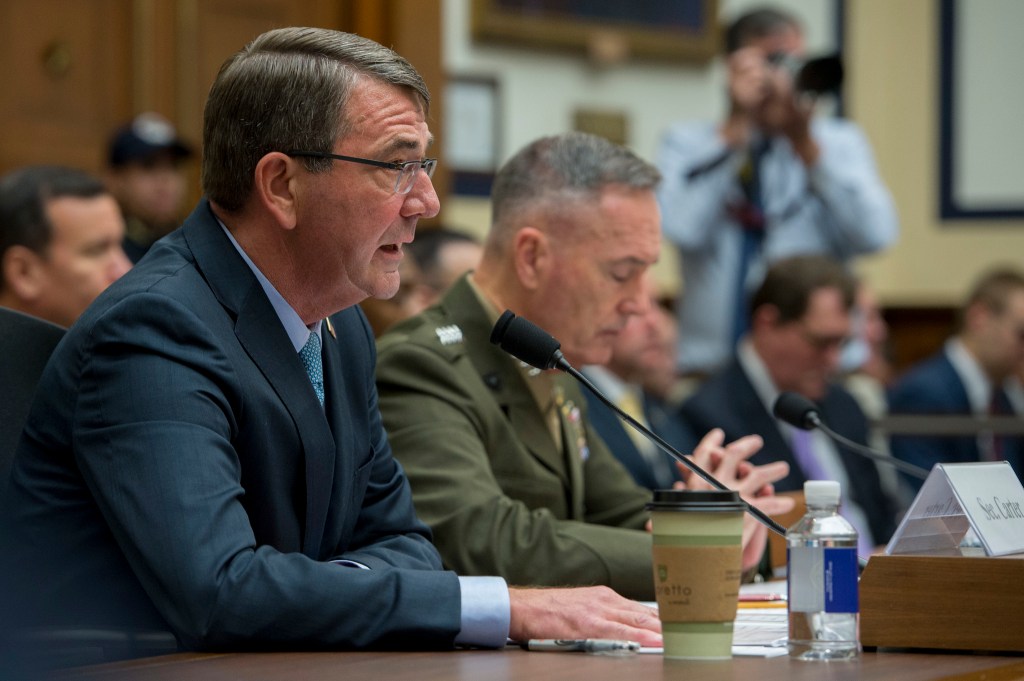
Defense Secretary Ash Carter didn’t mince words in front of the Senate Armed Services Committee Dec. 9, admonishing lawmakers that by prolonging the confirmation process for key Pentagon positions, they are making it harder for the military to combat threats from the Islamic State group, also known as ISIL or ISIS.
“I have appeared before this committee, as noted, six times over the last 10 months, four times on the Middle East and twice in just the last six weeks on ISIL,” Carter said, noting that only three of the committee’s 58 hearings last year were to confirm civilian Defense Department leaders. “DoD currently has 16 nominees awaiting [confirmation, and] 12 of the 16 are still awaiting even a hearing, including our nominees to be secretary of the Army, the undersecretaries of each of our three military departments, Army, Navy and Air Force, and the undersecretaries of both intelligence and personnel and readiness. These positions should be filled by confirmed nominees, especially in a time of conflict.”
The committee did, later that day, hold hearings for four such nominees, including Marcel Lettre, nominated to be undersecretary for intelligence; Gabriel Camarillo, nominated as assistant secretary of Air Force for manpower and reserve affairs; Vice Adm. Kurt Tidd, nominated as commander of U.S. Southern Command; and John Sparks, nominated as a judge on the armed services court of appeals.
Prior to that, the committee had held hearings only for major military positions, including the Joint Chiefs of Staff and the Army chief of staff.
Earlier in the spring, SASC Chairman Sen. John McCain, (R-Ariz.,) said that he would hold up the nomination process as “payback” for the Obama administration pushing through nominees via the so-called “nuclear option” that bypasses the traditional hearing and voting process, and also for changing confirmation rules.
“I told [them], ‘You jam them through, it’s going to be a long time before I approve of them,’” McCain told reporters in April, recounting what he told Democrats after they changed the rules in 2013 and confirmed dozens of lifetime judicial appointments and several high-profile Cabinet nominees, according to Politico. “It’s affected me as chairman of the Armed Services Committee.”
Carter acknowledged that some progress is being made on the Hill, but several key nominations remain unconfirmed, including the nomination of Eric Fanning as Army secretary and that of Adam Szubin as the Treasury Department’s undersecretary for terrorism and financial crimes.
“I think and hope and pray Republicans might be realizing their stalling national security nominations puts our country at risk and they are finally feeling the pressure to reverse course,” Sen. Chuck Schumer, (D-N.Y.,) said on a recent conference call, according to published reports. “People like Adam Szubin, Eric Fanning and many others should be engaged in the fight against ISIS, not fighting to get a vote in the Senate to get confirmed.”