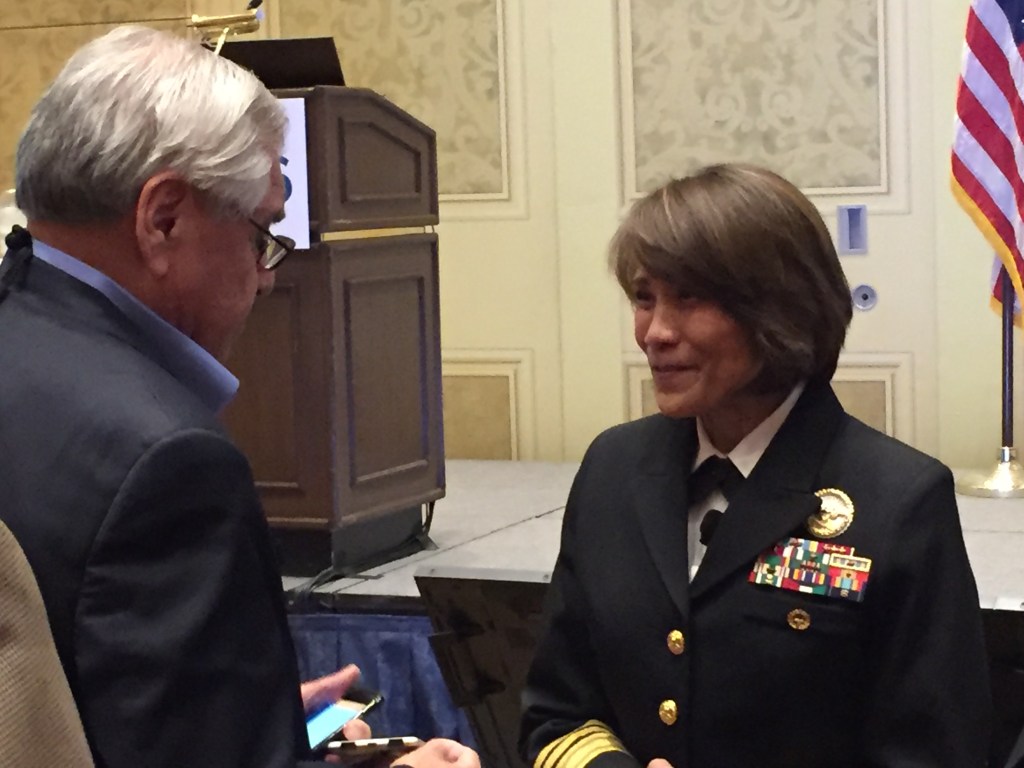
Raquel Bono knows what it’s like to be a patient frustrated by a fractured health records system.
Speaking at the 2016 HIMSS conference in Las Vegas, the vice admiral and head of the Defense Health Agency—the Department of Defense’s nearly three-year-old health care system—once developed a minor health condition during a six-month time of heavy travel for her then job as commander of a U.S. Naval hospital.
She said she saw several doctors in multiple locations, including a hospital in Jacksonville, Florida, and a couple of urgent care centers, updating each of her symptoms, history and medications she was taking.
“So I get to the D.C. area, and I go in to see a provider,” she said. “I was telling the provider my history. And the provider said to me, ‘Well, I don’t see any of this in your record.’ I said that I faxed my information from the urgent care center so they could include it in my record. She said, ‘Well, I don’t see it.”
What bothered Bono the most? “That the provider didn’t believe me.”
Bono said the experience helped inform DHA’s design and development of the Defense Healthcare Management Systems Modernization, its system for handling electronic health records.
The DHMSM system was designed to not only help the free flow of patient data across multiple health care technologies, but also to answer the growing shift in health care to give patients more control of their data and more of a voice in their care.
“The big thing is there has to be more shared decision making in health care,” Bono said. “It’s no longer your doctor telling you what the solution is. It’s you participating with not only one health care provider, but multiple health care providers.
To build that, Bono said DHA applied the design thinking principles used in Silicon Valley to build a health care system centered on the user. Inspired by tales of Apple’s development of the iPhone as a device designed around what users wanted, Bono said DHA held “immersive interviews” with patients to get deeper insights into what their health care experience was and what they would like it to be.
Those conversations, more than 2,000 data points, informed DHA on how to design DHMSM in its innovation lab.
DHMSM is rolling out test sites in the Pacific Northwest by the end of the year, but Bono said projects like the Joint Legacy Viewer that will allow patient files to be shared with the VA’s VistA system are “incredible” in terms how they’re developed.
But if the HIMSS conference has shown the vice admiral anything, it’s that there is no one silver bullet to interoperability and electronic health care, whether it’s DHMSM, VistA or the private sector.
“One of the things I have concluded in looking at the breadth and diversity of the exhibits that are out here is, No. 1, there is not a single solution that’s going to be out there,” she said. “[Health care is] too broad. There are too many things there, and to try and simplify it down to one single pathway is not necessarily the answer. It means a whole host of diverse solutions.
“The only way those diverse solutions can work is if there is some way to bring them to interface with each other and create that interoperability.”