
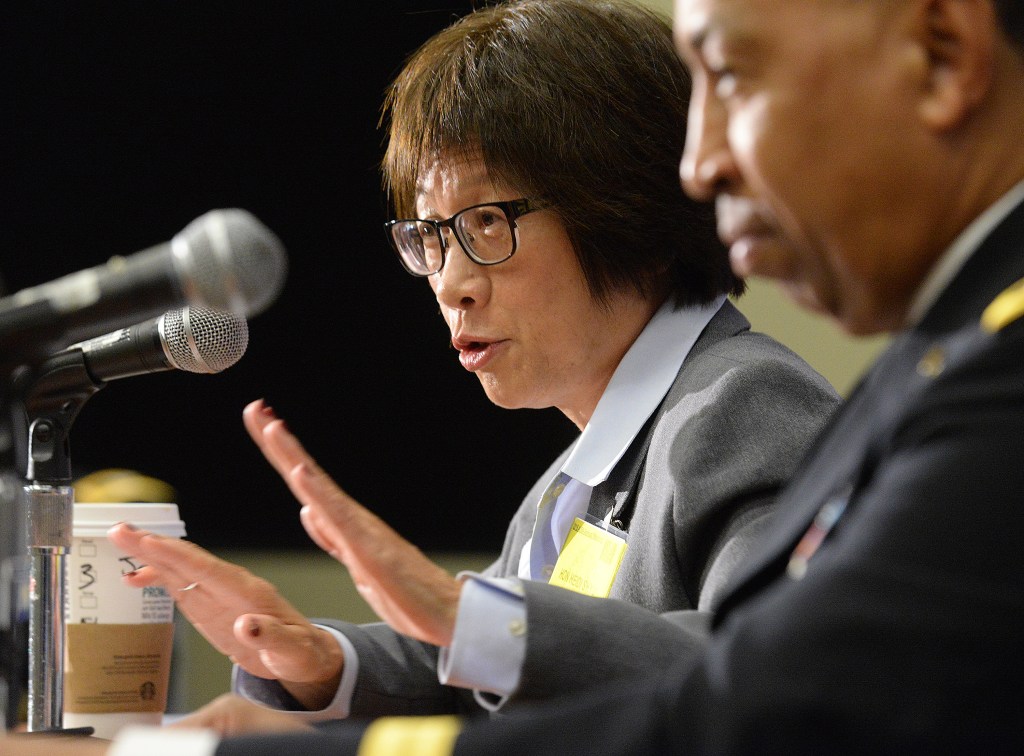
At the close of the second day of this week’s AUSA meeting, aA panel of military and civilian experts convened to field questions about the present and future state of military acquisitions at the Associated of the U.S. Army annual meeting in Washington, D.C.
While discussion ranged widely, a common theme emerged: The military is challenged by, and working to gets its arms around, a highly complex acquisitions situation. Or perhaps not so complex: What it comes down too essentially is money (never enough) and the pace of technological advancement (very fast).
Even as the military tries to keep abreast of evolving solutions, it also is faced with what one panelist called a “Rubik’s Cube” of needs to be addressed. There are “multiple dilemmas, multiple time periods, multiple adversaries,” said MG John Wharton, commanding general of the US Army Research, Development and Engineering Command.
Part of the solution lies in thinking over a very long term, said Heidi Shyu, assistant secretary of the Army for acquisitions, logistics and technology. She noted that for the past two years representatives of all the program executive offices (PEOs) have met quarterly to produce a rolling road map for the next 10 years’ acquisitions strategies.
Industry representatives meanwhile said they could help to resolve these long-term challenges, for instance through the ongoing development of a truly global market in communications systems. “We think that the DoD — and the Army in particular — can really benefit by harnessing the power of that commercial market,” said Dana Mehnert, Harris Corp.’s chief global development officer and senior vice president, Harris Corp.
Panelists also engaged in some spirited discussion about the challenge of developing an acquisitions process that is responsive to change, without being too ready to shift gears. Shyu suggested the system has shifted requirements too often, leaving industry off balance. Left in a state of “whiplash,” she said, industry is “constantly trying to hit a moving target.”
One way to balance the scales might be through acquisitions incentives, suggested Pierre Chao, founding partner of Renaissance Strategic Advisors. This means not just positive incentives for performance, but also the removal of negative incentives.
Internally, for example, purchasing officers who stay within budget often get penalized by seeing their savings funneled off to others who’ve exceeded gone over budget. That’s a negative incentive for performance, and such trends need to be removed both internally and externally, he said.
On another front, the panel considered issues that arise at the intersection of acquisitions and testing. It may be time to seek out a means to accelerate testing and hasten adoption, said Mike Jones, vice presidentVP and general manager of communications and navigation products for Rockwell Collins Government Services.
Shyu acknowledged the testing process can be redundant, with military labs reproducing results already verified by suppliers. She also noted that there are philosophical issues that slow adoption of new tools.
Anytime a product fails a test, for whatever reason, “it instantly gets scrutinized by every level imaginable,” she said, comparing this to Silicon Valley’s approach, in which failures are seen as positive increments toward success. The result is a bureaucratic bog down. “We’ve become risk averse. Every time you fail there are new laws being written, new reports you have to write.”
This leads to an overarching issue within military acquisition, that being the sheer weightiness of the thing. Shyu talked about signing off on documents that have already been reviewed by 17 other executives, most of whom had nothing new to add.
Visit our AUSA 2015 Show Reporter for complete event coverage.


