Westeros is beset by spies. And no, it’s not Varys’ “little birds,” unless those birds have secretly been robots this whole time.
As HBO’s fictional grimdark “Game of Thrones” universe heads toward an apocalyptic finale, keeping the exact machinations of the writers and actors requires powers beyond those of dragons or the old gods. In a recent interview, cast member Sophie Turner (aka Sansa Stark) revealed that set security includes counter-drone capabilities.
From Vulture:
Given how little the Wall did against something that could fly (spoilers!) it’s probably not old magic that’s at work here. So what might HBO be employing?
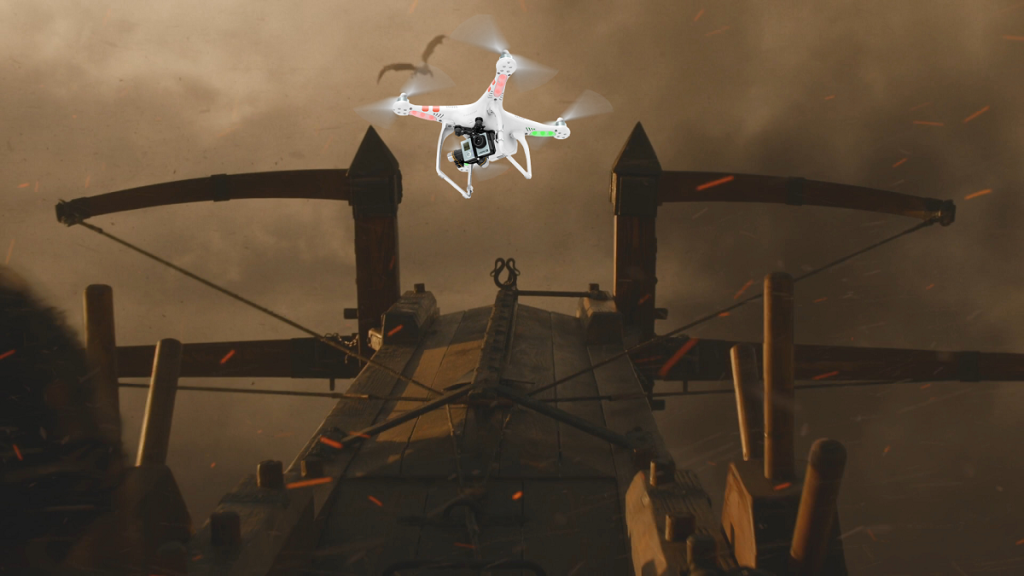
With the widespread availability of cheap and useful camera drones, there’s been an accompanying expansion of counter-drone systems designed to keep those same drones from filming. The Department of Defense is set to spend more in 2019 on stopping drones than it ever has before, and that’s even after cutting funding for a freaking laser. There are over 235 counter-drone systems on the market, though only few of them work as described by Turner.
In a survey of the industry by the Center for the Study of the Drone at Bard University, 67 were capable of both detection and interdiction. Narrowing down interdiction method is a bit tricky, since two contradictory effects are described. The first, “shoot down” implies nets, lasers, or some form of projectile that physically interferes with the drone — some kind of kinetic effect, like the fire that spits from Drogon’s mouth. That doesn’t match well with the other way Turner described the counter-drone tool.
Creating a field that makes the drones drop is more likely the work of a jammer that works on either radio frequency or global positioning satellite signal receivers, or a combination of the two. Spoofing, the non-projectile, non-jamming form of drone interdiction, works by feeding the drone new directional information and directing that drone elsewhere, which doesn’t quite match a drone flying into a jammed area and then dropping.
Ruling out projectiles, nets, spoofing and lasers, that leaves at least 47 counter-drone systems on the market that match the capabilities Turner describes.
If narrowing down the specific counter-drone technology is tricky, finding the company that likely uses it is at least a little easier. In November 2016, security contractor G4S Solutions spoke about the challenges drones pose to sets of “Game of Thrones.” At the time, G4S did not provide a specific example of technology it used to stop drones. By December 2017, speakers from G4S were leading workshops on using counter-drone technology at a conference in London, based on “real life experience about the different threats posed by drones.” The workshop billing also emphasized that it would be “delivered by global specialists on how counter-drone solutions can be incorporated into security solutions correctly.”
G4S did not immediately respond to a request for comment.
With filming wrapped, the mystery of which counter-drone system guarded the Seven Kingdoms will likely remain. Even in a land beset by terrifying beasts and armies of the dead, it seems keeping secrets means controlling the electromagnetic spectrum.