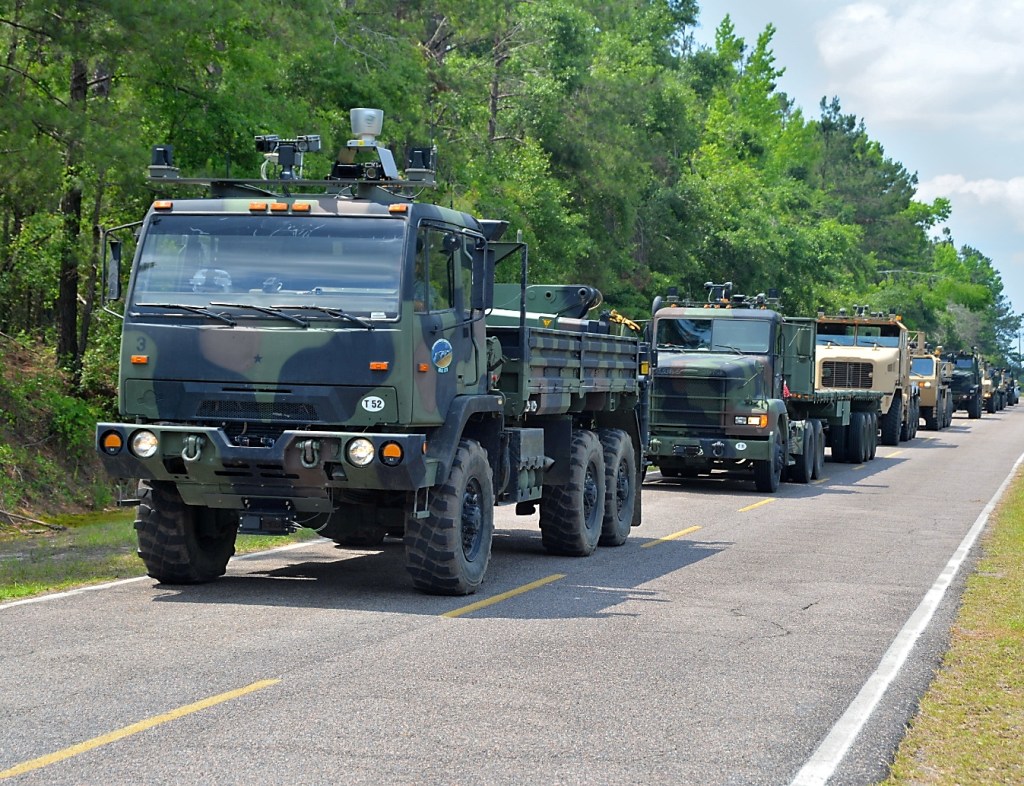
The Army wants unmanned ground vehicles that can be loaded and unloaded by other unmanned vehicles.
“My vision is for Army vehicles to have scalable autonomous capabilities,” said Matt Donohue, the Army’s science and technology ground maneuver technology portfolio director for the Assistant Secretary of the Army for Acquisition, Logistics and Technology.
“For Army tactical vehicles, this means scalable autonomy from leader-follower to fully autonomous capable, including the ability to be loaded and unloaded by autonomous material handling equipment,” Donohue said in an article in Army Technology Magazine[http://www.army.mil/article/137718/Army_focuses_on_autonomous_system_development].
Many advanced technologies have already been developed by the private sector. “For certain mission sets, most of the technologies we need for autonomous ground systems are mature and, in some cases, are being offered commercially by the automotive industry,” Donohue said. “These include the sensors and cameras used to enable active safety in vehicles, such as self-parking cars, blind spot detection, lane departure warning and lane keeping, backup cameras, adaptive cruise control and active braking.”
However, autonomy has limits when it comes to weaponry. “Armed robots may be technically feasible, but policy, legal and safety concerns may limit the Army’s ability to deploy armed robots in tactical roles,” Donohue said.
As evidence that the Army is serious about unmanned ground vehicles, Donohue pointed to a $23 million annual budget for robotic ground applications. “Robotics and autonomous systems have shown promise for many years,” he said. “With shrinking budgets and a potentially shrinking force structure, I think now is the time for autonomous ground systems, if done correctly, to make it into the force.”