
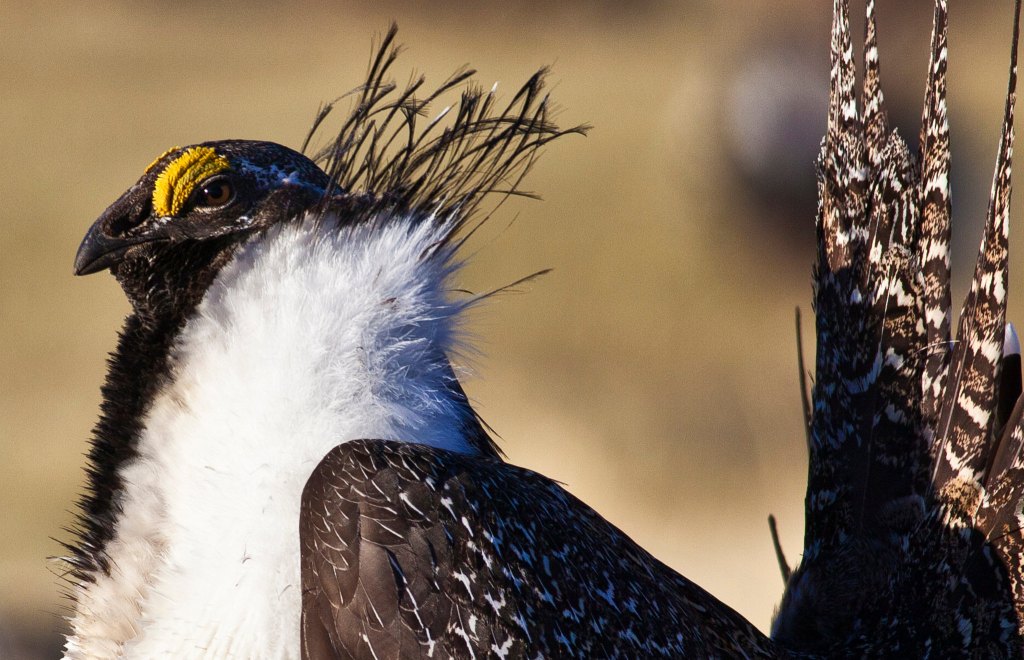
Now that the famous American bird is once again at the center of a kerfuffle over multibillion-dollar defense legislation, as we report in this issue, let’s pause for a moment and consider one teachable moment out of the feathery affair: National security is not just about the tracks of tanks or the wings of airplanes. Its circuitous paths can sometimes lead to a bird’s nest in the wilderness of Wyoming.
Who would have thought that the complexities involving the sage grouse’s protection-worthiness, oil and gas business interests, cattle-grazing rights, election-year politicking and – supposedly – military training would come to a head at such an unfortunate moment?
If nothing else, the episode illustrates that the old, limited understanding of what constitutes national security – namely, one characterized strictly by military elements – is insufficient. And in many cases, the logic connecting seemingly non-defense-related domains to America’s security is infinitely less torturous than that of the sage-grouse debate.
America’s adversaries have recognized that non-military competition is a viable avenue for challenging international order, but politicians must catch up.
There are many examples.
Consider that the Office of Personnel Management, while arguably a non-defense entity at first glance, last year experienced an unprecedented cyber theft of data belonging to civil servants, some of which have potentially very sensitive job descriptions in the national-security field.
The episode was a wake-up call exposing not only technical deficiencies, but also second-order ramifications on America’s security posture that, like the sage grouse, were not intuitively clear.
It doesn’t take much imagination to recognize that, say, public education also is a key ingredient in the security mix. With all else becoming more and more equal on the geopolitical stage – access to technology, for example, or economic output – the currency of an educated populace becomes invaluable in outsmarting one’s opponents.
The same could be said for politics itself. A Congress so divided that decision-making has become impossible is an impediment to national security. A Trump presidency, given the dangerous talk about anything from NATO responsibilities to nuclear weapons, also qualifies as such.
Unfortunately, an expanded vision of what constitutes national security is shared by lawmakers only as it is convenient.
As the argument continues on Capitol Hill over budget cuts and the right proportionality between the old-school view of defense spending – read: military spending — versus funding for critical civilian functions, GOP lawmakers routinely admonish Pentagon leaders for even giving the appearance of going to the budgetary bat for non-military causes.
A more whole-of-government approach to keeping America safe, while touted by everyone, remains a faraway goal.
As for the sage grouse, Republican leaders on the congressional committees with jurisdiction of the military find themselves in the unenviable position of seeing their party’s leadership block the fiscal 2017 military-policy bill over a cause they believe to be a red herring.
Senate Armed Services Committee Chairman John McCain, R-Ariz., told Defense News’ Joe Gould that the commanding officers of bases already can “train and go where they want” in the regions that the sage grouse calls home.
And defense officials, in letters to Congress earlier this year, pretty much made the same argument, telling lawmakers that the department’s environmental obligations to the sage grouse have no bearing on military training even under stricter protection requirements for the bird.
Wherever one falls on the question of whether the creature belongs in the defense bill, there is now a high-profile precedent in the annals of Washington policymaking of how Centrocercus urophasianus made its way into the security debate.
It’s a start.


