WASHINGTON – The US Senate on Friday passed, 89-11, a massive Defense Department policy bill, sending to President Barack Obama a bill crafted in secret that would clear the military to spend $559.2 billion in fiscal 2015.
In a bipartisan vote, the chamber easily approved a compromise version of the 2015 National Defense Authorization Act (NDAA) that includes $495.5 billion in base funding and $63.7 billion in war funding. The House approved the same measure last week.
The measure had to be negotiated behind closed doors after a Senate Armed Services Committee-passed version stalled on the north side of the Capitol. The compromise version keeps alive the Air Force’s A-10 fleet and green-lights the president’s plan to train and arm vetted Syrian rebels, among other things.
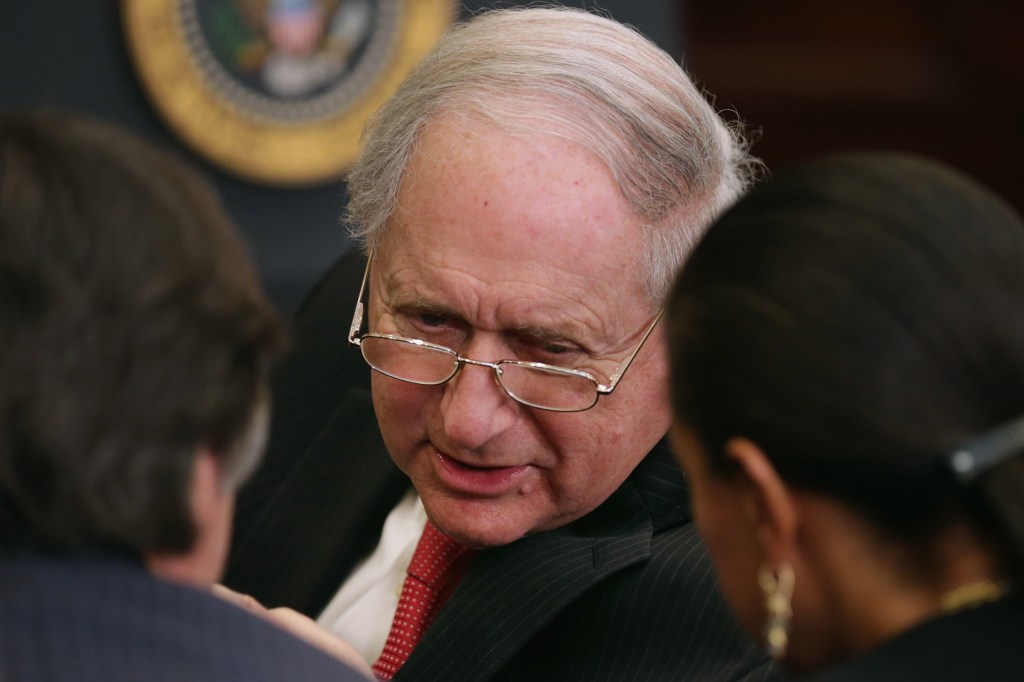
Sen. Carl Levin, D-Mich., in a statement about the bill, which passed the chambers with no amendments allowed, said it “provides for our nation’s defense and upholds our obligations to our men and women in uniform and their families.”
“It provides funding to train and equip Syrian ground forces to take on [the Islamic State],” Levin said. “And this compromise bill, at the request of the Joint Chiefs of Staff, takes the first, needed steps in the area of benefits reform in order to help protect the readiness of our forces to carry out their missions.”
The measure is named for Levin and House Armed Services Committee Chairman Buck McKeon, R-Calif. Both are retiring at the end of this legislative session.
The Air Force had proposed retiring its A-10 attack plane fleet to save billions over the jets’ remaining life. But lawmakers rejected the idea immediately, with many saying, among other arguments, the planes are needed now in Iraq.
The final NDAA includes “a prohibition on flying hours” for the A-10, a senior aide told reporters Dec. 2. “We preserved the option for some relief” due to Air Force concerns with language in the Senate bill, he added.
The compromise language, once signed by the president, will add $350 million so the Air Force could fund A-10 operations and maintenance efforts, the aides said.
“If they don’t need all of it, we have report language that they reprogram it to higher priorities,” a senior Senate aide said. “So some money could become available.”
As with other weapon programs, the compromise measure proposes only a one-year plan for the A-10 fleet.
On Navy cruisers, the measure would allow the sea service to “stand down two” ships in 2015. But it says nothing about what the service might be allowed to do in 2016 and beyond, the aides said.
The bill also would authorize the Navy to buy three littoral combat ships, while approving incremental funding for LPD-28, an amphibious transport ship.
The negotiators waded into testy waters over an Army plan to shrink its force and shift Apache helicopters from the National Guard to the active force.
The final NDAA includes a “prohibition on helicopter retirements in 2015” with a hybrid of House and Senate language designed to hold off on a final verdict of the service’s plans until two panels have weighed in. One will be a Government Accountability Office (GAO) study on the proposal, and the other an independent commission’s report.
“We didn’t want to lock them in,” a senior House aide told reporters. “They can proceed with what they need to do. … We don’t want to take sides until that [data] comes in.”
The aides said the bill clears the Navy to spend more than $300 million for additional E/A-18G Growler electronic aircraft.
The measure’s war-funding section includes monies to send additional American forces to Iraq. It factors in a recent White House request for its counter-Islamic State conflict, including $3.4 billion to fund US operations against the violent Sunni group and another $1.6 billion to train and equip Iraqi forces.
The compromise measure shifts language authorizing Obama to arm and train Syrian rebels into the annual Pentagon policy bill.
The senior aides told reporters they made some minor changes to the Syrian train-and-equip section, mostly because additional months allowed them to better understand the White House’s plans.■
Email: jbennett@defensenews.com.