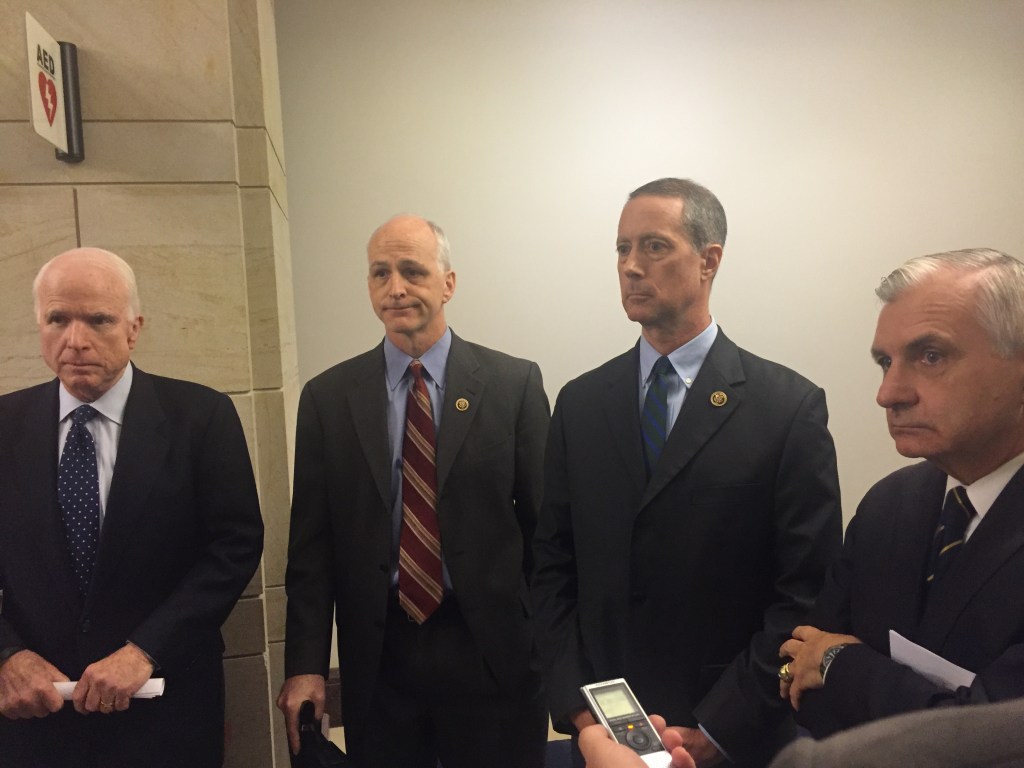
WASHINGTON — The Pentagon’s budget was the obvious top issue as the “Big Four” US House and Senate members hashing out the 2017 defense policy bill met for the first time for 90 minutes and behind closed doors Thursday on Capitol Hill.
As the Senate and House Armed Services Committee leaders reconcile the House and Senate versions of the 2017 National Defense Authorization Act, the biggest sticking point is the House bill’s use of wartime overseas contingency operations (OCO) funding. “The Big Four,” are armed services chairmen Sen. John McCain, R-Ariz., and Rep. Mac Thornberry, R-Texas, as well as the panels’ ranking members Sen. Jack Reed, D-R.I., and Rep. Adam Smith, D-Wash.
“I don’t discuss the status of negotiations, but obviously money is one of the issues,” McCain said after the meeting.
The Senate spending and policy bills support the president’s budget, while the House bills redirect $18 billion in OCO — which is exempt from statutory budget caps — for unrequested troops and equipment. The gambit spearheaded by House Republicans would leave operations in Afghanistan unfunded to force the next president to request Congress pass supplemental defense spending.
Lawmakers are racing against a legislative calendar with just four or five weeks before another month-long recess and the end of the fiscal year on Sept 30. Congressional leaders of both parties have said they are working to pass a stopgap spending measure to avert a government shutdown; Congress watchers expect a post-election omnibus spending bill afterwards.
The four lawmakers meet again on Monday, McCain said.
Thus far, negotiations were “going well,” McCain said, voicing hopes the bill would be done by the end of the month, though he would not commit.
“We know that we’re going to likely be out of here at the end of September. That’s what everybody is saying, so time is certainly important,” McCain said.
President Obama has threatened to veto the House and Senate versions of the bills — the House bill over its unorthodox treatment of OCO, and the Senate bill over its acquisition reform provisions and limits it would place on the closure of the Guantanamo military detainment facility in Cuba. Smith, too, has opposed the House bill’s use of OCO, calling the issue “a significant stumbling block.”
“The path ahead is the path ahead we had last year, which is to get appropriations resolved,” Smith said Wednesday. “But it’s going to be difficult, it’s going to take some time.”
It was an opinion shared by at least one other Democratic lawmaker, Senate Appropriations Defense Subcommittee Chair Dick Durbin, D-Ill., who said authorizers should follow the lead of appropriators. Durbin said the Senate Appropriations Committee, which hewed to the president’s DoD budget request, had the “more reasonable and realistic approach.”
“Ultimately, the appropriations bill will be considered, and if authorizers want to offer amendments, of course that’s their right,” Durbin said.
An internal strategy memo leaked this week in which Pentagon leaders aim to “play hardball” to derail the Republican-led House’s defense funding “gimmick” has rankled some lawmakers in the room. The memo called the president’s threat to veto the defense policy bill over the treatment of OCO “our primary weapon.”
Defense Secretary Ash Carter has said the “objectionable” OCO approach threatens to upend the two-year budget deal reached last year by congressional leaders and the White House. Obama vetoed the 2016 NDAA last year over its use of OCO for base budget needs and to gain leverage for the larger budget deal.
“I’m always concerned about it, especially given the state of relations between us and the White House,” McCain said of the president’s veto threat. “But they’ve always been against any reforms, and we have a lot of reforms in the bill, so we’ll see.”
The Pentagon memo was almost certainly a factor in what would have been a preliminary administrative session today, according to Punaro Group CEO Arnold Punaro, a former Marine Corps major general and longtime Senate staffer on national security issues. Lawmakers and staff were likely discussing the timing of a potential continuing resolution, as well as what would trigger the veto, among other factors, that could affect their timetable, he said.
Punaro called the unusually adversarial memo ill-advised, ill-written and inappropriate given Congress’s historically dependable support for the military. He suggested Pentagon leadership, which has in the past met with lawmakers drafting the NDAA, reach out to mend fences with them. White House representatives in the past have also been invited to Big Four meetings.
“This notion that we’re on different sides of the issue is just not the reality of how it works,” Punaro said. “You sit down and work it out. You don’t come up with all these tactics that, frankly, I don’t recall the Pentagon using in the past.”
Congress has a 54-year streak of passing annual defense authorization bills, and according to Punaro, conference negotiations on military spending have historically been marked by seriousness and collegiality, in spite of any policy differences.
Negotiations on the lesser issues in the bill, which began in June, has been guided by an administrative document called a “side-by-side” to compare sections of the bills by category.
Each provision typically has four staff members assigned to it, a Democrat and Republican from each chamber’s armed services committee expected to resolve differences. While lawmakers took a months-long recess to raise money and campaign in their home states, committee staff members routinely remain in Washington to work on the bill.
Simple issues of wording tend to resolve themselves quickly, some more important disputes must be resolved by subcommittee chairmen, and the most controversial differences next rise to the “Little Four,” or the committee staff directors who set the agenda for the “Big Four” meetings that just began.
The process, which is lead by the Senate this year, culminates in meticulous “page turn” sessions in which top staffers and attorneys go page by page through the negotiated draft. It has varied whether this process precedes or follows a meeting of the “Big Four.”
Ultimately, members can choose whether to sign the final conference report. It needs a majority of signatures before it proceeds to a vote in both chambers and, if approved, is sent for the president’s signature.
“People like to make this out to be a knock-down, drag-out, artillery shoot-out between the House and the Senate and that’s just not how this works,” Punaro said. “Everybody’s working to get a piece of legislation that can be signed into law, because if you’re an authorizing committee, and you don’t pass your legislation, you haven’t had your impact on the policy you wanted to have.”
Email: jgould@defensenews.com
Twitter: @reporterjoe