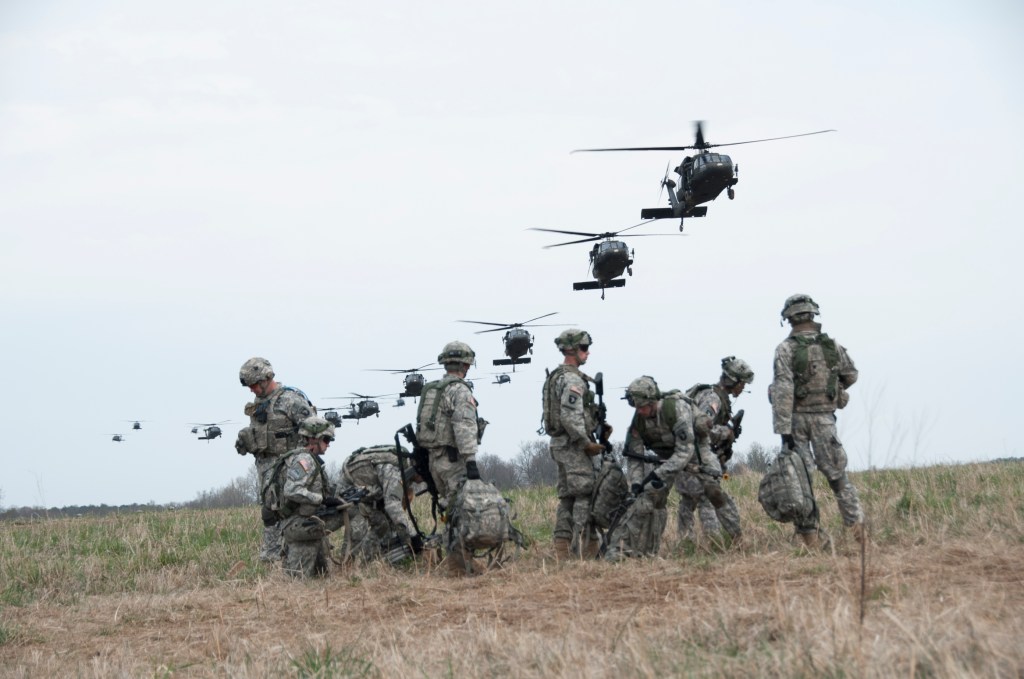
LONDON — It has been a long time coming for one of US Army aviation’s top priorities: to replace the engine in UH-60 Black Hawks and AH-64 Apaches with a more powerful and fuel-efficient one.
A request for proposals (RFP) for preliminary designs for the Improved Turbine Engine Program (ITEP) could be released any day now, Richard Kretzschmar, the program manager for the effort, told Defense News in an interview at the Defence and Security Equipment International (DSEI) conference.
Army leaders have long proclaimed the engine replacement as its number one No. 1 priority. But the service was slow to move the program out of science and technology development into a technology development phase as a program of record due to budgetary constraints that slowed the analysis of alternatives and other decisions along the road. A materiel development decision was made last year, finally moving the program forward.
When the RFP drops, “I don’t think you’ll see any surprises,” Kretzschmar said. “In fact, you won’t see any surprises in the RFP.”
The RFPrequest will call for preliminary designs for a future helicopter engine in a full and open competition. While A Honeywell-Pratt & Whitney team and General Electric — the two participants in the Army’s Affordable Advanced Turbine Engine science and technology effort — are likely to respond to the RFP, but Kretzschmar said companies like the United Kingdom’s “Turbomeca or others might play as well.”
The Army will work toward a Milestone A technology development decision in the spring of 2016, he said. Then the service plans to make an award in late next summer to up to two vendors to conduct a preliminary design review. The Army will then choose just one engine design to continue into the Milestone B engineering- and manufacturing-development phase in 2019. Low-rate initial production is expected in 2024, just six years before the start of low-rate production of a family of future helicopters to replace the Army’s current fleet, Kretzschmar said.
The goal is to replace T700 engines — developed in the 1970s — in roughly 3,000 attack and utility helicopters, adding up to about 6,000 engines. The engine also may be integrated into the Army’s Future Vertical Lift helicopter, expected to hit the skies in the 2030s. The new engine will be designed to save 25 percent on fuel consumption at 3,000-shaft horsepower, as well as boost the 65 percent horsepower-to-weight increase ratio by 65 percent and a 20 percent engine-design life increase by 20 percent.
Several industry sources said they believed the delay in moving the program forward was a sign of money troubles. While support for an engine had never been stronger, the Army was wrestling behind the scenes with whether it could carry two teams into the preliminary design phase and if whether industry should share some of the cost burden.
The president’s 2016 budget request would fund ITEP at $51 million and anticipates a total development cost of $720 million. The budget anticipates the first engine test and the start of physical airframe integration in fiscal 2021.
The long struggle to get the ITEP program moving forward at a reasonable clip will help other major acquisition programs in the future, according to Kretzschmar said.
“To me, one thing as a program manager that I’m really leaning on is those lessons learned on ITEP and all the struggles we went through to get that program in place,” he said. “We are basically not repeating past mistakes and doing things very deliberately.”
Email: jjudson@defensenews.com
Twitter: @JenJudson