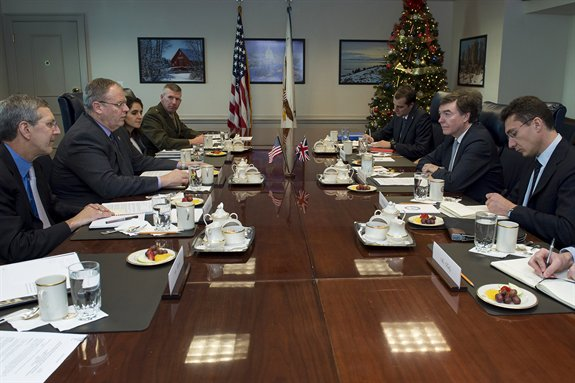

WASHINGTON — Top US and UK defense officials met at the Pentagon on Wednesday to discuss broadening a collaborative effort to allow the allies to share more cutting-edge science and technology research, particularly commercial products that could have defense applications, officials from both countries have said.
Prior to meeting Deputy Defense Secretary Bob Work on Wednesday, Philip Dunne, the UK defense minister for equipment, support, and technology, told Defense News that “we’ve got a lot of relevant expertise that we can bring to bear that should be of value to US customers in the defense area, and equally, the US has many areas of expertise that will be of value to us as well. What I’m looking to do is to encourage international collaboration on a bilateral basis.”
In February, the two officials signed a joint letter pledging to increase the number of collaborative science and technology (S&T)programs undertaken by the allies. The document identified areas like cyber security, space, and energy use as primary areas of concern.
“I think collaboration on S&T and innovation is really important,” Dunne said. As a result of the agreement, the US and UK have about 100 active projects in various states of maturity underway.
Despite budget pressure, “we are as a nation and a government investing quite substantially in scientific innovation” he said.
The UK government has pledged to invest approximately US $500 million “so that the UK becomes the largest space investor in European nations,” Dunne said.
Much like the recent Pentagon initiative to try to lure more commercial tech firms into participating in defense programs, Britain is looking to establish a series of commercial and defense-related “centers of excellence” to drive innovation.
Establishing these centers of excellence would help the UK Defence Ministry find ways to push defense innovation as defense spending in the UK is in danger of falling under the NATO goal of 2 percent of gross domestic product, with further cuts likely coming in the next several budgets.
Despite continued spending on science programs, British S&T spending in the defense sector remains low, having been slashed by the previous administration. The annual MoD S&T budget now accounts for around £420 million (US $659 million) or 1.2 percent of the defense budget.
The UK arrangement with the US is just one of several deals being stitched together by London on the international S&T partnership front in order to make the budget go further. India, France and Japan are other recent examples where joint programs are being hashed out.
In a statement issued by the Pentagon, spokeswoman Lt. Cmdr. Courtney Hillson said Work and Dunne “discussed the US and UK defense budgets and key program decisions. In their discussions, Deputy Secretary Work and Minister Dunne talked about future security threats and how they relate to new technology requirements, including opportunities for close UK-US collaboration on future capability investments.”
Andrew Chuter in London contributed to this report.