How can the Air Force improve upon its already highly capable intelligence, surveillance and reconnaissance platforms with sophisticated sensor suites that crowdsource intelligence collection at a much lower level?
“If you can imagine a very simplistic sensor that might not even be [radio frequency], or radar, but it could be a sound sensor, or an infrared sensor, very, very simplistic data flows so it doesn’t need a large pipe but it can flow that and be an indicator where the force can then bring in a more high-resolution sensor that’s more tailored,” Maj. Gen. Dwyer Dennis, program executive officer for C3I and Networks with the Air Force Life Cycle Management Center, said Thursday at the annual MilCom conference in Baltimore, Maryland. “So it kind of starts speaking to a crowdsourcing solution.”
Following his remarks, he told C4ISRNET that this crowdsourcing intelligence method can be done using commercial sensors such as iPhones on the ground. It’s “how we can get that collective intelligence, so to speak, from pretty simplistic inputs. Those simplistic inputs don’t require large pipes and the information can move very rapidly — it might even be coming from commercial sensors,” he said referring to the low bandwidth used by these devices as opposed to larger ISR video or signal feeds, which require large “pipes,” or bandwidth.
As the force thinks about command and control of these sensors, Dennis said it’s not just about commanding and controlling the operational system, but rather providing a command and control process network across the variety and diversity of sensors that might be used in an early indication scenario. “We’re not going to be able to put the high resolution everywhere,” he said.
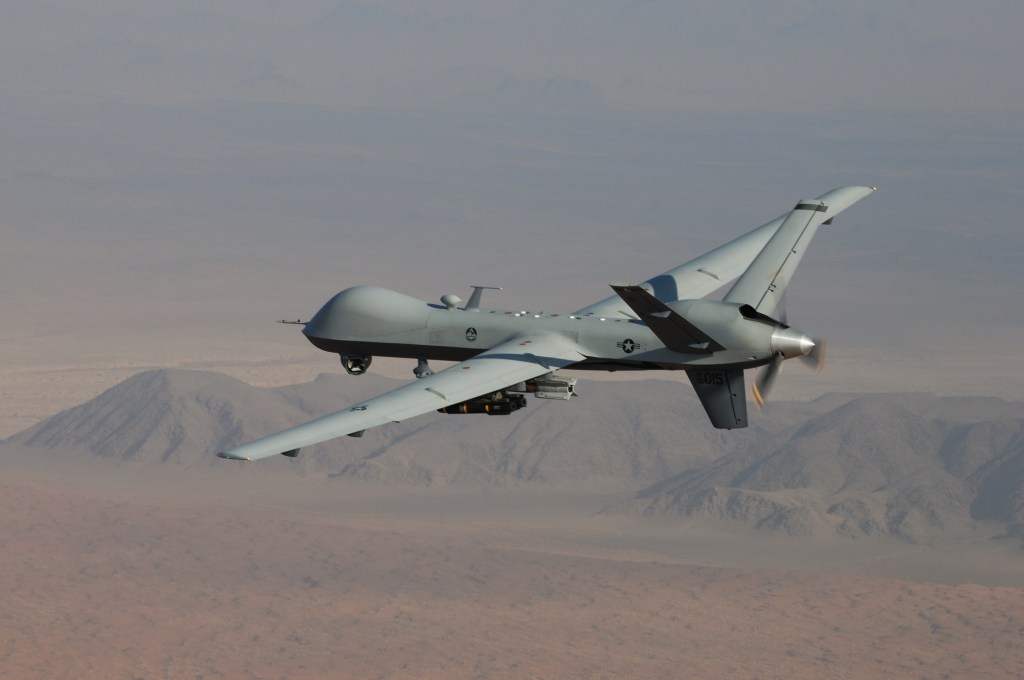
Upon early warning of an event discovered through these lower-resolution intelligence sensors, Dennis said the higher-resolution systems such as MQ-1 Predators or MQ-9 Reapers can be put on target.
“That was part of our challenge in trying to determine how many Predator or Reaper [combat air patrols] that we needed in Iraq or Afghanistan [and] we can continue to put a lot of sensors in, but then you have an awful lot of data, but then you might be better served where to put that higher resolution sensor,” he said. “Once you get into an indication of warning, let’s say I develop a tripwire and I see a certain level of activity reaches that, then I put the [Predator] and then I put something else on to continue to increase the resolution for that actual targeting solution.” This, he said, is important for target identification to avoid collateral damage.
In the vein of defeating so-called anti-access/area denial environments, Dennis said: “We have to build these future network capabilities with both our future advanced platforms in mind — or penetrating platforms — but also our fifth-gen and beyond platforms have and will have more incredible sensors.”
He noted how platforms such as the F-22 Raptor and F-35 Lightning have “absolutely eye-watering sensors and capabilities.” Though he referred to them as nontraditional ISR platforms, describing them as opportunistic.
“Say, for example, an F-35 goes out on a mission, it does its mission but on the way back you’ve got this incredible sensor suite — it can sweep, it can be collecting and be providing that data back into the system,” he told C4ISRNET. “I think we’re being more deliberative as we start to discover how powerful that is. … Now as we start to think about future systems and we start thinking about 2030 and any kind of next gen, we need to be more deliberative about that.”
This is even true for fourth generation platforms such as the F-15 and F-16, not typically thought of as ISR platforms. “Even their acquisition radars are pretty incredibly capable,” Dennis said. “It’s really getting every squeeze, every ounce of juice out of the squeeze. We’re just discovering more and more different — and that’s why making the data at a level where the format becomes ubiquitous — it doesn’t matter whether it’s coming off RF, radar or coming off of a [communications] signal. How do we fuse that data into a more cohesive and richer situational awareness?”
How can the Air Force crowdsource intelligence?